

In the beginning, long before the existence of mortals and life, there was nothing but vast Darkness. For aeons, this is all that was. One day, a crack appeared in the blackest part of the skies, and the goddess Theta was birthed from the darkness. From here, Theta took control of the vague, infinite space, creating from within it four Goddesses: one for each aspect of the Earth. For Theta feared, without them, life could not exist, and the Darkness She was created from would persist for all of eternity.
The Myth of the Four was the oldest and most commonly believed myth in Crissolonian folklore. All of the living must come from somewhere, and all of the dead must disappear somewhere else. The first Goddess born of Theta was Vatia, the Queen of the Skies. The second was Inelia, the Queen of the Seas. The third was Tilene, the Queen of the Underworld. And the fourth was Olena, the Queen of Earth and the Living. Together, the four Goddesses created the Earth and everything on it, each responsible for birthing a different race, so that the living can continue living, and the souls of the dead can exist forever.
The Oris were a white-skinned race, born from the clouds: formed as babies, ageing as mortals did until earning their immortality. They’d existed for thousands of years, believed by most of the Lost Folc to be just the same as themselves. Cerulea, the city in the clouds, was not visible to mortals, though many had claimed to have seen it. It was always cool in the city of Crissolo, but not unbearably so. The Oris had always existed. Many mortals refused to believe in things they’d never seen.
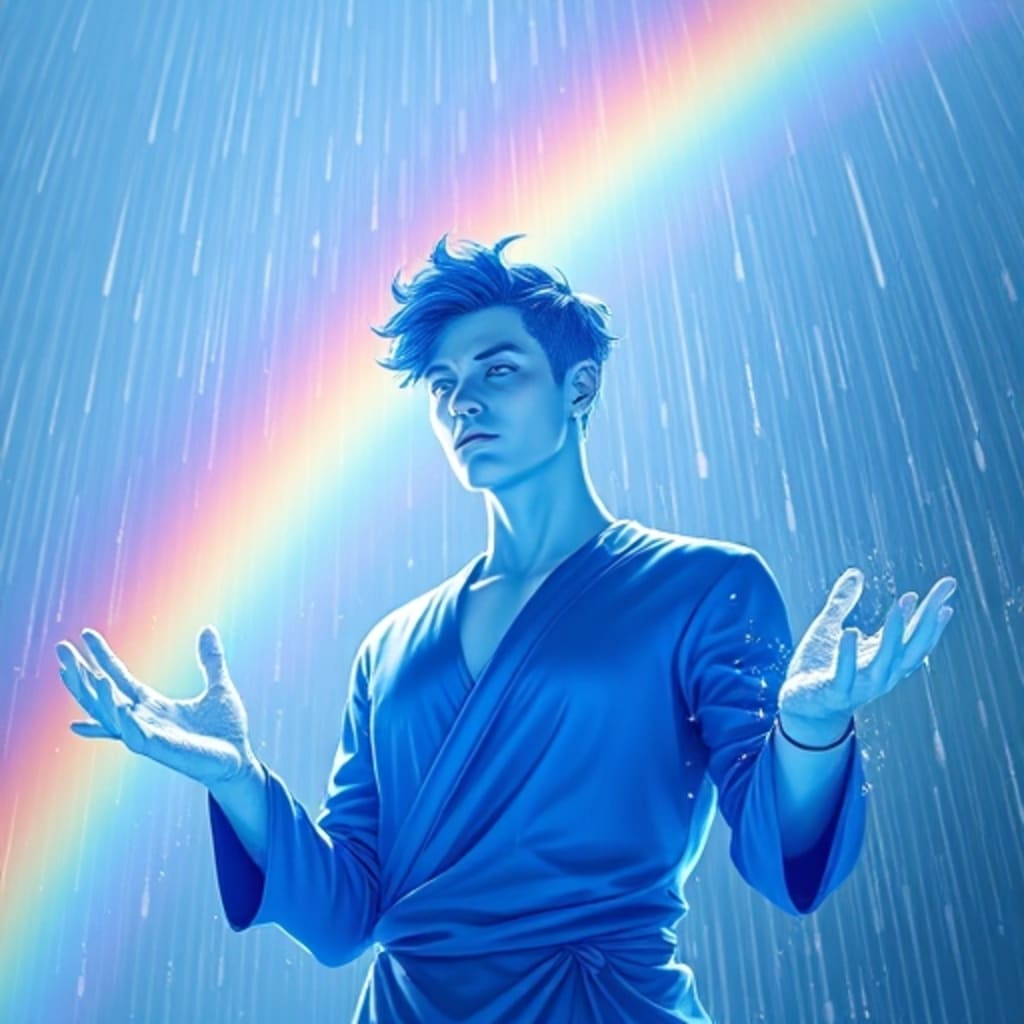
It was due to rain. Though it wasn’t always raining, it wasn’t uncommon for rainy spells to last four or five days at a time. Since his creation thousands of years ago, Uri had made the rain. He was one of only a few Oris who had ever touched the ground, and he always had stories to share about his journeys here. The buildings of Cerulea were light and feathery, and its inhabitants were the same. The Oris had no need for sleep or consumption - but in spite of this, Uri was known to carry foodstuffs or beverages during his trips to the ground. This, he intimated, prevented any suspicions by mortals - though the Lost Folc were unobservant, and rarely noticed that which didn’t concern them.
The name of the Cloudmaker was Celeste. She was far younger than Uri, but had earned her immortality earlier than he, which had left him rather discomfit. The Oris had hair that always matched the colour of the skies, and which was thick and bouncy. There were always clouds. At times, they were invisible to those who did not live atop them. Celeste held a zheajay on her shoulder, as she always did: a greyish, seven-inch bird covered in human-like hair, untameable to everyone except the Oris. There was Lior, the Lightmaker, creator of lightning and thunder. There was Vyther, the Windmaker, creator of breeze and storms. There was Mystis, the Starmaker, creator of astronomy and night. There was Dagny, the Sunmaker, creator of summer and music. Lastly, there was Zev, the Moonmaker, creator of mortality and sleep.
Crissolo was a country of mortals: stretching a measly three hundred kilometres, housing five hundred thousand Lost Folc. This was hardly enough Lost Folc to make any difference at all. Children of the Queens traveled Crissolo in the blink of an eye. The Lost travelled Crissolo for days at a time.
“Tell me again what it’s like on the Ground. I so desperately wish I could see it for myself.”
Nobody had ever existed without a purpose. Nothing ever changed. One was given a purpose at the moment of inception, and that was what one spent all of existence doing. Some became bored by this: craving new adventure, seeking out thrill. This made the Queens displeased. Those who displeased the Queens always came to rue it in the end. Uri had never longed for adventure. He blended in with the Lost, obeying the rule of the Queens, never arousing the slightest of suspicions during his trips to the ground.
He’d told Celeste, before, what Crissolo was like. For many, it was a far-off place that existed within a different universe. Lost Folc could be seen from the clouds, small and unfocused, never privy to the creatures they shared the ground with. “The Ground is frequently chilly, and always peppered with crispy orange, crunching beneath my feet. I don’t often wear shoes, though it arouses suspicion within the Lost Folc when I don’t.”
Unlike a human, Uri wasn’t pained by the feeling of rocks or glass under his feet. Though he was made entirely of cloud, he possessed the capability of solidifying upon each trip to the Ground. This prevented him from being blown away by a sudden gust of wind, or from frightening Lost Folc by allowing them to walk right through him. Even while playing as a human, he was perfectly capable of making rain, and he did it commonly.
“I can see you sometimes,” said Celeste, who formed clouds into strange shapes as a way of entertainment. “I can see you when you’re down there. You look like the rest, but far less blurry. Methinks those on the Ground can receive and hear messages from the rest, even when no sound is made.”
She believed correctly. The Oris weren’t an overbearing race. There had been times before when an Oris or a Zirrid had fallen in love with a Lost Folc, thereby relinquishing their immortality to marry them. There had been times when an Oris or a Zirrid had fallen in love with a Lost Folc and refused to relinquish anything at all. As a result, one was banished to the Ground, losing their powers and destined to spend the rest of their life as a mortal: mediocre and talentless. For an Immortal being, being destined to a life as a human was the most terrible punishment of all.
“I have received many messages.” Uri only touched the Ground when it rained, and he had no control over this. When necessary, he produced water out of the air with the palms of his hands, and used his fingers as a hose. When the rain began, it swallowed him, so that he became a drop himself and fell out of the sky. When the rain finished, he dried the ground, subsequently drying up himself, evaporating back up to the clouds until the next rainy spell. “They always come in the form of clouds or lightning.” When Uri became a God, he would possess the ability to travel at will, and to remain on the Ground even after his rain had dried up. One wasn’t born a God. One had to prove themselves.
Peregrin was the Snowmaker, and the lover of Uri. Although it was forbidden to yearn for the fancy of a mortal, romantic relationships between the Oris were at the arrangement of Vatia. Peregrin had hair of alabaster, swooping delicately: a snow-woman whose hands were always cold. When she wasn’t making snow, she hopped atop the clouds, or tended to the birds and the skies. “On the Ground,” she offered, feeding the bird upon the shoulder of Celeste, “there’s always an abundance of activities. I enjoy journeying through the cities, keeping to myself, feeling the crunch of the snow underneath my feet. I wish for you to get the chance, someday, to visit the Ground yourself.”
This was improbable. The Queens chose which Children could visit the Ground, and the will of the Queens was always final. There were stories of children who disobeyed the will of the Queens, and such Children were never seen or heard from again.
Many years ago, there was a Goddess named Krione, Queen of Winter and Death, who was venerated for her portrayal of winter, and for her protection of lost souls and deceased children. Krione, who was born from the darkness, was the daughter and subordinate of Theta. Several years after earning her immortality, Krione was sent to the Ground to guide the souls of lost children to the Underworld - a task that had since been taken over by a child of Tilene. During her time on the Ground, Krione fell under the spell of a Lost Man, thereby becoming susceptible to the mundanity of mortality. Theta was enraged by this, and gave Krione two choices - to abandon the man, returning home and never speaking to him again, or to surrender her powers and her immortality, forced to live among the Lost, destined to a life of mediocrity. In the end, Krione became banished to the Ground, and died the way a human did, frail and lonely. This was why the Lost were destined to a life of sin. This was why only the most upstanding of the Lost would find their souls in the Shadowvault when their bodies perished.
Rain spells often came with wind. Vyther stood atop a cloud formed by Celeste, blowing wind from his mouth. Vyther never touched the Ground, but floated in the midst of wind-storms, suspended in the air. Orders were given by Vatia, who never departed from the skies, but controlled what happened to them. The city of Zostrule was cold and wet; Uri splashed into a puddle when he landed. His landings were always inconspicuous - crashing to the hard ground with the raindrops, and growing back into himself like a plant. It never hurt to land. Cerulea was white and lively, and the chirp of the Zheajay could be heard from fifty feet away.
Things weren’t all that different on the Ground. The children of the Queens went shoeless among mortals for the purpose, mostly, of proving their humanity. A lot could be proven by the attitude a person took toward those they presumed to be inferior. Wanderers with bare feet and ratty clothing were seldom given notice - for even those who had spent a lifetime in Crissolo wandered with bare feet. When the body of a mortal died, its soul was judged by Xius, the Ghostmaker. It was the job of the Ghostmaker to determine which souls were eligible to become ghosts and wander the mortal realm at will, and which were destined to an eternity inside Demonvale, trapped and solitary.
Uri created puddles with the water that poured from his hands, and splashed through them soundlessly on his way into the city. There were many animals in Zostrule: some tame, and some only tameable to those who could speak to them. The Children had existed for centuries in stories and folklore, but were seldom often recognized by mortals. It was preferable this way. It was frowned upon to fraternise with one another, and for good reason.
Only the Faeries and the Reaper could travel at will. Most Children could not travel at all, and were envious of those who could. The inhabitants of Zostrule were not nosy. Most kept to themselves, too harried with everyday tasks to bother themselves with others. It was a small city, but it was home to many.
There was a thunderstorm brewing. These were not uncommon in Crissolo. When thunder erupted from the skies, it contained messages understandable only to Uri. This was the only way to communicate with those still in Cerulea, and it went unnoticed by Lost Folc.
“You look like someone I’ve seen before.”
There was one black wolf in Crissolo. It appeared at random times and places, and was never seen outside of this. There were differing theories regarding where the wolf had come from, and most of them were wrong. In truth, the Reaper oft took the form of a grey wolf upon her departure from Demonvale. Those who came face to face with the wolf always greeted Death shortly hereafter.
Uri had not seen the Underworld. Only those who had been personally invited by the Reaper could travel to the place, and souls who had been made to spend eternity here could never again leave.
A woman in a raincoat stood before him. She was golden-brown, and, though Uri had never before seen her, she looked at him as though they had been acquainted with one another. “What’s your name?”
Engaging in conversation with the Lost was inane, regardless of the nature of such conversation. She appeared to be friendly, or she acted this way outwardly in order to gain the trust of others. For those with short lifespans, it was difficult to obtain a semblance of self-awareness - and the majority of Lost Folc completed an entire life without obtaining any at all. This was not to say that Uri was unfriendly. He spoke amicably when engaged, but seldom went out of his way to make conversation.
“I am not one to pursue in search of acquaintanceship.”
Crissolo, like any place, had evolved over the centuries. This wasn’t to say that its inhabitants had evolved along with it. At times, Uri became confused between current centuries and centuries past - and in doing so, ostracised himself by acting strangely. Despite the wetness and the roughness of the ground under his bare feet, he felt neither cold nor discomforted. He didn’t dislike Lost Folc, but felt an apathy toward them that made interactions feel unfulfilling. Moreover, as a result of his brief, irregular trips to the Ground, Uri was not one to rely on for stable relationships. He appeared abruptly and unexpectedly, and left the same way.
It rained sporadically: sometimes for weeks at a time, and sometimes not at all. Snow was seldom in Zostrule, but always brought with it excitement and happiness. Peregrin, who shaped ice with her hands, chattered like a human, and found excitement in the most mundane of things.
Uri didn’t particularly enjoy the Ground. It was homely and impersonal, but he was doomed here when it rained, forced to find ways to entertain himself until returning home. He wandered, and the woman followed. She held an umbrella clumsily, her feet dragging heavily on the ground with each exaggerated step. “You’re the Rainmaker. I’ve read about you in mythology.”
In Crissolonian folklore, the first humans were created in Cavekeep Forest thousands of years ago. They were called Zela and Ottix: sand-coloured people, carved from clay, shaped into mortal beings by the hands of Thalia. Zela and Ottix had six children: all of whom had six children of their own. As humanity progressed, humans travelled by boat across the seas and mountaintops to expand their species, and to explore undiscovered lands. Zostrule was home to almost twenty thousand Lost Folc, most of whom had been born there. Though Peregrin took joy in conversing amicably with people, Uri had gone thousands of years without learning the name of a single mortal.
Following every rain spell, there was a rainbow. Oft, if someone followed the path of the rainbow, they could find Uri.
The woman smiled coyly. Her persistence was not quite maddening, but typical of the Lost. Although some species possessed the ability to travel by teleportation or flight, the Oris travelled by foot, and this was troublesome and slow. Still, Uri wasn't injured by things that injured humans. He healed from trauma very quickly, with no evidence that he had ever been injured at all. There was also, of course, a distinctly non-human quality in the inability to die at all.
"You’re described very specifically in the stories. Your hair is always the same colour as the sky. You talk like you're from the 1800's. You fall as a raindrop from the clouds, and solidify on the ground.” The woman spoke a lot, but said little of anything at all. There were many rainy nights in Zostrule. Seeking solace, Uri found refuge in tall building roofs and private, covered patios.
He grimaced, impartial to conversation. "It appears you have far too much free time, which you use to presume everything in stories to be objective truth.” This was an unfortunate side effect of being human. Many Lost Folc believed what was told to them without a second thought. Much of the time, this turned out to be their downfall. Despite this, it became much easier to tell the character of a person after engaging in conversation with them.
There were many myths about the Children and the Queens. The descendants of Theta were revered by many across Crissolo, in a religion called Thetaxism. It had been founded hundreds of years ago by a scholar who claimed he had climbed to the very highest peak of Mount Berosi, the tallest mountain range in all of Crissolo. There had been many stories written about the origin of the Earth, the sins of humanity. In the end, it all came back to Theta.
Like Uri, the woman was barefooted. This was curious, but Uri did not inquire. It was not unheard of for a Child of the Queens to masquerade as one of the Lost, and Uri had done this himself in the past. Unless you were particularly naive, you could tell a human from an Immortal by the way they spoke.
"My name is Aveline, by the way. What’s yours?”
He hadn't asked. Peregrin enjoyed telling him to be friendly: that some Lost Folc were worth befriending, that some had stories worth hearing. The problem with bothering with mortals is that they would inevitably expire, and another entire lifetime would pass without the company of anyone at all. Opinions on the existence of Immortals varied quite evenly in Crissolo. Half of the population seemed adamantly opposed to them, while the rest would have done anything to prove they did, in fact, exist.
Immortals never gave away their names, as their existence was never meant to be proven, and it was crucial for an element of mystery to remain. A name lived only as long as a mortal did, and then it meant nothing. Uri sat, longing for a message from home. He had been granted immortality twenty four years after his creation, and hadn’t aged since then.
“That isn’t for you to know.”
A breeze had been sent. When Vyther became particularly angry, he sent windstorms to the Ground, and he got swept up inside them.
The woman played with mud, crouching in a puddle, unbothered by each raindrop that splashed around her feet. “Come on, Mister Rainmaker. You don’t have to be all secretive and mysterious. I’m not going to tell anyone.” She exhaled loudly, petting the head of a Quala in her pocket. “No one would believe me, anyway.”
The Quala was a six-legged reptile, covered in green-orange scales. It was believed to understand the body language of humans, and communicated by emitting very high-pitched squeals. The Quala was a popular choice of pet among Lost Folc - as it was low-maintenance and required almost no knowledge to properly care for.
It rained for three days: pooling into cracks in sidewalks, leaving Uri’s feet covered in leaves and dirt. He was never fussed by this. He was made of raindrops, and did not become cold from wetness or chills. He followed the instruction of Vatia, whose word was always final. In the past, there had been instances of an Immortal disobeying a Queen. As a result, these immortals always seemed to disappear without warning, and a new one was birthed overnight, acting as though they had existed all along.
About the Creator
choreomania
i'm a queer, transmasc writer, poet, cat lover, and author. i'm passionate about psychology, human rights, and creating places where lgbt+ youth and young adults feel safe, represented, and supported.
30 | m.
follow me on medium for more.
Keep reading
More stories from choreomania and writers in Fiction and other communities.
Drowning your regrets won't heal you
This is an excerpt from my novel, Moonchildren. You can read more here. _________________ Everyone wants to feel like they mean something. Even if you believe that humans are all born for no reason, and that life has no meaning, nobody wants to spend their entire lives alone. Some insist they prefer isolation, that other people are too much effort and time. Some insist it’s safer or more comfortable to be alone. Maybe this is true. Even if someone spends their entire life in solitude, they deserve to feel like their existence means something.
By choreomania2 years ago in Fiction


Comments
There are no comments for this story
Be the first to respond and start the conversation.