
Overcoat of Ghulam Abbas
Appearance, Deception, Reality, Exposure.


On a January evening, a well-dressed young man walked down Davis Road, turned onto Mall Road, and began strolling leisurely along the tramline toward Charing Cross. From his appearance, he looked quite fashionable: neatly trimmed long sideburns, shiny hair, and thin mustaches so fine they seemed drawn with a kohl stick. He wore a light brown overcoat with a pale rose tucked into the buttonhole, a green flat hat tilted stylishly on his head, and a white silk scarf wrapped neatly around his neck. One hand rested in his coat pocket, the other held a small cane which he twirled playfully from time to time.
It was a Saturday evening in the peak of winter. The air was sharp and biting, cutting through like a blade, yet the young man seemed unaffected. While others hurried to escape the cold, he walked slowly, almost enjoying the chill. There was something graceful in his walk; so much so that cab drivers would spur their horses toward him, hoping for a fare, but he waved them away with a flick of his cane. A taxi stopped nearby, but he simply smiled and said, “No, thank you.”
As he moved closer to the livelier part of the Mall, his energy seemed to grow. He began whistling a light English dance tune and even started stepping in rhythm to it. Once, when no one was around, he suddenly pretended to throw a cricket ball as if playing an imaginary game. When he reached the road leading to Lawrence Gardens, he looked toward it but saw the park shrouded in fog and sadness. He decided not to go there and continued toward Charing Cross instead.
Near the Queen’s statue, his lively movements calmed down a bit. He pulled out a handkerchief, which he had stylishly tucked into his sleeve instead of a pocket, and wiped his face lightly. A few English children were playing with a large ball on the grass nearby. He stopped to watch them with interest. The children ignored him at first, but after noticing his steady gaze, they became shy, laughed, grabbed the ball, and ran away.
He spotted a cement bench and sat down. Evening darkness had thickened, and the cold grew stronger, but it seemed to please him. For people of pleasure, such cold nights were delightful; they stirred a desire to seek company and warmth. Those who lived alone felt tempted to leave their lonely rooms and find comfort in crowds, cafés, or cinemas. The Mall was full of cars, tongas, bicycles, and pedestrians. The shops on both sides glowed with light, and people were busy shopping or just wandering. Those who couldn’t afford any of it stood at a distance, gazing longingly at the colorful displays.
The young man sat watching people pass by: men and women of every kind, merchants, officials, students, nurses, clerks, and artists. His eyes lingered more on their clothes than their faces. Overcoats were everywhere, from rich fur-lined coats to old army coats bought from auctions. His own coat was old but fine in quality and beautifully tailored. It was well cared for, the collar crisp, the folds sharp, the buttons shiny. He seemed rather proud of it.
A boy selling cigarettes and betel passed by.
“Hey, you there!” the young man called.
“Yes, sir?”
“Do you have change for a ten?”
“No, sir, but I can get it. What would you like?”
“What if you run away with my note?”
The boy laughed. “Do I look like a thief? If you don’t trust me, come along. What do you want, sir?”
“No need. Here’s a penny. Give me one cigarette.”
After the boy left, the young man smoked with great satisfaction. A small white cat, shivering from the cold, came meowing at his feet. He smiled, patted it gently, and said softly, “Poor little soul.”
Then he rose and crossed the road toward the cinema, where colorful lights shimmered. The show had already started, so the entrance was quiet. A few people were standing around, looking at posters of upcoming films. Three young Anglo-Indian girls were studying the pictures and laughing together. He too stopped nearby, pretending to look at the posters while keeping a polite distance. The girls whispered and giggled, and when one made a joke, they all burst into laughter and walked away. He showed no reaction and soon moved on.
By now it was seven o’clock. He strolled again along the Mall, passing a restaurant where an orchestra was playing. A crowd had gathered outside, mostly drivers, vendors, and passersby, poor people who couldn’t afford to go in but stood quietly, listening with admiration. The tune was foreign, yet they seemed lost in it. The young man stopped for a moment, then walked on.
He entered a music shop nearby. Inside, musical instruments gleamed behind glass cases. He glanced through some colorful sheet music on a table; the covers were bright, but the tunes seemed cheap. Then he examined a Spanish guitar and a German piano, even pressing a few keys. A salesman approached.
“Good evening, sir. May I help you?”
“No, thank you. Just give me the list of this month’s gramophone records.”
He slipped the list into his coat pocket and walked out.
At a carpet shop, he paused again. “I’d like to see that Persian carpet. No, don’t take it down, I’ll just look from here. How much is it?”
“Fourteen hundred and thirty-two rupees, sir.”
He raised his eyebrows slightly, as if to say, “That’s a lot.”
The shopkeeper smiled. “Please, choose one you like. We’ll give you the best discount possible.”
“Thank you, but I’m just looking for now.”
“Take your time, sir. It’s your shop.”
He left after a few minutes. The rose in his coat buttonhole had slipped out a little. As he adjusted it, a faint mysterious smile crossed his lips, and he resumed his walk.
Now he was passing by the High Court buildings. Even after walking so long, he didn’t seem tired or bored. He twirled his cane on one finger, but it slipped and fell. “Oh, sorry!” he said aloud, picking it up.
Just then, a young couple walking behind him overtook him. The man wore dark trousers and a leather jacket; the woman, dressed in a white satin shalwar and green coat, was plump, with a long black braid swinging down her back. The movement of her braid caught the young man’s attention. They walked quietly for a while until the man said something, and the woman suddenly snapped, “Never! Never!”
“Listen to me,” the man insisted. “My friend is a doctor. No one will ever know.”
“No! I said no!”
“It won’t hurt at all,” he pleaded.
She didn’t reply.
“Think of your father,” he said softly. “What will he feel? Think of his honor.”
“Be quiet! You’ll drive me mad!”
The young man, who had spent the whole evening detached and carefree, suddenly grew curious. This couple, dramatic, almost like characters from a story, fascinated him. He wanted to hear more, maybe even see their faces clearly.
By now they had reached the main post office crossing. The couple paused briefly, then crossed toward McLeod Road. The young man waited a moment so they wouldn’t suspect he was following. When they were about a hundred yards ahead, he hurried to catch up, but before he could cross halfway, a truck loaded with bricks sped down the road and ran over him.
People shouted, “Get the number! Get the number!” but the truck vanished into the dark. A traffic officer stopped his motorbike and rushed to help. The young man’s legs were crushed, and he was bleeding heavily. They stopped a passing car, lifted him in, and rushed him to the hospital.
When he arrived, he was still barely alive. In the emergency ward, Assistant Surgeon Mr. Khan and two young nurses, Miss Shahnaz and Miss Gill, were on duty. They saw him being carried in, his brown overcoat still on, his silk scarf stained with blood, his green hat placed gently on his chest by someone kind.
“He seems from a good family,” whispered Shahnaz.
“Poor man,” Gill replied quietly. “He dressed up for a Saturday night and met this end.”
Inside the operating room, the doctors and nurses worked in silence, faces hidden behind surgical masks. He was laid on a marble table. The scent of the perfumed oil in his hair still lingered, and his parted hairline was perfectly neat. Though his legs were crushed, his hairstyle remained untouched.
When they removed the silk scarf, both nurses looked at each other in surprise. There was no shirt underneath. They took off his coat and found an old woolen sweater full of holes, beneath which was a dirty vest, even more torn. His chest was covered in grime as if he hadn’t bathed for months, though his neck was clean and dusted with powder. His trousers were held up by a strip of cloth instead of a belt, perhaps an old tie, and both knees were worn thin. His socks didn’t match, one black, one brown, both full of holes through which his rough heels showed.
By then, he was dead. His body lay still, turned slightly toward the wall, as if ashamed to face anyone in such naked truth.
From his coat pockets, they found: a small black comb, a handkerchief, six and a half annas in coins, a half-smoked cigarette, a tiny diary with a few addresses, a list of new gramophone records, and some advertising leaflets he had picked up while walking. His elegant cane, lost somewhere in the accident, was missing from the list.
About the Creator
Mansoor Afaq
Mansoor Afaq, a renowned Urdu and Saraiki poet, writer, and columnist, has authored 14 books and created 85 plays and 6 documentaries. His work bridges tradition and modernity, enriching South Asian literature and culture.
Keep reading
More stories from Mansoor Afaq and writers in Fiction and other communities.
Between Mirror and Reflection
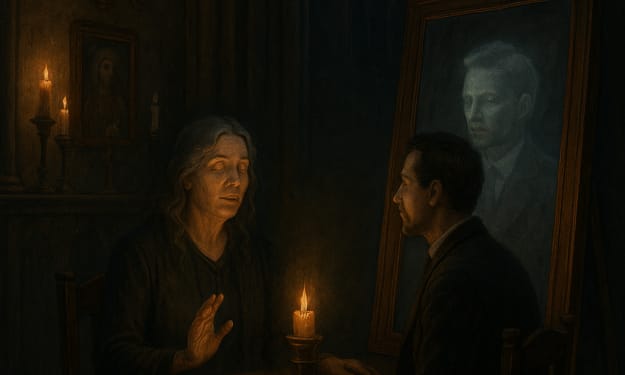
Noor was telling me: “Madam Norma is a woman who is said to look into the past and the future through contact with beings from another realm. She is so much in demand that people wait for months just to get a ten-minute appointment with her. I was lucky to get a half-hour slot when someone cancelled at the last moment.”
By Mansoor Afaq2 months ago in Fiction
Getting out of the house can be hard
"Come on Jack, wake up. It's 7:30 already. You'll be late. Don't you wanna have breakfast?" "Mmmmm." "Yeah I know, you probably stayed up till 2 again, playing that stupid game. Whatever, you're not 12 anymore. You do you. But don't say I didn't try when they kick you out of school for too many missed classes."
By Paul Finglabout 2 hours ago in Fiction


Comments
There are no comments for this story
Be the first to respond and start the conversation.