
Our House is a Time Machine
(and now we climb marigolds to see the stars at night)

“Mom?!” cried Jim this morning. The boy was standing in my door with a confused look on his face, and I shot out of bed.
“I’m up! I’m up!” I didn’t bother putting on day clothes, and I followed him outside without hesitation, adrenaline pushing my pulse like a crowd pouring out of a burning theatre. We might as well have been in one. “What is it, Jim?”
Past the screen door and onto the porch, I caught myself on the bannister and sat down on the steps. As soon as I saw it, I wondered how my son was able to speak through the shock. Even the thought of a single word made a foam in my chest (because really it was a thousand bubbles, none of which could attain the thought of any one appropriate word).
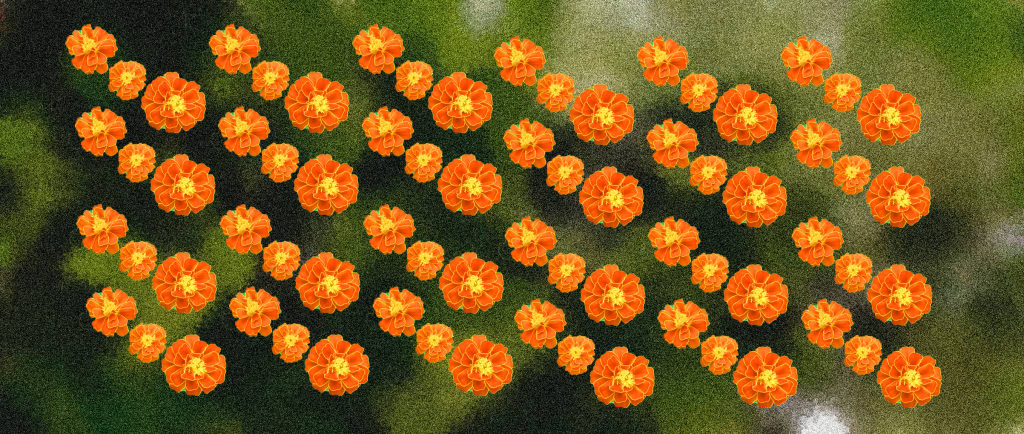
Our field had grown over night from a field of regular-size, ready-to-ship garden marigolds, to marigold plants the size of centuries-old oak trees. I’d never seen anything like it, not in all my thirty-six years in horticulture. I just sat on the porch, staring up at the stalks. They were taller than the house. The leaves were bigger than my whole body. It was so dreamy, so strange, and the earth was standing still. Jim sat down beside me. It explained the earthquake we felt last night. We had no cause to go outside, only to stay in where it felt safe. We didn't hear it as a wake-up call.
“What happened?” he whispered. Though it seemed strange to whisper, I did the same. These were god-plants.
“I don’t know. Get the radio.”
He brought it back: our wind-up kitchen radio. It didn’t take us long to find a newscaster speaking mid-report. Not only fields of flowers, but vegetable crops and orchards, and mountain forests that overnight, and as we spoke, twenty-four hours across time zones, were growing right in front of peoples’ eyes. Forests piling into cities, national parks gunning for towns like magic, crops boiling over highways, and algae blooms spreading in vast swathes over ocean passages. Rabid plants interrupting the foundations of apartment buildings and freehold houses and monuments and museums. Even finding ways to intervene in dead seas and deserts: all over the world underground water pipes were cracking to bursting, and canals were being made of city streets, and commuter traffic was getting crushed by this sudden burst of unprecedented growth. And the worst part for many was not the god-tree or the god-rose, but the god-grass. Make yourself into a speck of dust floating through a lawn and wake up to the grass become a jungle outside of your home, one Monday morning in August. You can’t find your car and the streets are gone and suddenly there’s no sense in rushing to work. Work is so small, and it’s so insignificant, because look, you used to walk on the grass, and now you don’t because you can't. There’s rubble between the blades where the sidewalks used to be, and when you walk through the brush you can get your arm cut by something that used to be a weed. Look, we can make fabric from dandelion seeds and give a dried lamb’s ear as a blanket on a child’s birthday. We can gather from all over.
That day wasn’t a nightmare, and it wasn’t a miracle. And it wasn’t Year Zero, because we remember what it was like yesterday. It was a miracle and a nightmare at the same time, and some people screamed “Armageddon!” And some cried “Paradise!”
Sitting on the porch on that first night on Earth, I feared what else might grow for a second, and then saw a black fly that hadn’t changed at all in size. And I went down the steps and around to the spot where the ants always follow one another in single file up the hardwood to their hole in the grain, and they were all the same size as they were yesterday, too. The bugs weren’t any different, and neither was the mother-spider, who sat on her web against the porch light catching prey with her egg sack hanging stiff, waiting to give birth. Sighing with relief, I debated telling Jim to get dressed for the day, and I debated doing the same. For some reason, getting dressed didn’t seem to matter. In the moment, it just didn’t make any sense. Our work didn’t make any sense. I wasn’t bent up about it.
Sometimes in life, you’re met with something that you wouldn’t have imagined could ever happen to your world. We left the radio on. Within minutes, among the stories of devastating overgrowth and overwhelmed ecologists, there were tales of people burning the god-plants to ash and accounts of rejoicing at the possibilities for feeding the world. One story of someone getting crushed by a giant pear and another where it took three people to harvest one ear of corn. We can feed a family with two kernels of ripe corn, can’t we? And how many ears of corn do we have? How many apples the size of trucks? These eggplants are like orcas, and these zucchini flowers will bear zucchinis as long as one car of a subway-train.
It made sense to me that people would burn invasive plants, but it also struck me as short-sighted. The rejoicing made more sense to me, but of course it was easy for me to sit here in awe of the god-plants. To me, the world was suddenly just different than it was before. There was a spark of something in it, something new (something terrifying, something good, something we all could share). But Jim and I both knew that we were just lucky. Unlike countless other houses, our house had not been destroyed. We had our things, and our things were good, but our things were different, they were from somewhere else. When we walk inside our home, it becomes a time machine.
A week from that first morning, the marigolds bloomed. We couldn’t harvest them; we couldn’t sell them (and they smelled awful, just awful). We had to close the windows and find ways to overcome the putrid, overpowering odour. We had to wear masks all day and when we went to sleep. But the sight of it, you know, there was nothing like it. A canopy of green and yellow orange, like seeing a sunrise in the middle of the day, and all you need to do is just walk between this marigold stalk and that marigold stalk.
We built a pulley system to harvest the petals and found a new way to live after the world changed overnight. Maybe the reason why we were able to make changes was because those changes were always coming. In some way, somehow, we were always prepared to see those changes through.
And here and there, I’d hear stories of people overcoming the adversity of this new life, and the stories always involved people who had once had where others had not. The people who were against the growth longed for the old world, the world where food wasn’t abundant, the world where trade didn’t thrive like it did now, where currency could hurt us.
And one day, down the line, I looked at Jim and asked: “Do you remember how it used to be in marigold season?”
He stopped with his basket of petals and seeds.
“You’re getting nostalgic.”
I laughed. “I’m just asking if you remember.”
“I remember,” said Jim. “I remember.”
“What do you remember?”
“This forest came from a field, and we used to harvest and wait out the seasons,” he paused. “You were more stressed out then. Your hair started to fall out.”
Automatic, I touched my hair. I wasn’t balding anymore. I hadn’t thought about that in ages. I looked up above, to the yellow orange canopy, and the sun was shining through, making a shadow play on Jim’s face, and the silhouettes were dancing a ballet all over the dirt. We were become dust in comparison with the god-plants, and the freckled light was like the stars used to be at night out here in the country.
There was a time when we could not see the stars in the city because our light polluted the sky, and to see them was a novelty. The stars are a memory now because the green is so dense that the sun makes for star light in the daytime. We climb the marigolds to see the stars at night.
About the Creator
Nadia Pacey
Nadia Pacey is a law clerk in Ottawa, ON with a film degree from Ryerson University, a Law Clerk diploma from Algonquin College. She enjoys writing science-fiction and recently learned how to shuck an oyster with a flathead screwdriver.
Keep reading
More stories from writers in Fiction and other communities.
The Sun Who Envied The Moon
Do you ever wish you were like someone else? Wish you had that dream life, that dream car, that loving family? I wish I was like the moon, she sees the real side of people, when humans are at their most vulnerable they turn to the moon like an old friend. People only talk to me when they’re “happy” but usually they are just faking it.
By Christian Sanchez3 days ago in Fiction


Comments
There are no comments for this story
Be the first to respond and start the conversation.