
Nocturnal Fruitions
Psalms, 8:2

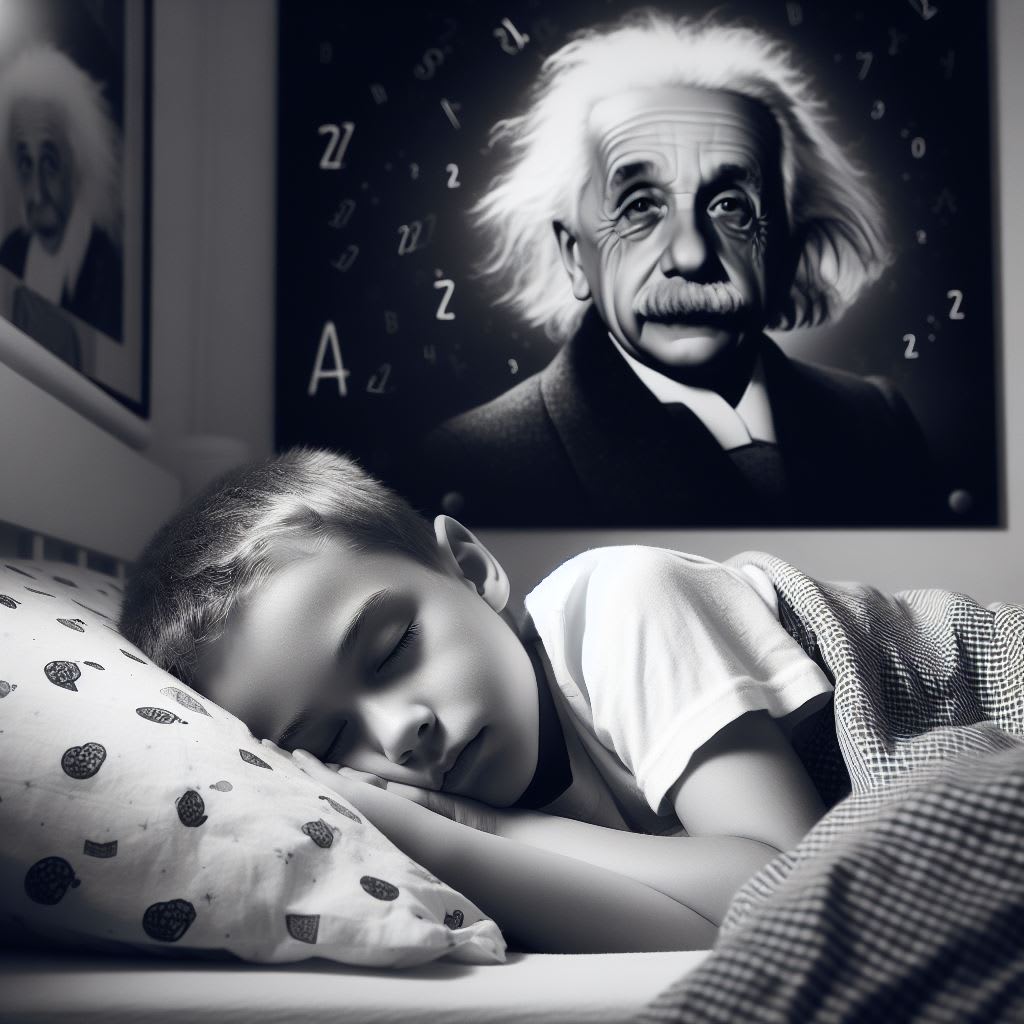
His mother was saying his night prayers with him, which he knew by rote, although she knew he had no real understanding of spirituality, souls, and the like. Once again she saw the tears in his eyes.
"Oh, Brock," she consoled him. "It's alright."
She knew why he cried. Brock, named after baseball Hall of Famer Lou Brock, was not smart. He would never make a team or lead anyone by example. But he wasn't so stupid that he didn't know it.
He was just in second grade, and both she and her husband knew it was just a matter of time before he were relegated to Special Ed. He was having trouble keeping up even in the simplified world of single-digit addition and subtraction. And he was astute enough to know how he was falling behind. Worse, the other kids were beginning to realize it and the taunts and bullying began.
Brock, Brock, dumb as a rock, they'd tease.
"What about your dreams, Brock?" she asked him. "The ones you have every night, right? Solving all the world's problems."
"Doesn't matter," Brock sighed.
"Sure they do. Every night you wake up all excited. At 3:00 AM, like clockwork. I can hear you, just chatting away with your ideas. I just bet you're going to cure cancer tonight."
"That's a hard one, Mommy," Brock replied.
"No!" she argued. "You've already solved the energy crisis, drug addiction, and the homeless problem, right? What else?"
He didn't really use the right words, but the ones he rattled off were what could be identified as room temperature fusion, carbon scrubbing, racism, poverty, mental illness, and gender inequality.
"See," she said. "You're a genius, Brockie."
"But only in my dreams," he whined. "They're just dreams. No one can remember their dreams. And when I try, it comes out all stupid because when I remember and I'm awake, I'm all stupid again."
"It's OK, Brockie. It can be our secret, then," his mother reassured him. "I'm so proud of you. Always will be. Dad, too. Now close those eyes and start your inventing and discovering."
His mother realized Brock's dreams were nightmares, constructs of compensation for the shame he felt over his IQ of 60 and his stupidity. What was worse? she wondered: a nightmare of something terrible or one in which something wonderful was dangled in front of you then yanked cruelly away by morning. After all, people's dreams were incoherent. No one could solve problems in dreams. Even if it resulted in some epiphany, how great could an epiphany be by someone--stupid--dreaming?
She imagined how happy he must have felt, however, feeling like he was smart every night. And even though he couldn'treally solve any crises or problems or cure cancer, in his dreams he did, only to have his sense of accomplishment torn away. It was no wonder he cried every night.
"Get up and go see him," her husband told her when she cried to him about the situation.
The situation: brain injury from birth hypoxia. Perfect Brock--like his namesake, Lou--but striking out at his 1-minute and 5-minute Apgars. He'd never have a perfect game in anything.
That was OK with his Mom and Dad. Of course it was. So what? They were a family and knew what the important things in life were all about, no matter the taunts and the bullying and the ridiculous idea of solving humanity's problems.
"Get up and go see him, tonight," he repeated. "Go write down what he says. Better yet, record it and write it down the next morning. He'll feel even more validated, and we can tell him it's a way to not forget his great discoveries."
They realized there were no Nobel Prizes coming Brock's way, of course. But validation, recording his gibberish "discoveries" that he could look at and review, would be great for his self-esteem. It would also, they knew, make him believe they took him seriously.
Thus, at 3:00 AM, she was there with the recorder. It was an old cassette thing that she had to put new batteries into. So armed, she stood by his bedside and waited for his telltale rapid eye movement under his lids and his subsequent mumbling. And as surely as 3:00 AM came, so did his REM-sleep.
He twitched and tossed a bit, then began mumbling. He continued mumbling until he began to laugh in his sleep.
"Brock. Brockie, honey. Wake up, my love." Brock stirred and opened his eyes wide in astonishment. "What, Brock? Tell me."
Brock mumbled hurriedly for a recording he didn't even know was being made. After eight minutes, he was asleep again.
When his Mom and Dad listened to the tape, Brock's talking was so fast and disjointed that they couldn't make sense of it. Indeed, even had it been biochemical words strung together, they'd still not understand, coming from non-professional backgrounds. But of course they weren't biochemical words or words of discovery, invention, or astounding realization. They just the misfirings of loose neurons in a sleeping, stupid boy.
"What'd you do last night?" his Dad asked him that morning,
"Finally I got it, Dad. I cured cancer."
"Which one, Brock?"
"All cancer, not just one or a bunch."
His Dad played back what Brock had said, and Brock began to cry again. "I don't know what I'm saying, Dad. I'm stupid again. I'm always stupid. I'll always be stupid!"
"No, Brock, you're wonderful. Don't you ever forget that. And you're not stupid. You're different. And special."
"I know what special means," Brock cried.
"It means much more than you think. We love the way you are. We wouldn't have it any other way." He leaned in to whisper so as to stress his next sentence. "You're the cure for everything as far as we're concerned. You're the best thing we could ever have."
He kissed his son good-morning and helped him pick out his school clothes. By breakfast, he had beaten his blues and was trying to read the words on the back of the cereal box.
"Maybe someone can understand what I said," Brock offered.
"Oh, I don't think so," his Dad answered. "But you know, a lot of geniuses were like that. They said Einstein couldn't even talk till he was five."
"That's OK if we can't understand it," his mother added. "And your dreams are wonderful. I love your dreams. And we love you all the time, day and night. And you're wrong about the daytime. During the day, you are my little genius." He smiled but it was a sad smile.
"Tell you what, Brookie-boy," his Dad chimed in. "Let's mail the recording to some scientists. They're smarter than us, and maybe they can hear something that'll give them ideas."
"Oh, Daddy," his Mom cautioned.
"It's OK. It takes years for these things to pan out. We'll send it off and wait." He winked.
Later, after the school bus had rendered their nest empty, Brock's Mom complained. "Don't trick him. You weren't going to send that off."
"Of course not."
"Well I say you do. You told him you would, so you need to do it."
"Whether I do or not, after months and years he won't remember."
"Really? This is Brock we're talking about. You mail it and you get a tracking number."
"C'mon, really? To who? Who should I mail it to?
"I don't know. Google it. Find someone."
"A waste of time," he grumbled. "I just said it to validate him a bit. No one's going to listen to some old cassette tape with all that mumbling. Does anyone even use cassettes anymore?"
"Do it. I insist." And he knew that he would: he'd seen that look before.
He came home that evening with a piece of paper in his hand. "Here. Here's the receipt and the tracking number. Happy?"
"Yes," she said and smiled. She kissed him and then put the receipt on the refrigerator, secured it with a magnet, along with all the other little notes, drawings, and other childhood nonsense.
Brock really did forget about it. The receipt yellowed on the refrigerator where the morning sunbeams struck it each morning, as if to mock what had the gall to call itself genius; the light shafts came every morning as sure as did Brock's feelings of rekindled stupidity.
Brock went on to enter third grade, but in Special Ed. There he excelled, able to compete with peers on an even playing field. He even became happy. Life went on in the household. Life was good.
Brock's dreams became less frequent, until by the time he went through puberty they had stopped altogether. His mother and father never spoke of them again, participating in their plot to keep at bay those nightly reminders of a cognitive deficit that rose every morning with the dawn sunlight.
One day, a large FedEx packet was hand-delivered to their address. Brock's Mom tossed it, sealed, onto the kitchen counter. When her husband came home from work, he asked about it.
"I don't know what it is," she admitted. "But nothing good ever comes in packets like that. The man left it anyway, even though I wouldn't sign for it."
"Let's just see," he announced, and used his finger to slide along the top to tear it open. He pulled out a large wad of papers with little flags sticking out from the sides--"SIGN HERE" flags of yellow and red.
"Well?" she asked him. "What's the big deal? Our flood insurance going up again?"
"It's a non-disclosure agreement. From Johns Hopkins University..." he paged through, "Oncology Research Center."
"My God," she said. "Is that who you--"
"I don't even remember," he answered, turning to the refrigerator to verify the address on the receipt. He stared at it for a long time, fretting.
"What's wrong?" she asked him.
"All his ideas...all his dreams...what if--?" Regrets over continued world hunger, war, poverty, and a hundred other disastrous plagues of humanity raced through his head.
Brock's Mom opened up a drawer that used to be a second junk drawer. In it lay rows of the cassette tapes she had continued recording every night. Then she smiled.
"I told you he was a genius," she said.
About the Creator
Gerard DiLeo
Retired, not tired. Hippocampus, behave!
Make me rich! https://www.amazon.com/Gerard-DiLeo/e/B00JE6LL2W/
My substrack at https://substack.com/@drdileo
Keep reading
More stories from Gerard DiLeo and writers in Fiction and other communities.
Miss Persephone's Manual to a Seemingly Ordinary Life
Miss Persephone was found at the dining table, her blue eyes swollen, her tears arriving and retreating like the tides of the ocean. Earlier that day, her family had visited her in the retirement home where she had lived for eight years. It was her eightieth birthday.
By Imola Tóth5 days ago in Fiction
Autonomy Is The Real Privilege
Good morning, freedom-seekers! Today we’re gonna be looking at autonomy. A strange word, I know; one many would probably look at blankly and run away from on sight. We’re gonna figure out what it actually means, consider how it’s achieved, and decipher just how deeply most of us are tangled up in dependence without realising it.
By That ‘Freedom’ Guyabout 10 hours ago in Humans



Comments (2)
Excuse me while my tears find the edge of my face 😭😭😭😭😭😭😭😭 I started crying from the beginning all the way to the end. I hate kids but stories about kids who are considered stupid would always break my heart. But my sad crying turned into happy crying at the end.
Never underestimate the wisdom of dreams! A compelling tale well told!