

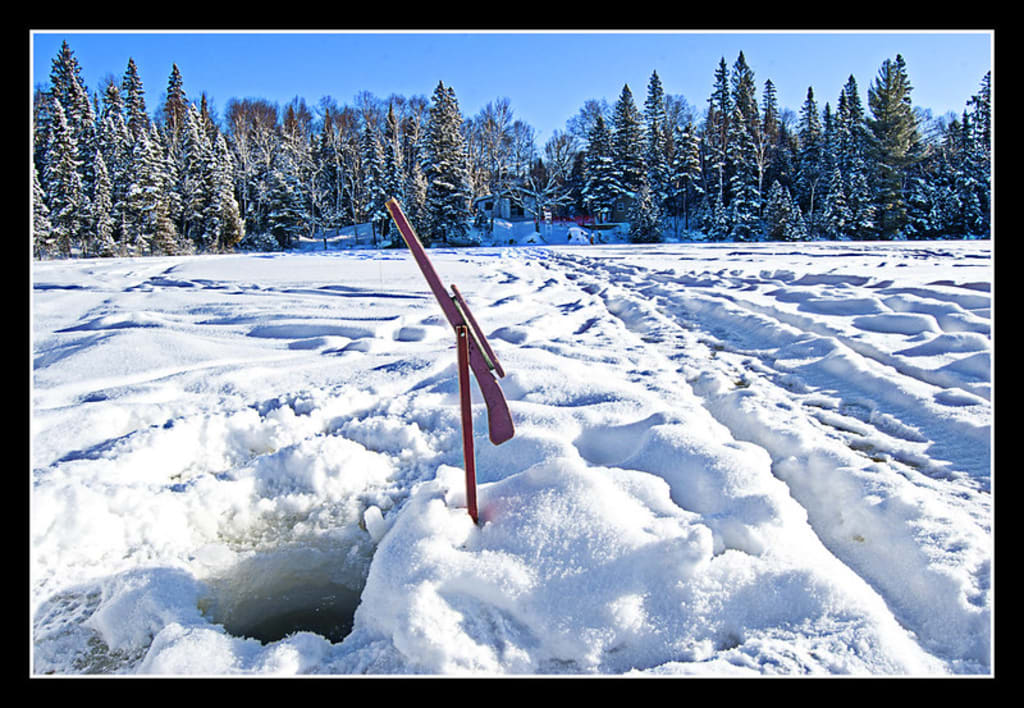
It was too small to be called a lake. I always knew it as the pond with small fish that took an hour to get to. Perchaudes is what we would call these small fish in Quebec. Little, golden fish with black stripes, and light delicious meat. Despite the fact that it was just a large pond, fish were bountiful there, making it a hub for fisherman from all over the province, especially in the winter months. Starting in January, the large pond’s frozen surface became crowded with cabanes, the ice fishermen’s wooden mobile homes.
Ice fishing was a family affair on this pond. There was the odd lone fisherman with a cabane all to himself. But mostly, the pond was populated with families just like ours. They would come with their van or SUV early in the morning, unload the fishing gear and get a fire going in the cabane’s wood stove. The fire was always a joint effort by the two parents, with the oldest child offering some suggestions to get it to catch more quickly. Once the wood oven bore an enduring flame, the father, accompanied by the older children, would fetch the ice auger to drill holes in rows. With the holes pierced in the ice, the whole family could step out and begin setting up the brimbales. Brimbales were known to the anglophones as tip-ups, however they themselves would use the French term when visiting. They were contraptions, often handmade, consisting of two rods – one serving as the base kept upright in a mound of solid slush, while the other was loosely connected to its top, left dangling, tipping up. The bate was usually a live minnow, hooked at the middle of its side. As a line, my father would use a thick black 40-pound test string and attach plonds, little weights joined on the line above the hook in order to keep the line down in the water.
When we had our dozen brimbales installed in a row in front of our cabane, our mother would return to maintain the fire. She would also get the hot chocolate ready for when we would need a break from the cold. There would usually be marshmallows too, which was special for us because we would rarely have them at home. I think my two older brothers and I enjoyed the hot chocolate as much as the fishing. I might have enjoyed it even more.
I was disappointed on this day when, after the hot chocolate was ready, we realized that we had forgotten to pack the marshmallows. It was alright though, the day was very windy and cold and the hot chocolate served as a respite. We stayed in the cabane for longer periods than we normally would. We could only go out for a few minutes at a time before our fingers needed to be heated. It was necessary to step out and check on the brimbales. Losing a fish was always devastating. We also had to maintain the holes. Thinking that we would only be catching perchaudes, we had brought an ice auger that drilled 4-inch diameter holes. With the day’s harsh cold, the small gap of water in our holes would begin to freeze quickly and we would have to scoop out the freshly formed ice. It was a task we needed to repeat every five minutes, and us brothers took turns performing this duty.
Due to the cold, my family would have stopped sooner if it was not for how well the fish were biting. Every fifteen minutes or so, a brimbale would tip downward. Sometimes it was the wind, but more often than not, it was a hungry perchaude. The person who spotted the tipped brimbale first would do the honors of giving it a good yank, hooking the fish, and pulling the line out of the water. The little perchaudes would comfortably make their way through our small holes as we pulled them out. Our persistence through the cold proved to be worth it, as we amassed a pool of eight little fish before lunch. When our mother finished roasting the sausages on the wood stove, we all took a break from the outdoors and kept an eye on the brimbales from the cabane’s window. Some dangled due to the wind, but none tipped fully.
After we ate, the fish stopped biting. We noticed that the surrounding families were not having any luck either. Usually, the fish nibble a little on the minnow, causing the brimbale to slightly bob down and up before fully descending. There was no sign of bobbing on any. Some brimbales would drop suddenly, but after yanking the top rod and pulling at the string, we would learn that they were tipped by the wind. We began to recognize the swift manner in which the brimbale fell due to wind. Nonetheless, we would always give them a yank in case a fish might be on the end of the line. As time went by without any fish, the yanks became less enthusiastic.
This fish drought lasted for about an hour.
“Well, looks like we caught all of them,” our father said.
“No, it’s probably the cold. They wouldn’t come up in this weather,” my oldest brother suggested. Given that it was even colder earlier this morning, I questioned his theory. I also had doubts about the fish ever having the intention of “coming up.”
I began to do a round of hole maintenance. I scooped away in the little holes, knowing that this would probably be the last time today that I would be doing so. I noticed the brimbale ahead of me tip down in one swift motion. Most likely the wind. I still needed to check to make sure. At a relaxed pace, I walked towards it to yank the top rod. But to my surprise, I was not able to. I took off the top part and gave the line a tug as I normally would. But I couldn’t. The line felt snagged, caught in a rock below the ice. I never got snagged before in the winter. I put both hands on the line and began to tug at it from different angles. The heavy rock felt stuck on the ground. How could the hook even get that low? Suddenly, I noticed the thick line start to sway in a circular motion. The rock was moving. As it did so, I gave it the most violent pull I could, only to have the line raised slightly and brought back down with a violent pull from the other end. Whatever was at the end of my line was not inanimate. It was very much alive. How a great white shark could make its way to a Quebec pond was a question I wondered afterwards. At that moment, I was in a fight with something I could not see. It pivoted with powerful strides underneath the four-diameter hole. I tried to take control, but my arms just followed its motion as if my hook was caught on the edge of a boat. I must have been shouting since my family stopped what they were doing to come surround me. I ignored the futility of this endeavor. There was no way this monster could fit through a hole drilled for perchaudes. But I had to see what it was.
And then, with a sudden jerk of what could have been its head, the line snapped. The hook, minnow, plonds, half of the black 40-pound test line – my chance of knowing what it was – all gone.
We stayed for nearly an hour afterwards. The wind had stopped, but the brimbales all remained tipping up.
About the Creator
Keep reading
More stories from Julian Moritz and writers in Fiction and other communities.
Bulls > Bears > Humans
There was a world that had three classes of animals: bulls, bears, and humans. The bulls were at the top. Aggressive and carefree, they tackled every venture with a thrust of their horns. Although lacking in morality, their modus operandi led to their successful reign over the cautious bears and frail humans. They dominated the business world due to their relentless risk-taking. Their ruthless attacks on fellow candidates rendered them unbeatable in politics. Their social circles had no room for humans, and only the slightest for a few bears.
By Julian Moritz4 years ago in Fiction



Comments
There are no comments for this story
Be the first to respond and start the conversation.