
Memories Fill the Barn Walls
To belong in a place for so long that your whole life appears before your eyes, simply from being there.


Old Man Brumby hobbled into the family barn, leaving three-footed tracks. One each from his aching foot, wooden peg-leg, and splintered cane, in the damp dirt and straw. His limp-featured face which resembled a wax likeness of a younger man left to melt in a windowless room, tilted upwards to inhale the stale air. Without turning, without so much as looking, Old Man Brumby saw the whole inside of the barn. His battlefield, bunker and abode.
The age-softened walls, to anyone else, were an occupational safety hazard in need of renovation. To Brumby, these walls contained a collage of memories that returned him to youth and vitality. These walls saved him from rheumatism and the default attitude of superiority belonging to old men. To anyone else, the rusted tin roofing, speckled with holes from years of hail resembled the pox and seemed in danger of collapse. To Brumby, the passage of pale morning light through these holes was pure majesty made on earth. Slapdash illumination. To anyone else, this barn would be what was left of a life. To Brumby, this barn was everything of his life.
Brumby listened to the high bleats and sharp exhales and baritone snorts that, once upon a time, filled the now empty atmosphere. At the back of the barn, there rested a faded mahogany rocking chair. Brumby tottered towards it and crumpled like linen into its arms. Here, the assault of the past commenced. Chatter that was quite out of place broke through the veil of silence that shrouded Brumby’s awareness. Brumby knew he was alone in that moment, accounting for every square centimetre and muddy corner in his intimate familiarity with the space. Yet there is an aspect of such allure to things out of place. It is this feline curiosity from which all mysteries are borne. Or horrors. Brumby leaned forward on the rocking chair, his feet steadying and stopping its motion, to turn and face the chatter. Shifting stiffly to his right, Brumby’s droopy waxen figures fixed in an expression of shock that was quite unsuitable for a man of his age and condition.
Instead of facing the bare wooden-plank walls, damp straw-covered ground and dust-mite infested air, the soft golden glow of lantern light revealed two figures; one small, one large. The larger figure of a man was wearing navy business pants, a linen shirt and a navy waistcoat; he spread his arms in awe and looked around at the then fresh barn. Brumby who as still in awe at the vivid apparition was hardly even shaken when the man began to speak.
‘Would you look at this, hey!’ The man said with that entrepreneurial quality of self-made.
‘A real change of pace, don’t you think? Clancy from the Overflow?’ He continued, addressing the small boy at his side. The boy gazed up at the man. Brumby from his seat felt his heart embrace the boy, for the lantern’s glow made the tears welling in his eyes a sympathetic spectacle. The man halted in his business pitch, and crouching to wipe away the boy’s sadness,
‘What’s happened? You don’t like the smell, I suppose, but we’ll get used to it. The smell o’the earth!’ Seeing this didn’t help cheer the boy, he changed tact. ‘I know you miss your friends, but your Ma invited them down here for school break, you’ll see ‘em soon. Besides, think of all the animals we’ll have to show your mates!’
The thought of rowdy creatures finally broke the boy’s obstinate depression, starting him into an excited flurry, to the man’s obvious delight.
‘What kind of animals? Will they be wild and beastly?’
‘I was thinking more like cattle, sheep, cows, y’know,’ the man laughed.
‘Please can we get a wild horse!’
‘We call that a Brumby, sonny.’
‘Can we get a Brumby then?’
‘If we did, it wouldn’t be wild, then you wouldn’t want it. Besides,’ the man chuckled, ruffling the boy’s already messy hair, ‘you’re already Brumby enough for your Ma. I’ll wager we can get you pony-riding lessons somewhere in town, though.’
At the sound of the heavy oaken barn doors being pushed open, little Brumby and his Pa (for the reader has no doubt deduced their identities by now) turned to meet the newcomer.
‘Pa, have you seen the trees? There must be treasure somewhere in there, and glorious adventure!’ Brumby’s Pa indulged this childish delight and told the younger Brumby to go and explore their new property with his little brother, Lamb. Tears sprang forth in Old Brumby’s spectating eyes, blurring the vision of his little brother’s appearance from so long-ago. Brumby remembered the year 1900, six-years old. Indeed, with the entrance of his brother, Old Brumby followed the apparition with his eyes to find the whole barn in its age, aged in reverse around him, as if he were observing from an invisible bubble travelling through time. Finding no feeble pinching would dispel these oh-so-vivid images, Old Brumby with surprising vigour launched from his rocking chair and approached his Pa and Lamb and little Brumby, led by meagre steps. Yet Brumby couldn’t reach these spectres before they vanished through the open barn door. He heard his Pa chuckle softly, “tempus fugit,” watching little Brumby and Lamb run off towards glorious adventure.
Indeed, time flew. Despite Old Brumby’s protestations received only by a deaf cosmos, he remained fixed in-place watching more Retrospects of the barn rapidly spiral and unwind around him. As if his life’s moments were carried by tempestuous air and he watched with the eye of a hurricane, he saw: his family dining in the barn to christen their scenery-change; escapades with Lamb in the nooks and crannies he knew so well; Pa ushering cattle, sheep, pigs, as promised, into pens built with the help of locals.
This temporal storm slowed and Old Brumby found himself facing Youthful Brumby. It must’ve been 1910, for Brumby’s expression was cocky, foolish and defiant. Youthful Brumby, disregarding Pa’s definitive refusal, found himself an actual brumby, determined to break-in and ride this beast of his own. Old Brumby new that day well. Let us speed through, not to dwell on its painful beats. The youth valorously attempted to mount the brumby and at first succeeded. Quickly he was thrown, however, landing so poorly that his left leg shattered, fractured, twisted in such a way that the urgently beseeched town doctor had to take a moment to collect himself. We summarise the doctor’s advice:
“The limb is irreparable; he is losing blood.”
Either Brumby’s Ma or Pa or Lamb – the voice was distant and unfamiliar – responded desperately, “what must we do?”
“Amputate the leg immediately.”
Old Brumby remembered that clearly. It is a waste of words to respectively describe the simultaneously instilled feelings – loss, frustration, depression, terror, anguish, dejection - that were felt in that moment and for years after. To lose your left leg at sixteen in 1910, imagine. You are written-off, thrown a wooden replacement, made societally ineligible, rendered crippled and useless to oneself. In the eyes of everyone you know, where regard and expectation once gleamed, you see only pity. Old Brumby felt his counterpart’s soul harden and wrinkle with furious self-denial, darkening to resemble the shadow he felt himself to be. To the disconsolate and contented alike, tempus fugit.
And so, Old Brumby continued to watch his life drift past, like walking through a corridor lined with paintings of shifting faces belonging to people he once knew. So much comes and goes within four walls, devastation, promise; supreme darkness, supreme dawn. The old man remembered the burning desire to fight for his country in 1914, remembered the despair when he was rejected for his peg-leg, receiving the papers and reading his mail in between tending to the barn-animals. He relived summer 1915, when the recruitment officer sauntered purposefully into the barn ignoring Brumby, to announce Pa and Lamb’s conscription as able bodies. Many lonely days followed, accompanied only by his Pa’s animals.
Then, it was autumn and a woman shocked Brumby, who ambled absent-minded about his work. Black curls framed her face with the tumbledown majesty of a waterfall. She captured his attention with expecting eyes, she made the air mercurial. Her name was Beatrice. She asked if Brumby’s barn could be used for a weekly congregation of war-affected families. He didn’t hesitate to accept. Tempus fugit, when love enamours and gilds the heart. Old Man Brumby watched Beatrice come to love him for his clumsiness with her, his care for animals, his quiet focus, the way he gave himself to others and deprived himself. Old Brumby choked on tearful laughter when Beatrice said she adored the tracks he left in the hay as he went about his tasks as farmhand. Unfortunately, they weren’t wedded inside the barn (there are limits to everything), but Old Brumby relived that scene in his theatrical mind, every day.
The dawn only grew brighter. In 1919, Brumby, thinking Beatrice was trying to surprise him, turned suddenly, only to face the quiet smiles of Pa and Lamb, returned. The whole family dined in the barn that night, with animals and all. Over time, the barn’s tin-roof became peppered with holes from hail. Brumby fancied this an advantage for Beatrice’s evening meetings; the vastness of the sky illuminated by its varying gemstones rained beauty down upon the barn. A beauty matched only by the affections and filial care that were contained inside the barn, and the people inside. For townspeople continued their congregations at Brumby’s barn. Those who were lost were remembered; those left without their loved came together; those who felt themselves lacking found fullness in others. All of thus, inside a barn.
Before the past is left alone, we discover this story’s significance. We refer often to the barn, Brumby, time. We raced through the years. In fact, we leave quite a period untouched, beginning and ending with a far-older version of the man we have thus seen. This pacing may seem disjointed, random, clumsy. Why? It brings a particular idea into focus. The world in its totality is happening. This view of Brumby’s life can be deconstructed and explained in terms of magnitude. If we focus so extremely and meticulously on any object, say a barn, you may expect to find something unique in or about it. An expectation will be offset by the simple reality of it’s being a barn and your eyes are strained having focused so intensely. Conversely, refusal to focus to the slightest degree, nothing is absorbed. The image is unfocused; you see only a brown smudge sitting in a green haze. You disengage, grasping nothing. This timeline shifts magnitude, drawing attention to particular moments, drifting past others, centred on a farmhand called Brumby. Much of his life happened here. There was nothing especially gravitational about the barn to make it so, yet you read this far. There is enough allure in the simple reality of life; its tragedies, romances, nostalgia. For the ultimate significance of the barn, focus on any once inhabited location. It is likely that a great portion of someone’s life happened there. Realise that yours is also happening, with the swiftness of Brumby’s: tempus fugit.
We return, finally, to Old Man Brumby. Conversations and memories played out before his eyes on the barn’s uneven wooden slats, like a puppet show or old film reel gifted projection – a form of rebirth – by the fire of his experienced mind. He felt feeble. It was 1980, Brumby knew the film was ending. Ghosts resembling the people he passed in life flickered from view, as his own flame finally burnt itself out. His cataracts were vanquished by the clarity of these visions – remembrances hazing and hijacking every sense and sensation. Brumby, like his namesake, galloped through the soft and dewy grasses of the ever-stretching fields, in the endless space behind his eyes. There, he lived his last physical moments; in infinity, where ‘the end’ isn’t known.
About the Creator
Keep reading
More stories from Daniel Andrawis and writers in Fiction and other communities.
The Parochialism of Dystopia
I. How Humanity Arrived at the Present I begin this retrospect in the custom of my Modernity: by naming things what they are. That is, to plainly say what is meant. The unraveling of twenty-one centuries’ development shrunk and fit neatly into a little timeline, all to save my rheumatic fingers a bit of scribbling. Along this timeline we will, plainly stated, observe the old world order, what we call “The Old World” and its order; we will see it completely overthrown. Just as we call the people of The Old World “Oldies,” our thinking is plainly stated. The events on this timeline have been plainly titled and briefly summarized. Keep in mind the overlap. The demise of that past life was borne from many dynamic parts. Note that the below dates are suffixed by “bf.” refers to events occurring before flood. At the time of my writing, it is the New World, specifically the year 25.
By Daniel Andrawis5 years ago in Fiction
The Path to Salvation
The late autumn evening air filled the monk's lungs, but it wasn't the season that chilled his bones. The heavy-handed presence of evil he had sensed upon entering the woods surrounding this mountain village had not bothered to conceal itself from him.
By Made in DNA7 days ago in Fiction
The Hidden Door: A Family Secret Unveiled
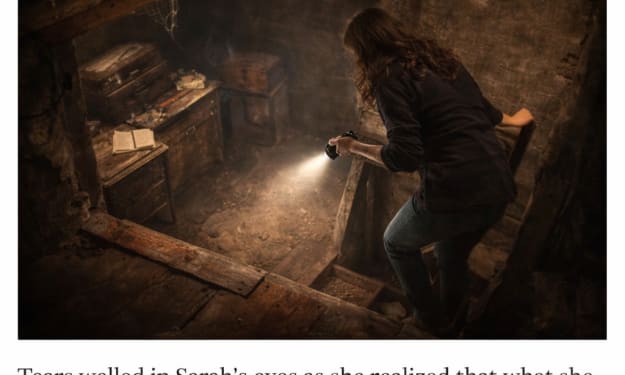
The Hidden Door: A Family Secret Unveiled A forgotten map leads to an ancient mystery hidden beneath the attic. It was a rainy evening when Sarah, curled up in the warmth of her grandmother’s study, found herself once again going through the many boxes of memories her grandmother had left behind. She had never quite known what to do with these things. Every object seemed to hold a piece of the past — an old family photograph, a faded letter, a trinket here and there — and each one stirred up emotions she didn’t know how to process. But on this particular evening, one box in the back corner of the room caught her eye. Unlike the others, it wasn’t full of old pictures or knick-knacks. It was packed with what appeared to be her grandmother’s journals, each worn and yellowed with time. Sarah hadn’t known her grandmother very well before her passing, and now these journals seemed like a window into the woman who had once been the family matriarch, full of stories, wisdom, and memories. As she flipped through the first few pages of one of the journals, something fell out — a small, crumpled piece of paper. She unrolled it carefully, revealing a faded map that seemed to have been drawn by hand. The paper was old, its edges torn, and the ink had blurred in some places, but Sarah could still make out the important details. The map was marked with symbols and what appeared to be a path leading to an “X” in the center of a room she didn’t recognize. It was the attic. Her curiosity piqued, and she immediately began to wonder what her grandmother had hidden all those years ago. Sarah sat back, staring at the map, trying to make sense of it. It had been years since she had explored the attic. As a child, the attic had always seemed like a forbidden place — dark, dusty, and filled with the remnants of a bygone era. Her parents had always warned her not to venture up there, saying it was too dangerous, too cluttered. But now, the map seemed to call her. Her mind raced with thoughts of what could possibly be hidden in that attic. Was it just a memory, or was there something more? Was this map leading her to a treasure, an heirloom, or perhaps an answer to a family mystery that had long been forgotten? Without hesitation, Sarah grabbed the map and hurried to the attic. The wooden steps creaked beneath her weight as she ascended. The musty air hit her the moment she opened the door, and the dim light from a single window barely illuminated the cluttered space. Dust motes floated lazily in the air, and old furniture, boxes, and antique furnishings were piled high, nearly reaching the ceiling. It was the same attic she had visited as a child, but it seemed even more mysterious now. She pulled the rug away from the center of the room, just as the map had indicated. The floorboards creaked as she knelt down, her heart pounding in her chest. Slowly, she ran her fingers over the worn wood and found a small hatch — it was barely noticeable, but there it was, as though it had been waiting for her all this time. The hatch was old, its wood splintered and faded with age, but it had a rusted latch. Sarah hesitated for a moment, wondering if she was about to uncover something her family had kept hidden for generations. She turned the latch slowly, the sound of metal against wood echoing in the quiet attic. As she lifted the hatch, a wave of cold air rushed up from the darkness below. The space beneath the hatch was small, and Sarah could barely make out the shape of an old, wooden door. It was unlike anything she had ever seen — covered in dust and cobwebs, but solid, like it had been shut for years. The key, it seemed, had always been in her hands — the map, the clue she had uncovered in her grandmother’s journal, had led her here. With a mix of excitement and trepidation, Sarah descended into the hidden space, her flashlight illuminating the way. The room was smaller than the attic, but it was filled with strange artifacts — old trunks, letters, and trinkets from a past era. It was like stepping into a time capsule. And there, in the corner, stood a chest — just as the map had suggested. She felt a rush of adrenaline as she approached the chest and opened it carefully. Inside, she found an old family heirloom, a beautiful silver necklace, its intricate design shining even in the dim light. Along with the necklace was a letter, written in her grandmother’s handwriting, explaining the significance of the necklace — a piece of their family’s history, passed down through generations. Tears welled in Sarah’s eyes as she realized that what she had uncovered wasn’t just a hidden treasure, but a piece of her family’s story. The hidden door had opened, revealing more than just a room filled with relics. It had revealed a legacy she never knew existed.
By ÅBBÅS KHÅÑ4 days ago in Fiction



Comments
There are no comments for this story
Be the first to respond and start the conversation.