
Living in Today’s World: A Story of Change and Challenge
How Our Global Society Balances Technology, Connection, and Uncertainty

Living in Today’s World: A Story of Change and Challenge
How Our Global Society Balances Technology, Connection, and Uncertainty
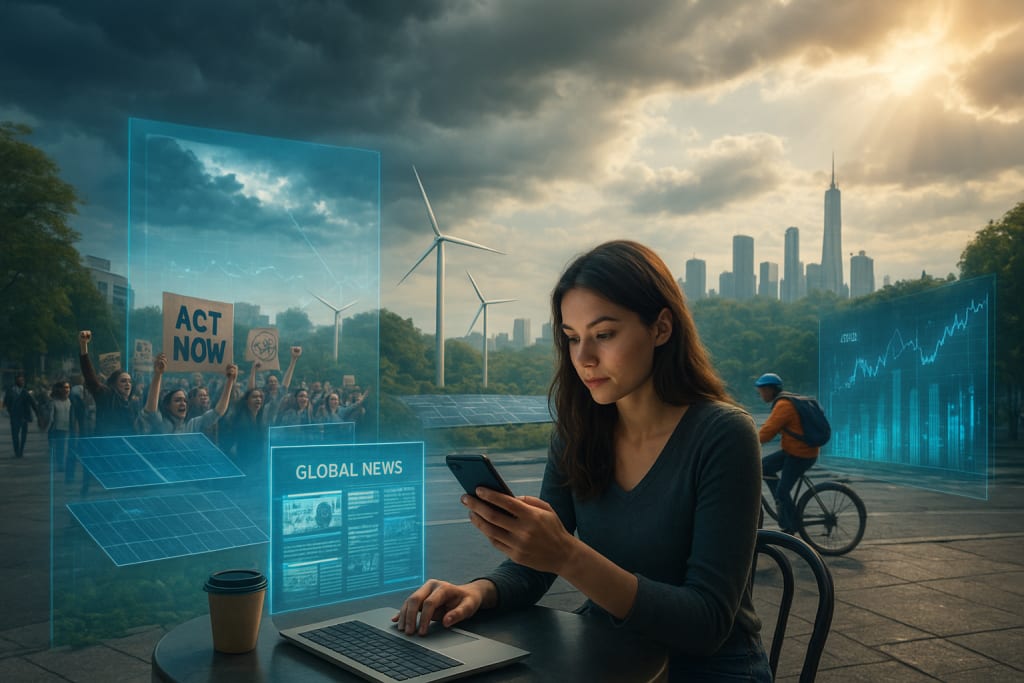
In the vast timeline of human history, every generation has believed they lived in extraordinary times. But today’s world feels different—more connected, more fragile, and more unpredictable than perhaps ever before. Our daily lives are shaped not only by local realities but also by global events happening thousands of miles away. Technology has stitched humanity together into one vast web of information, while challenges like climate change, pandemics, and conflicts remind us how interdependent we truly are.
A Digital Age of Connection
The most obvious feature of today’s world is the dominance of technology. Nearly half of humanity carries a smartphone, a small device that contains the power of a library, a television, and a radio station all at once. Social media platforms have transformed the way we communicate—allowing a teenager in Nairobi to connect instantly with another in New York, sharing ideas, music, or even activism.
But this same digital age has blurred the boundaries between truth and falsehood. Information travels at lightning speed, yet so does misinformation. While one post might inspire millions toward positive action, another can spread division, hate, or fear. This dual nature of technology makes it one of the greatest opportunities and greatest risks of our time.
The Fragility of Peace and Prosperity
Another reality of today’s world is that peace feels fragile. Conflicts in one part of the world create ripple effects far beyond borders. Wars no longer just impact soldiers on battlefields; they impact global food supplies, energy markets, and migration flows. A farmer in Asia may feel the consequences of a political crisis in Europe, just as a family in Africa may face rising costs of essentials because of instability in the Middle East.
Global prosperity, too, has become deeply interwoven. A disruption in one country’s manufacturing sector can halt production lines worldwide. The pandemic made this painfully clear, when supply chains collapsed and simple items like masks or medicine became scarce.
Climate as the Great Equalizer
Perhaps the greatest shared challenge of today’s world is climate change. No nation, no matter how powerful, can fully escape rising sea levels, extreme weather events, or food shortages caused by global warming. From floods in Pakistan to wildfires in California, humanity is witnessing disasters that once seemed distant or rare but now appear on the news almost daily.
Yet climate change has also become a catalyst for innovation. Countries are investing in renewable energy, individuals are rethinking consumption, and scientists are pushing the boundaries of what’s possible. While the challenge is enormous, it has inspired cooperation across borders—proof that humanity can unite when survival is at stake.
The Human Spirit in Uncertain Times
Despite these challenges, there is something deeply inspiring about today’s world: the resilience of the human spirit. When natural disasters strike, people mobilize donations and support within hours. When injustice occurs, voices rise up online and offline, demanding accountability. Young generations, especially, are leading movements for climate justice, gender equality, and political reform, reminding us that hope is not lost.
Ordinary people are proving that small actions matter. A teacher in a rural village sharing knowledge, a doctor serving during a crisis, a programmer designing apps for education—these efforts echo louder than we sometimes realize. While it is easy to feel overwhelmed by global problems, the truth is that individual contributions still shape the bigger picture.
A World Still Being Written
Today’s world is not perfect—it never has been, and never will be. But it is uniquely ours, defined by both its incredible opportunities and its daunting challenges. We are connected in ways no previous generation could have imagined, and that connection carries both responsibility and power.
The future will depend on the choices we make now: whether we let technology divide us or unite us, whether we prioritize short-term gain or long-term survival, and whether we choose fear or hope.
In the end, today’s world is not just something we live in—it is something we are actively shaping. Each decision, each innovation, each act of kindness contributes to the story of humanity. The question is: what kind of story do we want it to be?
About the Creator
WAQAR ALI
tech and digital skill
Emotions and ideas of a Rainbow
“The rainbow has such a beautiful tint to it. The colors permeate into my very soul.” “What do you mean permeate?” “The red seeps into my skin with anger, enjoyment, love, and life. Red is a strong color that makes me dance inside with desire. It gives me the energy of love but says hello I am dangerous. It brings excitement. Makes your heart rate go up quickly and can contribute to arousal in ourselves. Red stresses the intensity of the positive and negative thoughts that corrode our very being. Red prompts quicker decisions in us that can be rash decisions at times. In Africa red can symbolize mourning and death of life.”
By Tabitha Hinkley7 days ago in Fiction



Comments
There are no comments for this story
Be the first to respond and start the conversation.