

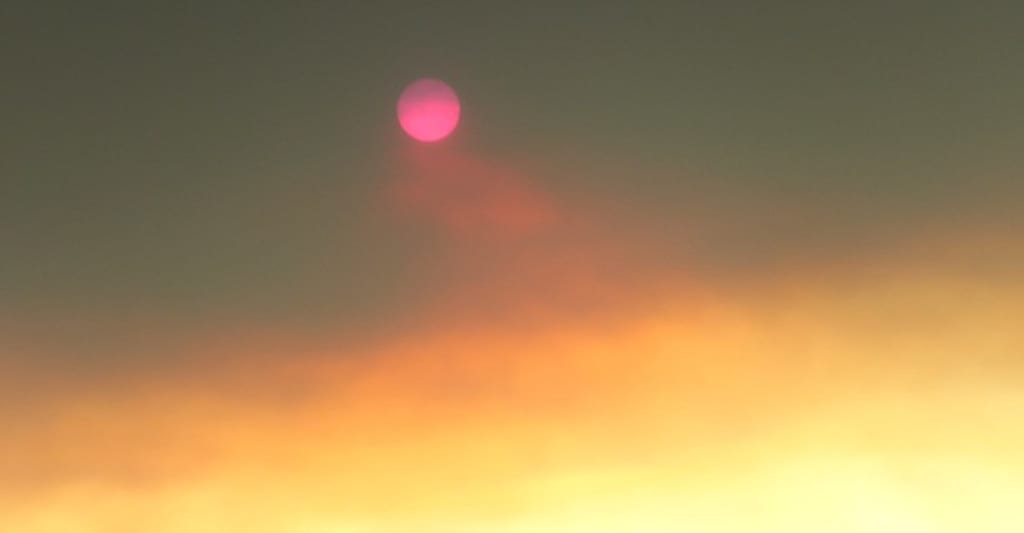
Kaiya willed her eyes to blink, but it were as though her mind had fully separated from her body. She couldn't believe her eyes. How could there be so much beauty among so much chaos, so much destruction? The beams of light seemed to shatter and reassemble, not in the same way as they were, but in a stunning calamity, both delicate and volatile. The rays pierced through the haze, brilliant vermilion and amber, muted by ash and soot and smoke. The brightness tore through the opaque veil of smoldering devastation, clawing away, desperate to penetrate. The light danced and darted with no semblance of a rhythm, as Kaiya’s eyes tried, to no avail, to catch the elusive glisten. Every time she seemed to match the tempo of the rays, the beat changed, the chords augmented and she was lost again.
Years later, people will argue over the cause of the explosion. Some will say it was an elaborate plot to shift attention away from the atrocities that were being committed at the hands of the crumbling government; that it was merely a red herring. Still others will claim to have secret knowledge of covert scientific testing that, coincidentally, was taking place directly underneath the spot where the explosion occurred. Many will talk, few will ever know the truth. Human beings want there to be big causes for big events. It isn’t satisfying to think that the world as we’ve known it could be brought to her knees by a mistake. It isn’t gratifying to think that after 200,000 years of existence, humans would be indiscriminately decimated because of an accident. We want big events to have big causes, but that isn’t how it works. And at the moment, none of this mattered anyway, least of all to Kaiya.
There were so many smells, acrid and harsh, like bleach on a hot day. There were scents of gasoline and melting tar. There were lingering traces of hot metal and burning plastic which assaulted her nostrils each time the wind shifted direction. But there was something else that floated above, something almost pleasant. As Kaiya tilted her head, cocking her face halfway to the sky, she was finally able to close her eyes. In that moment, she realized what she smelled, crackling wood. She opened her eyes and inhaled deeply, hoping to hold on to that smell. With each inhale, she felt Christmas.
She saw her living room packed tightly with her family. She saw her Uncle Walter teaching her brother Charlie the perfect way to stack the logs in the fireplace. She saw her mom, frantically, but joyfully, arranging all the dishes on the buffet, trying desperately to make sure everything came out of the oven at the same time. She saw her dad with his arm around her sister Lily, as he listened intently to all of her stories from her first year at school. With every word, his face grew a bit brighter, his pride uncontainable. With her next breath, Kaiya saw the tree. Each ornament had its story. There was the sand dollar from their trip to Key West, and the clam shell with a nativity scene painted inside of it from their vacation to the Cape. Each had its spot on the tree, not too perfect, not too precise, but deftly hung. And then there were the lights. Each year, there was a debate among the three kids as to whether there should be colorful lights or white lights on the tree. Lily could never arrive at a decision, while Charlie thought that it was too boring to just have white lights. Kaiya never really cared, so she, ever the attorney, argued both sides. Ultimately, Charlie would get bored and concede, and Lily would endlessly vacillate until she decided which lights best complimented her aesthetic for that year. All of these memories flooded Kaiya’s mind at the moment she smelled the burning wood. All of the laughter, all of the decorations, all of the food. But what she remembered most were the lights.
Kaiya’s eyes opened and scanned the ground before her, but her brain kept these memories running in the background, like the radio you keep on so you don’t have to be left alone with the silence. Her mind was back in Lowell, Massachusetts, sitting propped up by her grandmother’s needlepoint pillow, her dog, Winston, lying atop of her feet, as she felt the warmth of the fire on her face, but her eyes, her eyes couldn’t help but fixate on the scarred earth before her. All of the people of the town, her friends, her neighbors, reduced to their scattered items on the ground.
Her neighbor, Ruby, was an 87-year-old widow who had a quick wit, a love for NASCAR and an incredible talent for telling it like it is. Ruby’s children lived out in Oregon, so Kaiya felt like her east coast granddaughter. Ruby didn’t like to cook much anymore, she said it wasn’t fun to cook for one, so every now and then, Kaiya would try out a new recipe and bring it over to Ruby. They would sit and eat together, and Ruby would regale Kaiya with stories of growing up in New England in the 1930’s. Ruby would tell her all about the beach, and how the kids would leave in the morning and spend the whole day down at the ocean, building sandcastles, throwing seaweed at each other, and seeing who could run the fastest. At the end of the day, they’d all head home, eat steamed lobster (“which was cheaper than a hot dog in those days!”) and hang up their wool bathing suits (“which never dried!”). Ruby’s husband died 30 years ago, and Ruby never remarried. She said she had her one fairytale romance, which was more than most people could say, so she was content with living out her days on her own.
The light shifted directions again and landed on the corner of the small silver necklace, half of the heart buried in the ash. Kaiya recognized it immediately, and knew, without opening the locket, that it would contain a sepia-tone picture, barely recognizable, of a young man, stoic and strikingly handsome, with his mouth curled ever so slightly, as though he were only a moment away from erupting with laughter. She remembered how Ruby’s hands would lightly graze it when she was caught in a memory, or how she would clutch it if Kaiya said something shocking. She remembered how Ruby’s thumb would rub the front of it, absently, as if she were trying to coax William out of the picture, back into her arms. At least they were together now.
The scent of the wood was starting to fade, or perhaps Kaiya was just getting used to it. As she tried to exhale, she was acutely aware of the tightness in her chest. Kaiya was a decent athlete. She was on the crew team in college and despite her short stature (she was only 5’1), she was quite the rower. After practice, she would inspect her hands, marveling at the callouses that were forming on her palms, on the soft skin just below the base of her fingers, and the blisters that plagued the inside of both her thumbs, right in the crook between her thumb and index finger, the space where the oar would rest and rub. Despite the discomfort, Kaiya would secretly relish in the outward expression of her strength; these were her badges of courage. Other rowers wore gloves or taped their hands before practice, but Kaiya liked having visual proof of her perseverance. Yet, even though she could row until her hands bled, Kaiya always struggled to match that intensity when she was forced to run. As soon as she hit that quarter mile mark, it felt like someone was progressively tightening a tourniquet around her chest. Kaiya was diagnosed with asthma when she was in elementary school, the diagnosis which only came after she was rendered shell-shocked and oxygen-depleted thanks to her first 2am asthma (or perhaps anxiety?) attack.
Ever since then, if she felt her lungs tighten, she would immediately be confronted with the all too familiar “fight or flight” sensation that she knew, all too well, normally preceded her panic attacks. Over the years, she learned to talk herself down off that ledge, to rationalize what was happening, and tell herself that she had been here before, she had survived this sensation in the past and she had always made it through. However, as Kaiya stared out at the vast nothingness in front of her, that touchstone of past success, and the tiny comfort that she used to find in the familiarity of that feeling, were gone. The Welsh have a word for this sensation; hiraeth. They describe it as a yearning feeling, flecked with suspense, as if something is about to be lost and never recovered. Kaiya had never heard of this word, but she felt it, deeply, in her bones.
It was clear that nothing in her life, whatever of it remained, would ever be the same. Kaiya knew, as soon as she was able to open her eyes after the explosion, that everything she had known, was gone. Yet, tragedy is sneaky, and our minds try to protect us. Kaiya’s brain wouldn’t let her know all that she had lost at once. Her mind would only allow her to recognize the enormity of the situation in small bites. Her family was dead. Her neighbors and friends were dead. Her entire understanding of the world was shattered. Her mind had slotted “no longer able to manage anxiety through past experiences” much further down on the list. Yet, in her psyches’ effort to protect her, and keep from overwhelming her, Kaiya would now just suffer death by a million papercuts. She would continue to realize that there were so many more things that she lost that day, but instead of being bombarded by them all at once, she would be struck by them, one at a time, without warning and without any armor to shield herself from the realizations. It would be at that point, that she would make the choice.
Strength is subjective, at best. Sure, we try to quantify it, he can lift 225-lbs. or she can run the 2,000 meters in 6 minutes and 42 seconds, but there is strength that cannot be tallied or charted, like the strength it takes to get up in the morning, to simply drag your legs out from under the covers and put your feet on your bedroom floor, the day after you’ve been fired from your job. Or the tenacity required to not lose hope after you’ve received a soul-crushing diagnosis. That type of strength cannot be reduced to numbers. Yet, there is also strength in giving up. There is a strength in completely surrendering and letting go of control. Kaiya chose this kind of strength.
In her 33 years on Earth, Kaiya had always fought. She fought to prove herself to her peers, she fought to succeed in school, she fought to be a survivor. She confronted her fears head-on, and trudged through every obstacle that was placed in front of her. But she was done, this was simply too much to bear on her own. She chose to surrender.
Kaiya watched the prisms, now muted cobalt and azure, tiptoe through the smoke, as though they were trying to be careful not to trample the curling wisps. Kaiya tipped her face towards the sky, her eyes heavy, almost dreamy. She inhaled again, her lungs expanding like the throat of a bullfrog, and she was gone; back to Lowell, with Winston on her feet. She was gone; back to Christmas and crackling fires. She needed to leave this time and space, with all its destruction, despair and nothingness, but she’d never quite be able to leave behind the light.
About the Creator
Keep reading
More stories from writers in Fiction and other communities.
Affection and Healing for Yourself
During the night of the last quarter moon, I gathered my ritual supplies. I carefully handled the chunk of black tourmaline that would protect me from your overall negative and narcissistic energy. I carefully walked the house with my stick of selenite in hand, asking the universe to cleanse our working space.
By Alisha Wilkins ✒️🦋🖋️6 days ago in Fiction
📢 Raise Your Voice Thread: 01/22/2026
Our “Raise Your Voice Threads” are hosted most alternating Thursdays at 12PM ET to offer creators more avenues to uncover exceptional stories on Vocal. As we are continuously searching for fresh creators and inspiring stories, this thread provides an opportunity to exchange and discuss the stories that have moved and motivated us on Vocal.
By Raise Your Voice by Vocal3 days ago in Resources


Comments
There are no comments for this story
Be the first to respond and start the conversation.