

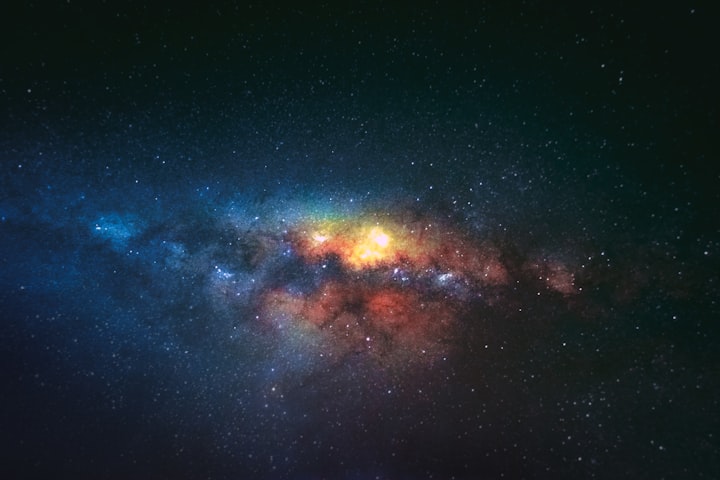
I owe you my life, whoever you are. Not just mine really. The entire crew of the generational ship does. If you hadn’t sent us Lifeline to guide us here, lifetimes of traveling would’ve been all for nothing. Our ship was barely holding together. It was old, cobbled together from mismatched parts from systems never meant to interact and jury rigged to within a micron of its life. In the end, it had to look like a flying scrapyard.
We’d entered the Void entirely out of desperation in generation three. Generation two had attempted to colonize an uninhabited world that perfectly matched the parameters of what our people required. It was warm, largely ocean and brimming with flora and fauna we could use as food and medicine sources. We’d entered orbit of that world and prepared to send down the first away missions to the surface to establish a colony. The records speak of a flurry of excitement. People were eager to claim a bit of new paradise for themselves. The elders were gleeful at the thought of setting foot on a planetary surface again. Space travel had not been agreeable long term for them.
Then the Enemy arrived. We don’t know anything about them, other than that they were fiercely territorial. They entered orbit, passing so frightfully close to us we feared they may be mad enough to ram into our ship. We attempted contact, but they were stubbornly silent. When they began to fire upon us, we had no choice but to abort our colonization plans. We had hoped this would stop their hostility, but they continued to give chase. We must’ve sent out hundreds of hails, pleading for negotiation, offering all manner of concessions, anything we could think of. But the only response we ever got was to be fired upon and pursued. The Void appeared on long range sensors and we saw no indication of enemy presence within it. We’d taken heavy damage and needed to make repairs. So we went for it.
It turns out there was a reason for the lack of Enemy presence within the Void. It seemed to have a mind of its own, the records tell us. The cartographers would chart a path to where they believed it would end, with reams of sensor data to prove it, only for the readings to change when we neared what were supposed to be the Voids borders. After several such attempts, the captain elected to chart a course in a straight line. There would be no deviating from our heading except to navigate around any debris or threats, not that much of that existed within the Void. The reasoning was basic, but sound. As large as space is, all anomalies have an end. So to did the Void. It just had to be so.
If only the captain knew just how far the Void stretched. In their defense, we still don’t have an answer to that question. We maintained a constant heading, traveling from generation three through eleven, scavenging materials from derelict vessels misfortunate enough to never escape the Void and anything else that came our way. The problem was that such scavenging opportunities were few and far between. And that says nothing of the process of integrating technologies of disparate races into a functioning pastiche. It was in generation eleven when we had reached the limits of our thrift and creativity. Our environmental control systems were wearing out and long-range scanners gave us no indication of scavenging opportunities within our range. Our people were forced to make the decision to cull the population in order to take pressure off our taxed systems. Only essential ship personnel and a few multiskilled individuals retained their lives. All told, seventy two percent of the crew was euthanized. Few resisted, so strong was the greater good mentality and the mental fatigue associated with what felt like the futility of existence. Others…it was regrettable. But it bought us time.
And to think we almost missed Lifeline. The cull had cast a malaise over those left alive and not long after, things continued to go wrong. As soon as one system was repaired, another broke down. Everyone was constantly working, but in the back of their minds, they all envied the culled. Their end had been quick and merciful. Those left behind could see only a continuation of this pointless existence for themselves and any descendants that would follow. And at this rate, our people had another generation or two at best. No one had any hope of escaping the Void and finding a home. But none were bold enough to voice this belief, let alone give up for fear of the social ramifications. And so we worked. And worked. And worked.
Then this little, almost insignificant hunk of metal and primitive circuits came floating by. We almost let it pass, but one engineer, desperate for diversion and sick of contemplating how bleak things were, transported the junk aboard. Understand, Lifelines collection was on a whim. And yet it changed everything.
We still don’t know Lifeline’s purpose. We know now that it contains zettabytes of information, but its nothing we can access. So much of our technology had to be pared back to basics, but maybe someday we’ll be able to unlock Lifeline’s secrets. That’s what we call your machine. And we were fortunate someone among you thought to go deeply primitive with etchings on a gold alloy plate inside Lifeline. There we found a pulsar map and what we later figured out to be a spectrogram of this planet’s composition. It wasn’t perfect, but it was close enough to what we needed to survive.
The life this breathed into the crew was something to behold. They became giddy, filled with anticipation and anxiety, not knowing what to do with these new feelings. Understand, they’d never felt hope before. They’d never seriously imagined anything would change. At least not in their lifetime.
We traced and charted Lifeline’s trajectory and performed an analysis on its materials. When it was taken aboard, Lifeline was found to be seventeen generations old, or in terms of your planetary revolutions around your star, about one hundred thousand revolutions old. With nothing to lose, we set a course and retraced Lifeline’s path. Lifeline led us through the Void and into normal space. We don’t know exactly how or why the Void decided to release us for doing nothing more than tracing Lifeline’s path, but it did. We gazed upon stars for the first time in nine generations. Lifeline guided us through nebulae and asteroid fields rich with materials we could use for repairs.
Our engineers and astrophysicists marveled at this. Surely Lifeline should’ve been damaged if not destroyed before it reached us. It had no means of altering its course or changing trajectory. The odds of it intersecting on our path unscathed were so mind bogglingly remote, a few took it for divine intervention. Individuals of that persuasion have pointed to the Enemy chasing us into the Void and the Void refusing to let us go until we located Lifeline as further proof of some larger divine plan. They also preach that you having sent out Lifeline prior to our forced flight from our original home world meant you had the gift of omnipotent sight and, taking pity upon our plight, sought to deliver us to a safe haven via your mechanical emissary. Mind you, religious thought only existed in historical texts, ending about fifty generations prior to that point among our people. As of today, it is a different picture. There is now a small cult of Lifeline worship and its devotees seek to uncover the texts within. They see Lifeline’s creators, you, as gods who we must learn about and venerate. I agree, you must be studied and remembered, but forgive my skepticism of your divine provenance.
When we reached this planet, Lifeline’s origin, we expected to find you, or at least your descendants. We had agonized over how to communicate, how we would make contact, what offers we would make if you were hesitant to share your world with us. Our experience with the Enemy, though generations past, still lurked in the back of our minds. Arguments abounded. Some clung to the belief that you would never have sent out a map to your world if you didn’t wish to be visited. Others cautioned that much time had passed. You could’ve changed your minds. We felt our best hope was to bring something to the table. Using the spectrogram, you gave us, we aimed to secure materials that were rare or nonexistent on your world in hopes we could trade for a small slice of your world.
And yet when we arrived, all on this little blue orb was quiet. We have found no evidence of any substantial intelligence on this world, except for ubiquitous microscopic compounds that are synthetic in nature and petroleum based. We have no cities, monuments, dwellings, nothing to indicate you ever existed. I might’ve chalked you up to a fever dream if not for our certainty Lifeline came from here and that we have found pieces of machinery in orbit similar to Lifeline. The spectrogram of this world is also different from what you sent. The atmospheric mix is more to our liking, the planet mostly ocean with small smatterings of land. It is geologically and atmospherically active and seldom cold anywhere but the poles and high elevations. Its perfect, as if in the time between when you sent out Lifeline and we arrived, you’d prepared it just for us. As you can imagine, the Lifelinites take this as even more evidence of your divinity. Again, I question that interpretation, but until we unlock the information within Lifeline, we cannot possibly presume know your motives or nature.
And that’s why I have come before you in the Lifeline temple today. It has been three generations since our arrival and the Lifelinites are close to accessing the data in Lifeline’s circuits. Our questions will soon be answered, and there is one answer in particular that has my interest. I want to know why you included the object that sits before me now on-board Lifeline. It was in the compartment behind the gold panel. It, forgive my candor, seems useless. It doesn’t connect to any system and has no functional value to Lifeline. It’s a gold device with two rounded protuberances at the top and a point at the bottom. The outer surface is etched with vines and leaves similar to those found on the landmasses. One side has two hinges and the other a weak magnetic clasping mechanism that allows it to be opened and sealed. It looks like there was once something inside, but the sealing mechanism was very poor to say the least. Whatever was inside became so damaged that we haven’t a clue as to what it once was. If it had not been so deliberately placed, I would’ve taken it for junk acquired on Lifeline’s journey. But clearly it meant something. Why else would it be sealed inside of Lifeline, especially if it had no conceivable value to the success of Lifeline’s mission. Lifelinites call it the relic. I hope to know one day what it means and why you gave it to us. For now, we will keep it safe, for if it meant something to you, it should mean something to us. And we will do all we can to be good stewards of this world you have led us to. The Lifelinites believe you will one day return when we unlock the secrets of Lifeline. I have my doubts of that, but on the off chance that they are right, please know our people seek to conduct ourselves as grateful and respectful guests in your home. We will keep it in good working order should you ever come back.
About the Creator
Jasmene M. Ramirez
Decided I could either dream of being a writer one day or actually make moves to become one. So here I am. Let’s see where this wild ride takes us…
Keep reading
More stories from Jasmene M. Ramirez and writers in Fiction and other communities.
I Like Hunting Monsters
This cake is delicious! Thank you! Really, I mean it. Thank you! Nothing like a good slice of chocolate cake after biking…what was it, ten, eleven-ish miles. Whatever, it doesn’t matter. Ah…yes, about that. I promised to tell you why I was out so late on the highway. Well, it’s kind of a long story. Yeah, I know, what a cliché beginning but it’s the truth. Good thing we have time while that waitress goes to get the sheriff. Weird business it is with the phones not working. First your cell, then the cells of everyone here and now the landline at this diner. Real weird.
By Jasmene M. Ramirez 5 years ago in Fiction
The Devil's Cut
“Comrade, finally you’re awake.” The voice was smooth, sensual. A flickering incandescent bar was all that lit the white, sterile room. All Vladimir remembered was everything going black. He tried to move his arms and found them strapped to the gurney.
By Matthew J. Fromm7 days ago in Fiction
An Architecture of Returning
Part One: The Selection After the wound, you must move. Act quickly. This does not have to be a physical motion. Select something you love. This need not be a place you can touch. This can even be a place inside you. It will always be safe. It will always be protected. It’s where you can go, and where all your thoughts will stop swirling.
By Anne Spollen5 days ago in Fiction


Comments
There are no comments for this story
Be the first to respond and start the conversation.