


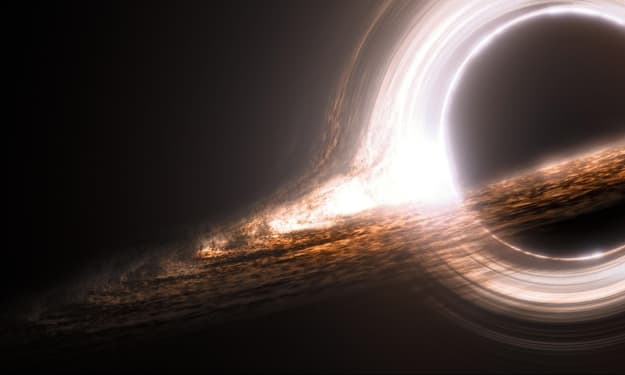
Imagine this: you stumble upon a wormhole, a gateway to another realm, right here in our reality. And what a sight it is! This cosmic phenomenon appears round, spherical, almost like a mysterious black hole. But it's not just a void; it's a window to a faraway place, allowing light from the other side to pass through and captivate your senses. As you gather the courage to step through this enigmatic portal, your old home starts to fade away, receding into the shimmering spherical window. And just like that, the other side comes fully into view, revealing a whole new world before your eyes.
However, the question remains: are wormholes genuine phenomena or merely a guise of magic disguised as physics and mathematics? If they do exist, how do they operate and where can they be found?
Throughout the majority of human history, the prevailing belief was that space possessed a rather simplistic nature; a vast, flat stage upon which the events of the universe unfolded. Even if one were to remove the planetary and stellar set pieces, something would still remain. That vacant stage is space itself, existing in an unchanging and eternal state. However, Einstein's theory of relativity revolutionized this notion, asserting that space and time jointly constitute this stage, and they do not possess uniform characteristics throughout. The entities present on this stage have the ability to influence the stage itself, causing it to stretch and warp. If the previous stage resembled immovable hardwood, Einstein's stage can be likened to a waterbed, possessing a malleable quality that allows for bending, and potentially even tearing and patching together, thereby rendering wormholes conceivable. To better comprehend this concept, let us consider a two-dimensional representation. Our universe can be envisioned as an expansive, flat sheet, contorted in just the right manner. Wormholes, in this scenario, would serve as conduits connecting two exceedingly distant points, bridging the gap with a concise passage that could be traversed almost instantaneously. This would enable travel throughout the universe at a velocity surpassing that of light.
So, where can we find a wormhole? Right now, they only exist on paper. The theory of general relativity suggests that they might be possible, but that doesn't mean they actually exist. General relativity is a mathematical theory that has many possible solutions, but not all of them describe reality. However, theoretically, wormholes are possible and there are different types. The first type of wormholes to be theorized were called Einstein-Rosen Bridges. They propose that every black hole is like a portal to an infinite parallel universe. Let's imagine them in a simpler way. Empty space is flat, but when objects are present, it curves the space around them. If we compress that object, space becomes even more curved. Eventually, space becomes so warped that it collapses into a black hole. At this point, a one-way barrier forms called the event horizon. Anything can enter the black hole, but nothing can escape it. Everything gets trapped forever at the singularity at the center. However, there is a possibility that there is no singularity. On the other side of the event horizon, the parallel universe might look similar to ours but mirrored and with time running backwards. In our universe, things fall into the black hole, but in the parallel universe with backwards time, the mirrored black hole might be spewing things out like a big bang. This is known as a white hole. Unfortunately, Einstein-Rosen Bridges cannot be crossed. It would take an infinite amount of time to travel to the opposite universe, and they close in the middle. If you were to enter a black hole, you wouldn't become the stuff coming out of the white hole. You would simply die. So, in order for humans to travel across the cosmos quickly, we would need a different kind of wormhole. A Traversable Wormhole.
VERY OLD STRING THEORY WORMHOLES
If string theory or one of its variants is the accurate depiction of our universe, it is plausible that our universe may possess an intricate network of innumerable wormholes. Following the Big Bang, quantum fluctuations at the subatomic level may have generated numerous traversable wormholes, which are interlaced with cosmic strings. During the initial billionth of a trillionth of a second after the Big Bang, the extremities of these minuscule wormholes were separated by light-years, scattering them throughout the universe. If wormholes were formed during the early stages of the universe, either through cosmic strings or other means, they could be dispersed throughout the universe, awaiting discovery.
There is a possibility that we are closer to discovering wormholes than we think. Black holes and wormholes bear striking resemblances, prompting physicists to propose that the supermassive black holes at the heart of galaxies might actually be wormholes. Although reaching the center of the Milky Way is a daunting task, we can still explore the challenging option of creating our own wormhole.
MANMADE WORMHOLES
A wormhole needs certain qualities to be useful. Firstly, it must connect faraway parts of space-time, like different rooms or planets. Secondly, it should not have any event horizons that would prevent travel in both directions. Thirdly, it must be big enough so that the gravitational forces don't harm travelers. However, the biggest challenge is keeping the wormhole open. Gravity tries to close it, but we can use exotic matter to keep it open. Exotic matter has negative mass, which means it repels instead of attracts. This creates anti-gravity that can keep the wormhole open. Exotic matter is very powerful and can push space-time open, even more than the pressure in neutron stars. With exotic matter, we can control space-time as we wish.
We have a strong candidate for the exotic matter we seek - the vacuum of space itself. The constant creation and annihilation of particle-antiparticle pairs through quantum fluctuations in empty space creates a boiling effect that we can manipulate to produce a negative mass-like effect. This discovery could be the key to stabilizing our wormholes and opening up a whole new world of possibilities. We can start by wiring the solar system, leaving one end of each wormhole in orbit around the earth and flicking others into deep space. The earth could become a hub for a vast interstellar human civilization spread over light-years, just a wormhole away. However, we must be cautious as wormholes have a dark side. Opening even a single wormhole could potentially create time travel paradoxes and violate the causal structure of the universe. But with our newfound knowledge, we are confident in our ability to navigate these challenges and unlock the secrets of the universe.
In the vast realm of scientific wonder, there lies a captivating enigma: wormholes. These elusive cosmic tunnels have perplexed many brilliant minds, leading them to believe that crafting such marvels is beyond our reach, and perhaps, that they are mere figments of imagination. Presently, we can only fathom their existence within our hearts and as intricate equations on paper.
About the Creator
Reader insights
Nice work
Very well written. Keep up the good work!
Top insights
Easy to read and follow
Well-structured & engaging content
Eye opening
Niche topic & fresh perspectives
The Path to Salvation
The late autumn evening air filled the monk's lungs, but it wasn't the season that chilled his bones. The heavy-handed presence of evil he had sensed upon entering the woods surrounding this mountain village had not bothered to conceal itself from him.
By Made in DNAa day ago in Fiction
Breakfast
The room was like any I had seen on any episode of Law and Order or other police procedural. They invited me here, said it was voluntary, but I knew it was not. After a while, I lost all track of time. I dozed off and then woke with a start. I’d read somewhere that Thomas Edison slept for an hour or two at a time, around the clock. Not much different from my own bouts insomnia.
By Mindy Reed7 days ago in Fiction
Rachel Reviews: The Spiral Archive by Pieter Hendrik
It's difficult for me to know where to start with a review of this book as it was, for me, an entirely unique experience and one that I'll probably never have again. I don't want that to be interpreted as unenjoyable but it has left me scratching my head a little and ruminating on its content, its themes and its characters.
By Rachel Deeming5 days ago in BookClub


Comments (2)
is worm hole near to your house ?
How do You know That ?