

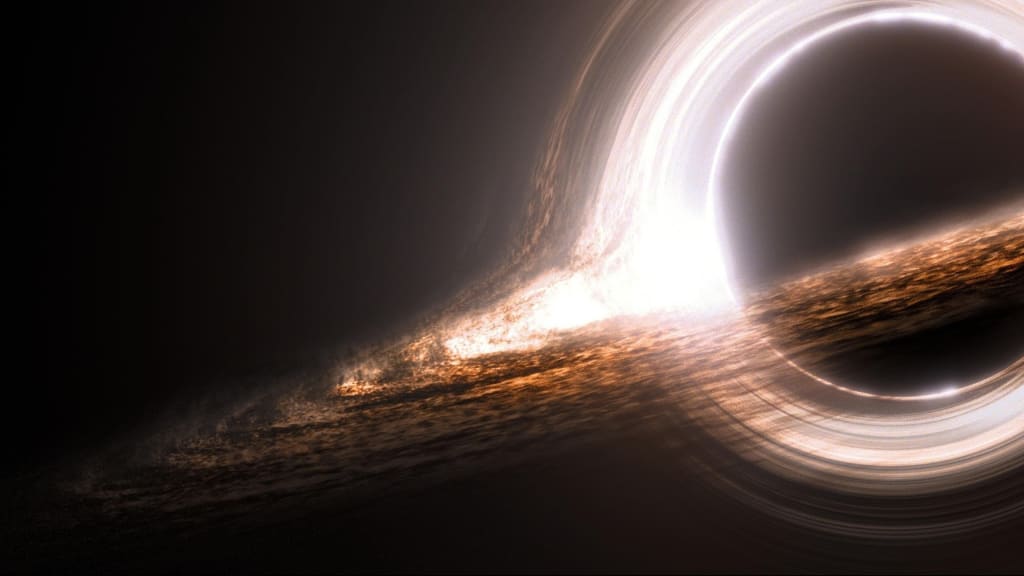
Are you ready to push the limits of physics and explore the power of black holes?
These mysterious entities have the ability to destroy everything in their path, but can they be destroyed themselves? Let's find out! In the imaginary Lab, we've created a tiny black hole with the mass of our moon. But we're not stopping there. To really test its limits, we're going to nuke it. That's right, we're going to explode the world's entire nuclear arsenal around our black hole and see what happens. As expected, the black hole swallows everything that crosses its event horizon, including matter and energy. And since E=mc2, all the energy that enters the black hole increases its mass.
So, as we nuke our tiny black hole, it just gets bigger and more massive! But what if we throw a moon's mass of antimatter at it? Unfortunately, the black hole doesn't care whether the object is made of matter or antimatter. It completely deletes its past identity and only cares about the total mass-energy of the object. So, throwing an anti-moon has the same effect as throwing a moon – the black hole just gets more massive! This "deleting ability" of black holes is fascinating. Despite their size and power, they're similar to elementary particles in that they don't care about the identity of the objects they consume. So, can black holes be destroyed? It seems that even pushing physics to its absolute limits may not be enough to destroy these incredible entities. Imagine the mind-boggling simplicity of elementary particles like electrons. Astonishingly, black holes share this trait. With just three numbers, their mass, spin, and charge, they are fully defined. Whether from a star or a banana, nothing else matters. But could an anti-black hole annihilate it?
Now, imagine a black hole and its anti black hole counterpart. They should have the same mass but opposite electric charge. What if we make them collide? Unfortunately, the charges will just cancel out, leaving us with a new black hole twice as massive but with no charge. But wait, there's more! Let's push the boundaries of physics even further. Did you know that if a black hole's spin or charge becomes too large, the event horizon, that mysterious boundary, will dissolve? It's like the black hole is hiding an infinitely compressed mass with gravity so strong that nothing can escape. Mind-blowing, right?
not even light.
A black hole is the ultimate prison, with an event horizon that traps anything that crosses it. But what if we could break free from this cosmic jail? When a black hole rotates, it creates a repelling effect that could potentially break down the event horizon. The same goes for electric charge - if it's too large, the ironclad jail will break open. Destroying the event horizon would allow us to get as close as we want to the singularity and come back. The key is overfeeding the black hole with objects that increase its charge or spin faster than its mass. While this is a subject of debate among physicists, it's a tantalizing possibility.
Equal charges repel each other with an undeniable force. The more of these charges we gather together, the more forcefully they push back. Now, imagine a negatively charged black hole. Our goal is to feed it an abundance of electrons, whose charge far outweighs their mass. As we introduce more electrons, the black hole's negative charge intensifies, resulting in a stronger repulsion. However, there is a limit to this phenomenon. Once we reach that threshold, the electrostatic repulsion becomes so overpowering that no additional electrons can enter. The black hole adamantly refuses to be overfed. Nevertheless, a group of scientists has stumbled upon a potential solution. By strategically introducing matter at the precise moment before the black hole reaches its limit, we may be able to surpass its capacity. While many scientists remain skeptical, let us embark on this experiment and see what unfolds!
Breaking Physics
There is a catch though. The event horizon of a black hole hides the singularity. So destroying the horizon would leave us with a **“naked singularity”**, one that is not hidden by an event horizon. And this poses a problem: it could mean the **end of physics as we know it**. There is a big dirty secret about black holes.
future events based on past observations. So if we were to encounter a naked singularity, we would be faced with a complete breakdown of our understanding of the laws of physics. It would be a truly mind-boggling and incomprehensible phenomenon. In conclusion, while the singularity of a black hole is not located at its center, but rather in the future of anything that crosses its event horizon, the concept of a naked singularity presents even greater challenges and uncertainties. The nature and implications of a naked singularity remain a mystery, as it defies our current understanding of the laws of physics and the fabric of spacetime.
Imagine a world where "where" and "when" lose all meaning. A realm of unpredictability and infinite gravity, brimming with boundless energy. From this enigmatic source, anything could emerge without reason or rhyme. Picture a pile of bananas materializing out of thin air, or perhaps a lost sock or even an entire solar system. The laws of predictability, causality, and physics as we know them would crumble before our eyes. Yet, amidst this chaos, scientists believe that nature forbids the creation of naked singularities. These mysterious entities are enveloped by event horizons, shielding the universe from their insanity. Black holes, once feared as monstrous, may actually be the unsung heroes preserving the sanity of our universe. But beware, for tampering with these event horizons could unravel the very fabric of our existence.
You know what?
Let’s not do that.
The Safe Option
As far as we know, there’s just one safe method to destroy a black hole: Wait.
Black holes emit Hawking radiation, causing them to gradually lose mass and eventually vanish without leaving behind a horizon or naked singularity. The time it takes for a black hole to completely evaporate depends on its mass. In the case of our mini black hole, the size of a speck of dust, it will take approximately 10^44 years, which is 10 billion trillion trillion times the current age of the universe. So, destroying a black hole is indeed possible, but it requires patience. However, there is no need to wait that long, as there are countless captivating wonders to explore right here on our planet, right now.
About the Creator
Reader insights
Outstanding
Excellent work. Looking forward to reading more!
Top insights
Easy to read and follow
Well-structured & engaging content
Eye opening
Niche topic & fresh perspectives
Masterful proofreading
Zero grammar & spelling mistakes
On-point and relevant
Writing reflected the title & theme


Comments (2)
Marshal D Teach
Great story! ❤️