
🛡️Legend of Holger Danske: The Sleeping Hero of Denmark
🏰A Legendary Watcher in the Shadows of Elsinore

🏰 Origins in Song and Saga – From French Epics to Nordic Legends
Holger Danske, also known as Ogier the Dane, is a legendary Danish hero whose tale stretches across the patchwork of European myth, medieval literature, and national pride. While his legacy is firmly embedded in Danish folklore, his origins are surprisingly French. The first known mention of Holger appears in the 11th-century French epic poem "La Chanson de Roland," where he is called Ogier de Danemarche. In this early form, he is portrayed as a vassal of Charlemagne, the great Frankish emperor.

In the French chansons de geste (heroic songs), Ogier is a noble knight of great strength and character who rises in fame and honor after conflicts with Charlemagne. These tales depict his exile, military feats, and eventual reconciliation with the emperor. Over time, Ogier’s image was adapted and absorbed by Danish culture. Danish writers and storytellers reimagined Ogier not just as a knight from Denmark but as a symbol of Danish identity and patriotic spirit.
By the time the legend matured in Danish hands during the late Middle Ages and Renaissance, Holger Danske was no longer just a knight in Charlemagne’s court. He became a national symbol—an embodiment of Denmark’s enduring strength, destined to return in the country’s hour of greatest need.

🛏️ The Sleeping Defender – The Legend Beneath Kronborg Castle
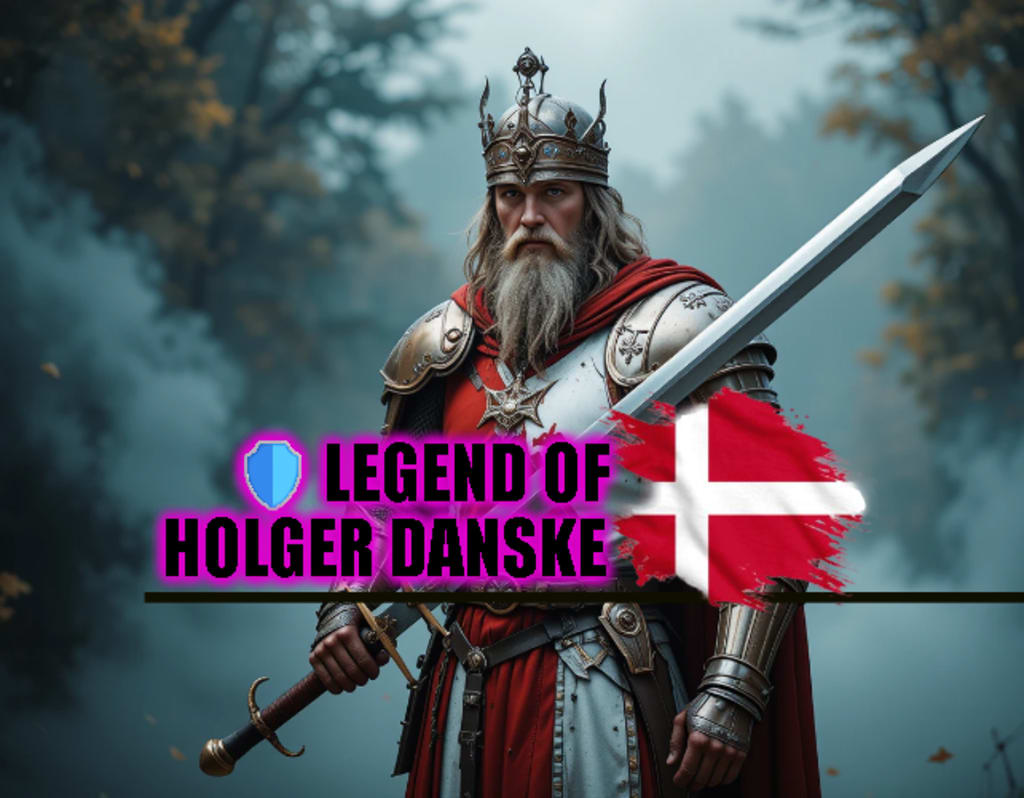
The most famous and enduring version of the Holger Danske legend centers around his enchanted sleep beneath Kronborg Castle in Helsingør, a fortress made even more famous by Shakespeare’s Hamlet. According to Danish folklore, Holger Danske lies in a deep slumber in the dungeons beneath the castle. Clad in armor, with a sword across his lap and a beard that has grown long enough to reach the stone table at which he rests, he waits.
🇩🇰 The legend says Holger will not rise for minor threats or small national trials. Instead, he will awaken only when Denmark faces its most desperate crisis, a time when no earthly force can save the nation. At that moment, Holger will rise, pick up his sword, and lead the Danish people to victory.
This motif of a sleeping hero—often referred to as the "king in the mountain" archetype—can be found across European folklore, from King Arthur in Britain to Barbarossa in Germany. But in Denmark, Holger Danske holds a unique place in the national psyche. The imagery of a slumbering protector offers comfort and inspires resilience, especially during periods of invasion, war, or national anxiety.
Kronborg Castle itself contributes to the legend’s power. The ancient halls and subterranean tunnels are said to house the hero’s stony resting place. A statue of Holger Danske, carved by sculptor Hans Peder Pedersen-Dan in 1907, was placed in the castle to visually represent the myth. The statue's imposing presence, massive sword, and solemn expression have captivated visitors and deepened the myth for generations.

⚔️ Symbol of Resistance – Holger Danske in World War II
Holger Danske’s image as Denmark’s eternal defender took on profound new meaning during World War II, when the country was occupied by Nazi Germany from 1940 to 1945. In this time of darkness, Danish resistance fighters chose the name "Holger Danske" for one of their most famous underground resistance groups.
🕵️♂️ Formed in 1943 by a group of brave patriots, the Holger Danske resistance unit grew rapidly in size and effectiveness. They carried out sabotage missions, assassinated collaborators, and provided intelligence to the Allies. The name was no coincidence—it invoked the spirit of the legendary hero, reminding Danes that their protector, though mythical, lived in their hearts and actions.
The resistance group Holger Danske operated primarily in Copenhagen and played a key role in the Danish underground movement. It is estimated that they carried out over 100 assassinations of informants and Nazi collaborators and were involved in numerous acts of sabotage, including the destruction of German military equipment and factories.
Holger Danske became more than a legend during the occupation. He became a symbol of defiance, courage, and national identity—a quiet but thunderous reminder that Denmark was not broken, merely waiting to rise.
Holger Danske continues to inspire Danish identity to this day. The original statue carved by Hans Peder Pedersen-Dan was moved from Kronborg Castle to Hotel Marienlyst in Helsingør, where it is housed in a dedicated chamber and viewed by thousands of tourists annually. This statue remains one of Denmark’s most recognized cultural symbols.
📚 Holger Danske also lives on in literature, film, and popular media. Danish authors have reimagined his story in books and plays, while children's versions of the tale ensure that new generations grow up with the image of the silent protector beneath the castle. During national holidays or crises, Holger Danske is sometimes referenced by political leaders or invoked in national speeches.
🇩🇰 He is not just a relic of the past, but a living symbol—one that reflects the values of bravery, duty, and the eternal hope that, when needed most, heroes will rise.
Even today, visitors to Kronborg Castle often gaze at the darkened stone corridors and whisper, half in jest, half in hope: “Is Holger Danske still sleeping down there?”
Holger Danske belongs to a larger tradition in European mythology known as the sleeping hero or king in the mountain motif. Across the continent, tales tell of ancient kings, warriors, or saints who did not die, but instead lie dormant in sacred places, waiting for a time of great need.
🗻 In Germany, the Holy Roman Emperor Frederick Barbarossa is said to sleep in the Kyffhäuser mountain, his red beard grown through the stone table. In Britain, King Arthur is believed to rest on the Isle of Avalon, waiting to reclaim the throne in Britain’s darkest hour. In the Balkans, Marko Kraljević is a similar figure, a national hero waiting to rise.
What makes Holger Danske unique is how strongly his legend has been woven into national consciousness—not just as folklore, but as a moral compass and a call to courage. His evolution from a French epic character to a Danish national icon is also remarkable, showcasing how legends cross borders and become adopted as symbols of identity.

This cultural malleability and relevance make Holger Danske one of the most intriguing figures in Scandinavian myth. He is proof that legends, no matter their origins, can shape nations and live on far beyond their medieval roots.
🇩🇰 From medieval chansons to World War II resistance fighters, Holger Danske’s story remains one of Denmark’s most powerful legends. He is the sleeping guardian, the eternal warrior, and the soul of a nation—silent, still, but always ready to rise when Denmark needs him most. 🛡️⚔️
About the Creator
Kek Viktor
I like the metal music I like the good food and the history...
Keep reading
More stories from Kek Viktor and writers in Fiction and other communities.
🧙♂️ The Legend of the Draugr: Norway’s Undead Mariners of the North
🌊 The Roots of the Draugr Legend — Where Sea and Death Collide In the ancient Norse worldview, few forces were as terrifying and mysterious as the sea. Cold, vast, and unforgiving, the ocean was not only a means of travel and trade—but also a realm of death. Norwegian sailors and coastal villagers told tales of the Draugr (plural: Draugar), a revenant of the sea. Unlike typical ghosts, Draugar were physical beings—corpse-like, bloated, with pale or blue-tinged skin—and they were known to haunt grave mounds and coastal waters.
By Kek Viktor7 months ago in Fiction



Comments
There are no comments for this story
Be the first to respond and start the conversation.