

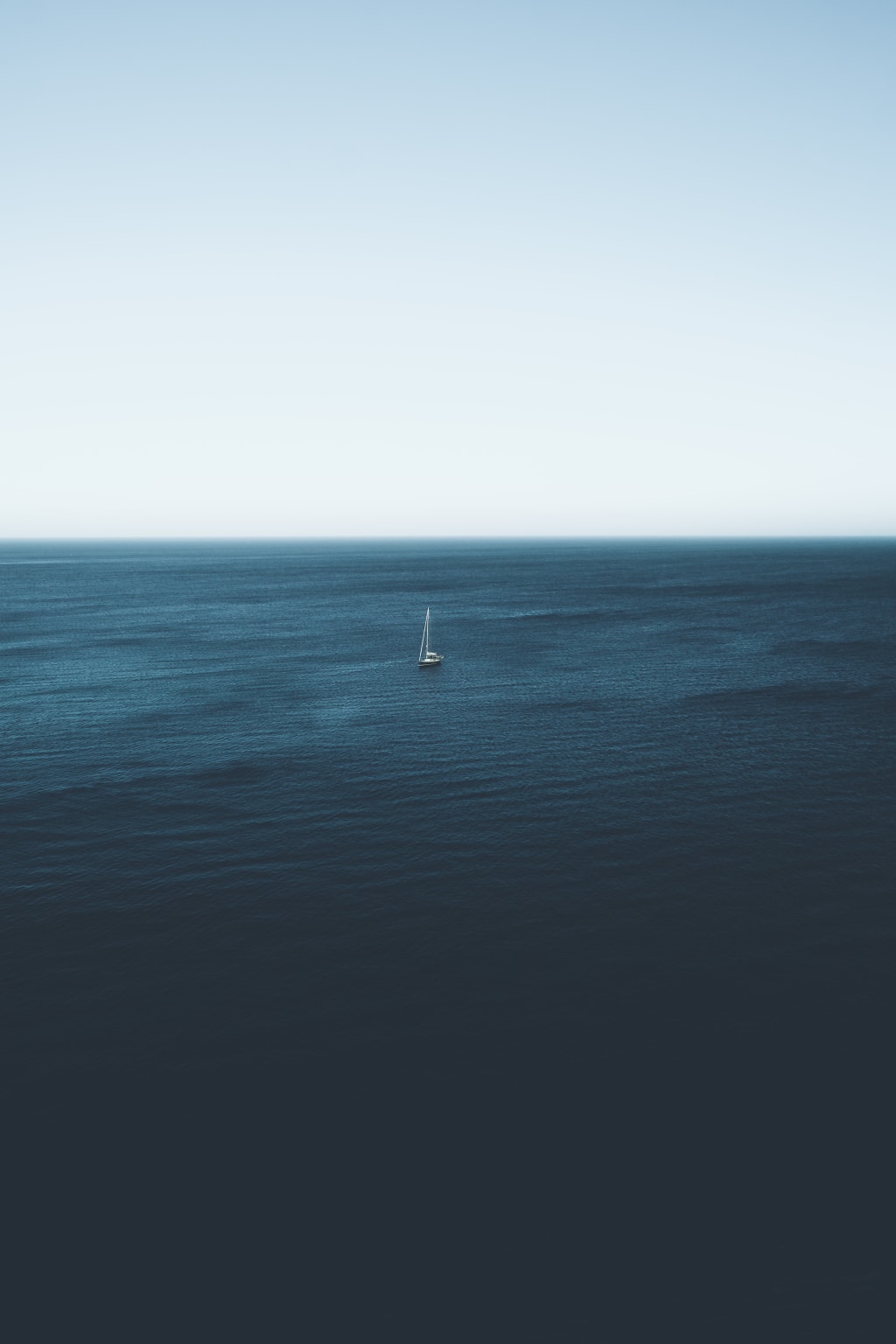
When Diana slit open the belly of the anemic-looking cod Ned had hauled aboard the Landless that morning and caught a sunlit gleam of gold among the refuse that spilled into the bucket she wasn’t surprised. The catholic tastes of these fish coupled with the great floating islands of garbage that now boasted more surface area than the remaining land meant that she found all manner of strange objects tied up in the innards of these fishes.
Mostly, it was nonsense—trash to be returned to the sea, although it gave Diana a pang to think that the plastic bags, broken bottles, rusty tins, or swathes of half-disintegrated fabric could show up in another fish on another day. She had found treasures, though, and mysterious objects. These she rinsed of fish slime and delivered to Ned as he manned a series of self-made poles and nets or carefully adjusted their heading as if it mattered where they went other than “not too close” or “not to beyond.”
She occasionally had to wait several minutes for Ned’s watery blue gaze to leave the horizon and focus on the solidity of an object in her hand. Over the years she had held out as offering no less than five rings and brooches, a wrench, a screwdriver, a half-digested newspaper that she had read greedily before making the trek across the boar, a small porcelain vase, a sheaf of official-looking documents in a language she didn’t know but liked to imagine was Portuguese, and a still-corked bottle of wine that had lost its label.
In each case, Diana held the reminder of a landed world up for Ned’s inspection, waiting for his pronounced verdict to “trade it.” Only once had he changed the script and told her to “keep it”—the bottle of wine that they had knifed the cork out of and passed back and forth on the deck of the Landless that night. The unexpected smell of the leaves and the dirt of the vineyard burst forth from the bottle and the sea was calm enough that, for just a moment here or there, Diana could feel the earth solid beneath her feet, a return to her last days as landed. Those brief moments of solidity were forgotten the next morning, though, as Diana nursed a headache and nausea that brought back those first horrid, vomity months at sea.
The rest of her finds they hoarded in a small, waterproof box in their stuffy quarters down below, waiting for one of those all-too-rare crossings with another boat that looked small enough and shabby enough to be harmless. Tied up together, the two- or three- or five-person crews of the sailboats would line up their treasures on deck and, with gritty voices, invite the others to survey their offerings.
Diana and Ned tried to hold out for the ships that were organized enough or brave enough or stupid enough to occasionally venture to smaller ports on the abbreviated shores. These operations took their salt-packed fish and seaweed braids and buckets of oysters to the small markets that marked these villages hanging on the edges of the earth, trying to stave off the capital, and returned to sea with rope and sailcloth and tinned goods and news that the sea-bound boats like the Landless limped along for. Diana and Ned had chanced the coastline only once, and they had lost so much that they had never returned, instead eating sunned fish and salty seaweed soup and drinking desalinated water while looking out to the endless horizon for signs of storms or distant mountaintops.
Expecting another worthless piece of tin that probably would have killed the fish anyway, Diana reached into the slippery depths of the fish guts to feel her fingers catch around the edges of something hard, metallic, and better-formed than any piece of trash. When she extracted her hand and opened it, she found a small, heart-shaped disk attached to a loop of chain that, underneath the layer of bloody slime, was remarkably intact.
Scrubbing the pendant furtively on the hem of her frayed tunic, Diana glanced around the boat to make sure that Ned was still occupied with his lines at the opposite gunwale. After nineteen years at sea, nearly a dozen of those just the two of them, Diana still felt guilty over these small, stolen moments of privacy. When Jonathan was still with them and mourned the loss of solid ground that accompanied the rapidly rising tides, could still remember the retreat to the boat stolen in the night from someone more trusting than would have been able to survive the waters anyway, Diana would share these moments with him. The small reminders of a former world of sandy shores and trees and saltless air calmed the boy and let them live on another month or two in peace.
Pushing down the memories of huddling with Jonathan at the edge of the transom to investigate her finds or to flip through the salt-rubbed photographs of their small, suburban home carved out of the farmlands of eastern North Carolina, Diana slid a dirty fingernail into the seam running the rim of the locket, prying it open.
The photographs that she had thrown into her rucksack at the last minute, grabbing a haphazard stack of them as they raced for the Landless to outrun the inrushing waters hadn’t lasted long through the sun and the salt and the obsessive flipping, even as they did their best to preserve them in the waterproof box with their finds and their treasures. The reminder of land was too strong to keep locked away. By the time the glossy images had faded and cracked, pieces sloughing off under their parched fingers, Jonathan had made his decision, demanding to be dropped off at the shore, desperate to join the New Cartographers and gain access to those small pockets of remaining land. When they dropped the boy (he still felt like a boy) off in the rocky bay in those dark hours before dawn and pushed off back to sea, Diana felt acutely the twin loss of his presence and his image in the photos. Ned must have grieved as well, but the depth of the hole in her stomach left little room for her to shoulder his burden. Silence stretched across the deck for days at a time.
So Diana didn’t expect whatever was in the locket to have survived. But there, carefully cut and placed in the confines of the metal brackets, was an image no bigger than her thumbnail of a dark-haired child surrounded by the green and brown and filtered golden light of a forest. Diana felt the Landless shift under her and looked up, searching for sudden troubled water, but the sea remained calm and glassy. She returned to the picture. The image was a little ocean-blurred at the edges, but then so was she. She couldn’t tell if the figure was a boy or a girl—they were young enough, and with one of those done-at-home haircuts that she herself now had that gave no clue—and she spared no more than a glance at the child’s face. Again and again her eyes circled the perimeter of the image, encased as it was in gold. The trees closed in around the figure, a green cocoon both safe and claustrophobic, so far removed from the endless expanse of sea and sky around her that she felt herself falling into the mossy woods of the image. Tears threatened her eyes and she wiped at them viciously, unwilling to allow more salt water to invade the deep loamy scent just at the edge of her memory.
“Done with that fish yet?” Ned called from the far side of the boat and the other side of the world, jolting Diana from the cool and leafy shade back to the sunbaked and salt washed deck, the dryness of her throat and the leather of her skin momentarily shocking her. She tried to plunge back into the edges of the image, feeling the rough bark of trees cool beneath her fingers, but the glare of the midday sun ran red through her eyelids.
She quickly pried the photo from its case and held it tightly in her hand before making her way across the small expanse of the deck.
“Found this,” she said, holding up the locket by the chain as she sidled up next to Ned.
“Anything in there?” Ned asked gruffly as he gestured to the necklace, voice hoarse from disuse.
“No. Water must have got to it. Just the locket.” She spoke steadily, looking out over the ocean and feeling Ned’s human heat next to her.
“Trade it.”
She nodded once and went to put the locket in the box under their pallet.
Once she had reached the other side of the helm, she unfurled her fingers and considered the scrap of paper in her palm. She took the heart-shaped sliver and carefully placed it on her tongue, searching for the taste of earth and leaves and fresh water.
About the Creator
Keep reading
More stories from Sarah George-Waterfield and writers in Fiction and other communities.
One Unchecked Box
"Republished" because it was the only way to add the embed for the newly recorded audio version of this story due to the Top Story badge. Plus it serves as a nice, informal announcement of the podcast's revival for another season (go subscribe!):
By Stephen A. Roddewigabout 3 hours ago in Fiction


Comments
There are no comments for this story
Be the first to respond and start the conversation.