

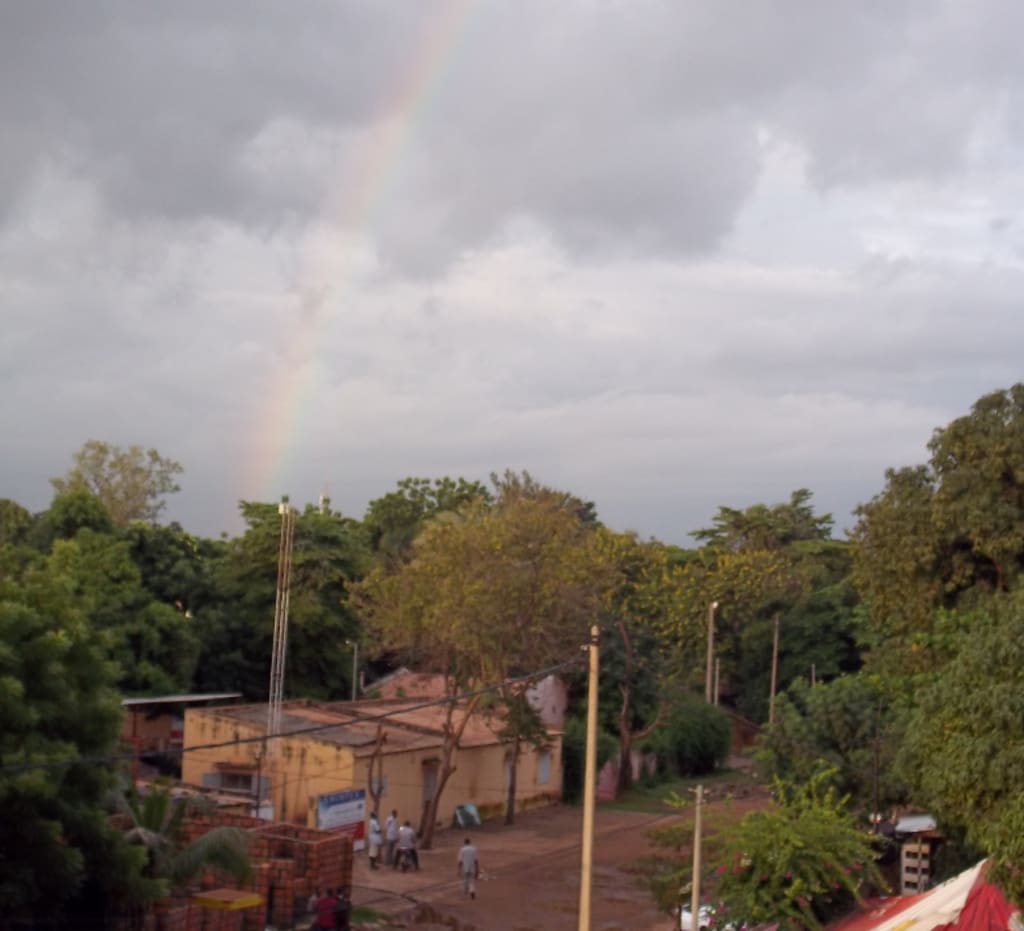
“Maintenant, je pense que Umu reste heureuse,” my homologue, Moro, whispered one evening as I leant back from the fire to look up at the stars before the rising moon.
A dusty mist coats the cliffs in the distance and the early morning train clatters at my side as I lope through sandy trails and much-used cow paths. Between dodging spiny bushes and trying to follow the track in the pre-dawn gloam, it is several minutes before I realize that the sun has risen just enough to cast a pinkish tinge to the white dust around me, slowly solidifying the trees and scorched patches of earth first into hazy imaginings of their selves, filled with an ancient and alien spirit of observance, before creating a simple scene of dusty roads, scrappy trees, and even scrappier cows. Just enough of the palimpsest of purple breath is left hanging over the village by the time I return that a cup of coffee and contemplation over the fence bears up sights of hazy goats trooping through the streets on secretive missions. And rare, hushed individuals materialize from one house to disappear around a corner with whispered “good mornings” sent out across the palpable sense of space.
And then it’s time to start hauling water.
The new year brought a new Peace Corps site in a village at the edges of Mali, a terrifying and incredible prospect. Moving back out to village life, creating new friendships, learning a new language, maybe actually doing something that resembles work, finding a new routine. Sometimes, though, it’s the role of such a complete and jarring change to not only give you a new future, but also to make you realize just how much you were missing in the past.
The process of settling into the tiny town of Manabougou Coura has been one that I’ve thrown myself into fully (out of necessity perhaps, but still), becoming, in the process, completely enraptured with the people and possibilities, as well as discovering my own set of goals and expectations, which I had somehow been lacking before without realizing it. A motivated, gregarious, ridiculous, marvelous set of people live in this strange strip of land anomalously placed out in the middle of Mali. Scratching through the earth to coax fields of peanuts from the reluctant soil, the farmers are now turning their hopes to community gardens, village associations, and the common good of their small town.
As for myself, I spent three hours washing clothes yesterday, and it’s the first time my fingernails have been clean in two weeks. I spend, quite blissfully, all of my time playing around in the dirt. First order of business on coming to village was to build a personal garden attached to my concession, surrounded by woven bamboo sticks and beneath the shade of the neem tree. What this means, then, is that I can spend any moment of my day that is not caught up with morning runs, chatting with my language tutor’s family, dancing for the strange woman who starts clapping any time she sees me from across village, sitting with the dugutigi, actually having language lessons, staring blankly at the lisping children who are trying to get me understand their cryptic messages, or sitting around the fire at night with my homologue, I can be fully immersed in garden related tasks. I have spent hours collecting manure, sifting dirt, building sunken beds, starting a pepiniere (made out of tiny paper sacks that I constructed out of previously read Newsweeks, The Nations, and the American Prospects — I’d like to think they would approve of their subsequent use), trying to break through the earth to create a meter-deep compost pit, planting spinach, lettuce, cabbage, tomato, eggplant, cucumbers, beets, radishes, pumpkins, green peppers, and celery. And that’s just the start of the seeds.
The uptake of this operation, however, is that quite a bit of my life revolves around hauling water from the pump (exactly 230 steps from the gate of my concession, if you’re wondering) to be able to get at any of the dirt. Not that I really mind, because not only do I walk through village to get to the pump, but it also serves as a gathering place for the women as they go about their busy daily lives, giving me a chance to chat casually, waiting for a chance to fill my watering can and watching the goings-on of a mishmash of old women, new mothers, teenage girls, all equipped with their buckets, wheelbarrows, piles of laundry, and bright smiles of conversation. For the two minutes that I’m also waiting for water, I’m a quiet participant in this space, with these people.
Returning back to the garden with load one (or eight) of water, I generally find a few stray children peering in around the gate or chasing chickens out of it. I can settle back into work with my big-eyed, silent observers, who occasionally hand me something before quietly wandering away. I can then go back to singing Sinatra to my onions while I sift through yet another mound of dirt — the sifter I bought at market this week is possibly the most exciting purchase I’ve made in a month. This either means that I need a life or…well, I suppose that’s all it could mean.
The garden brings a whole host of curious villagers to my house. Or at least gives them an excuse to come and gawk at whatever strange thing I happen to be doing. Peering over the fence and cooing questions at me, the women ask for seeds and various vegetables when they grow and the men berate me for not planting okra. I’m getting there, but I won’t give them that satisfaction just yet.
Despite appearances, the garden is not simply a pet project of mine. The first priority of the village is to build a community garden for the Women’s Association. Several spirited meetings into my stint here, we determined that fencing needed to be built and the pump repaired to give the women a chance to grow vegetables during the winter season to make up for the terrible, terrible harvests of last fall and allow her to feed her family. And now? The pump is fixed and flowing, the gele trees are piled up to be used as fence posts, with more coming in by bicycle from the brush each day, and the fencing is waiting patiently to be attached. When, water running from the pump for the first time in over a year, I felt a barrage of hasty, strong hugs from about thirty-five women in turn. With them grinning and taking turns pumping from the resuscitated source, I removed myself from the pack and thought about potential, transformations, fresh starts. There’s something satisfying in knowing that I am not alone in starting anew in the village. Because that’s what these gardens are about as well, growth and change and perseverance in the midst of the dust. An ideal of hope.
About the Creator
Keep reading
More stories from Sarah George-Waterfield and writers in Humans and other communities.
Pattern Placement
Growing up in the 1960s and 70s as a six-foot-tall woman (although she’ll swear up and down she’s 5′ 11″), off-the-rack bell bottoms, shift dresses, and pussy-bow blouses were never going to be quite right for my mother. In addition to the requisite Home Economics courses she had to take throughout school, my mother also sewed out of necessity. She stayed up overnight to finish a Simplicity dress for a date that required exactly the right shade of aquamarine blue and a little extra swing in the fabric.
By Sarah George-Waterfield5 years ago in Families
Whiskey At Dusk
Guess the whiskey was more important to you in the end, wasn’t it? It was more than the well-being of your friends; more vital than showing up to the places you promised you would and could come to; more critical of a matter than fulfilling your damn responsibilities and getting the press off your back.
By Snarky Lisa3 days ago in Humans



Comments
There are no comments for this story
Be the first to respond and start the conversation.