
Kindness Tastes Like Lemon Tea
Sometimes the warmest places aren't lit by sunlight, but by someone who sees you.

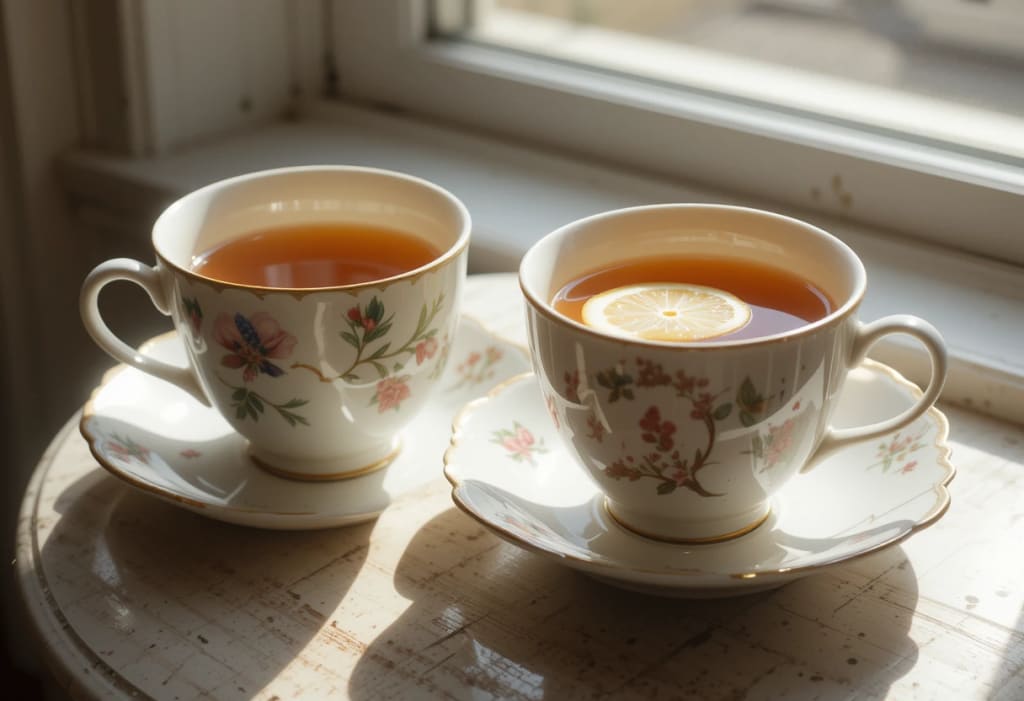
I never liked tea.
Not the bitter green kind, not the herbal kind my mom kept insisting would help me “balance out,” and definitely not the flowery ones that tasted like wilted garden petals. But I drank it anyway—every day at 4:15—for nearly four months, sitting at a round table by a window in Mrs. Calloway’s faded yellow kitchen.
That’s how long I spent learning how kindness tastes.
It started on a Tuesday.
I had skipped school. Again. My stomach was tight with guilt and anger and everything else I didn’t know how to name. I didn’t want to go home either. I had failed a math test the day before, and my dad had barely looked at me when I showed him. He just said, “Figures,” under his breath and went back to scrolling on his phone.
So I wandered.
I ended up on the far side of the neighborhood—the part with the old houses that smelled like pipe smoke and creaky memories. It was quieter there. It felt like the world forgot about that side of the street.
So did I. Until I heard the creak of a screen door and a voice call out, “You look like you need something warm.”
I turned, startled.
Mrs. Calloway stood there in a blue cardigan with sunflower buttons, white hair frizzed around her face like a soft halo. I didn’t know her. I had only ever seen her hunched over her front garden, trimming roses like they whispered secrets to her.
“I’m okay,” I said quickly.
She smiled like she knew I was lying. “Well, I’m not. I’m lonely. So let’s both be not-okay together.”
And before I could really think about it, I nodded.
Her kitchen smelled like citrus and cinnamon. There was a cat I never saw but always heard—rustling behind cupboard doors or thudding up the stairs like it wore boots. She poured tea into two mismatched cups. Mine had a chip on the handle. The saucer was from a completely different set. She placed a lemon wedge on the rim and slid the cup toward me.
“I call this ‘sunshine for the tired,’” she said. “Lemon, honey, and a little bit of ginger if I’m feeling bold.”
I sipped. It was sharp at first. But then warm. Soft. It unknotted something in me.
We didn’t talk much that day.
But I came back.
At first, I told myself I was just being polite. Then I told myself I was bored. Then I stopped making excuses.
She never pried. That was the thing. She didn’t ask why I wasn’t in school or what I was running from. Instead, she told stories.
About her husband, who passed away seven winters ago but still visited in dreams. About the first time she left Ohio and saw the ocean, cried into a stranger’s shoulder, and never looked back. About the joy of mismatched things—cups, people, memories.
“You don’t always need symmetry to be whole,” she said once.
Sometimes, I shared things too. Not big things. Not yet.
Just small ones. That I hated math. That my mom worked double shifts. That I didn’t feel like I belonged anywhere. That my chest sometimes felt like it was closing from the inside.
She never gasped. Never pitied. She nodded, poured more tea, and told me how hard it was to be a person sometimes.
“Kindness isn’t always about fixing people,” she said. “It’s about sitting with them long enough they stop thinking they’re broken.”
It was on the thirty-ninth cup of tea—yes, I counted—that I cried.
Ugly cried. Nose-running, throat-tight crying.
I had gotten into a fight with my dad. Told him I was tired of trying. That it didn’t matter what I did, I’d never be enough. He had just said, “Maybe stop being so dramatic.”
So I left. Ran. Ended up in Mrs. Calloway’s kitchen again, holding a cup too hot for my trembling hands.
She didn’t ask what happened. She passed me a napkin. She let me sob.
Then she did something strange.
She poured herself another cup of tea.
And started crying too.
“I miss my daughter,” she said. “She stopped calling after the funeral. Said I was too much. I keep wondering if I was.”
We both sat there, spilling.
Not because one of us was broken—but because we finally had space to be honest.
After that, everything felt different.
I started going to school again—not because I magically loved it, but because I wanted to tell Mrs. Calloway about it. She’d smile when I walked in and say, “Ah, here comes my lemon-sipping accomplice.”
We even gave our tea a name: Courage Brew.
Because, she said, “You don’t drink it to feel better. You drink it to feel through.”
The last day I saw her, it was spring.
The garden had begun to bloom again. The cat (yes, she finally let me see it) sat purring on my lap. The tea was slightly sweeter than usual.
She told me, “I think you’re going to be okay.”
I smiled. “Because of the tea?”
“No,” she said, placing her hand gently over mine. “Because you stayed. And because now, you know how to offer a cup to someone else.”
She passed two weeks later.
Peacefully, the neighbor said. In her chair, with a book open in her lap and the cup still warm beside her.
There was no funeral, just a quiet notice in the paper and a garden full of flowers that kept blooming, like they knew she was still watching.
Now, I make lemon tea every week. Same time.
Sometimes alone. Sometimes with someone who looks like they need something warm.
I use two mismatched cups. Always. One chipped.
Because kindness doesn’t need to match.
It just needs to sit with you.
Long enough to taste like home.
About the Creator
Keep reading
More stories from waseem khan and writers in Fiction and other communities.
Sometimes It's Like That and That'sThe Way It Is
It was the late 1960s, and ten-year-old Gloria Coleman was standing with her grandmother on the side of the highway waiting for the bus. As the Greyhound pulled up, it seemed monstrous and intimidating. Grandma Elizabeth grabbed Gloria's hand, holding it tightly as they boarded.
By Cheryl E Preston2 days ago in Fiction
The Leaving Door
Mara noticed it before she noticed the quiet. The driver set her suitcase beside the gate, nodded once toward the house, and returned to the road without looking back. Not at the porch. Not at the windows. Not at Mara standing there with one hand on the latch and the other wrapped around the strap of her bag.
By Flower InBloom6 days ago in Fiction
My First Time Skiing and I Got Lost, Alone, in the French Alps
Looking back, I can trace some of my life’s biggest adventures to a simple action from my sister. She’d introduced me to Tommy (a very long time ago), a colleague of hers, who had overshared his penchant for Italian-looking women, and I ticked that box.
By Chantal Christie Weiss3 days ago in Humans




Comments
There are no comments for this story
Be the first to respond and start the conversation.