
The Leaving Door
In the village where departures were done facing forward, everyone knew better than to turn around.

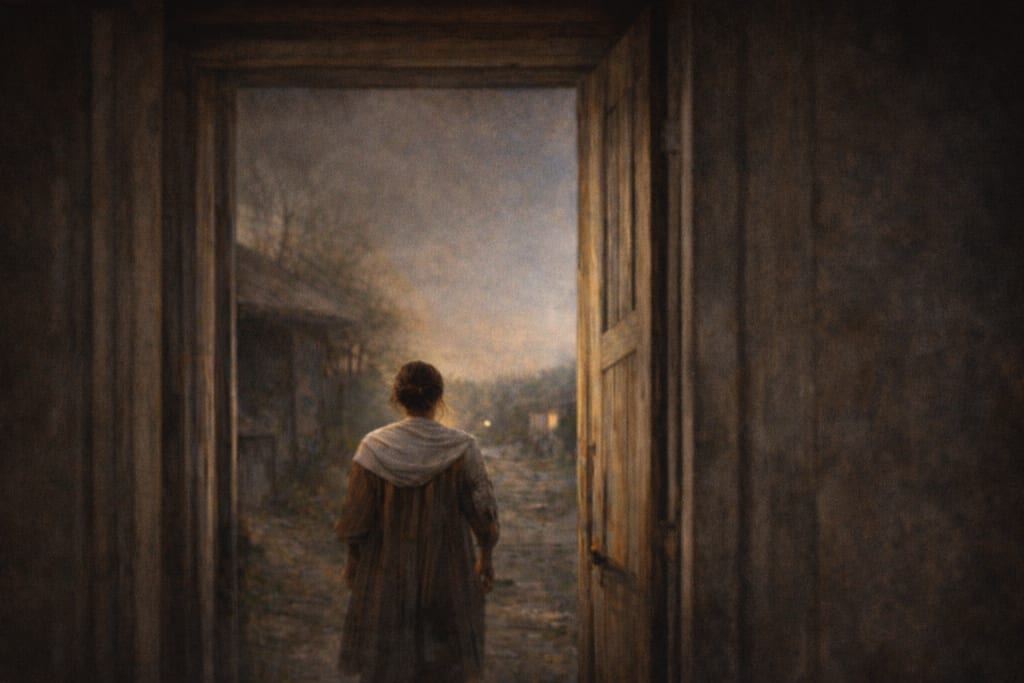
Mara noticed it before she noticed the quiet.
The driver set her suitcase beside the gate, nodded once toward the house, and returned to the road without looking back. Not at the porch. Not at the windows. Not at Mara standing there with one hand on the latch and the other wrapped around the strap of her bag.
He lifted two fingers in farewell while still facing the hill.
Then he walked on.
The house sat exactly as she remembered it: blue paint worn down to gray in places, porch railing smooth from years of hands, the brass knocker shaped like a sleeping fox. One upstairs curtain stirred, though the day held no wind.
Mara stood very still.
Ten years was enough time to forget the sound of the gate, the smell of rosemary by the path, the slant of light across the front steps. It was not enough time to forget the way the village moved around its thresholds.
Her hand went instinctively to her shoulder, to the place her mother’s fingers used to land when Mara was small and careless and forever twisting around at the wrong moment.
A touch. A pressure. Forward.
The front door opened before she knocked.
“A long trip,” said Aunt Elin, wiping her hands on her apron. She did not step onto the porch. She did not lean past the frame. She only opened the door wide enough for Mara to enter and moved back to let the crossing happen cleanly.
Mara went in.
The hallway smelled of boiled onions, lavender soap, and old wood warmed by the sun. Her aunt kissed her cheek, held it there for half a second too long, then looked toward the back room.
“He’s awake.”
That was all.
No one said you came in time. No one said he asked for you. No one said you should prepare yourself.
In the village, the largest things were handled with the fewest words.
Mara left her bag by the stairs and followed the shape of the house she still knew by heart. At the end of the narrow passage, the back room stood open to the garden. Her father lay in the bed they had moved there so he could look through the windows at the pear tree. His face had become all ridge and shadow, but his hands were still his hands, broad and weathered, the knuckles nicked white from years of mending fences.
When he saw her, he smiled as if she had only been gone a day.
“You took the north road,” he said.
“There was less mud.”
He nodded, pleased by the practical answer, and gestured for her to come closer.
She sat beside him. On the little table near the bed stood a cup of water, a dish of sliced apple gone brown at the edges, and the brass watch he had carried every day of her childhood. It was not ticking.
For a while they said ordinary things. How tall the weeds had grown near the shed. Which roof tiles needed replacing. Whether the neighbor’s black hen had survived the winter foxes. Aunt Elin brought broth and bread and set the tray down softly. She pressed Mara’s shoulder once as she left the room.
Forward.
That evening, as the shadows stretched long across the garden, Mara stood at the sink washing cups. From the window she could see the lane and the bakery across from the well. A little boy burst from the bakery door with a sugared bun in each hand, laughing at something behind him. He had one foot on the step and one in the air when his mother caught his wrist.
Not harshly.
Not loudly.
But with the speed of someone plucking a child from the edge of deep water.
The buns slipped from his fingers and landed in the dust.
His laughter disappeared.
The woman bent, gathered the buns, brushed them once on her skirt, and set them back in his hands. Then she turned him by the shoulders until he faced the lane. Only then did she let him walk.
The boy did not cry. He did not ask why. He only stared straight ahead as they went home, crumbs trembling at his lips.
Mara dried the last cup and set it on the shelf.
Aunt Elin, who had seen it too, closed the curtain without comment.
In the morning, the bell at the chapel rang once for old Mr. Tavin’s funeral.
The whole village passed his house before noon. Men in dark jackets. Women with pinned collars and sensible shoes. Children washed and solemn, hands tucked into sleeves. They entered by the front gate two by two. They came out one by one, each person stepping through the gate and into the lane with eyes fixed ahead, as if the road itself required complete attention.
No one lingered at the fence.
No one turned to offer comfort through the bars.
No one looked back at the widow standing in the doorway with both hands clasped in her apron.
Mara watched from her father’s window. She had watched the same thing as a child and called it manners because children always name the edge of mystery with the nearest simple word.
“Mara.”
Her father’s voice was thin now. She went to him and sat.
He looked toward the garden, where the pear tree leaves flashed silver-green in the light. “Your mother used to count to seven before she stepped from a room.”
Mara smiled despite herself. “She counted everything.”
“She liked to leave properly.”
The sentence settled between them.
Not instruction. Not warning. Just another fact laid gently on the table with all the others.
By afternoon his breathing had changed. Even Mara, who had been gone too long and wanted to believe in one more week, one more morning, could hear it. Aunt Elin moved about the house with unusual softness. Once, Mara found her folding and unfolding the same dish towel. No one came by. In the village, people knew when a house needed silence more than company.
Near sunset, her father opened his eyes and found hers.
“Tired,” he whispered.
“I know.”
He looked past her at the door.
The room had gone gold with evening. The garden beyond the windows was all light and drifting seed. Mara understood then with a terrible clarity that the look on his face was not dismissal and not impatience. It was care.
He was waiting for her to do what everyone here had always done.
To leave cleanly.
Her throat tightened. “I can stay.”
His hand moved an inch across the blanket, as if searching for hers and not quite finding it. “You came,” he said. “That is enough.”
She stood because she could not bear to. She bent and kissed his forehead, cool with the faint scent of lavender water. Then she walked to the door.
At the threshold she stopped.
Not long. Barely a breath.
Her palm rested against the frame worn smooth by years of passing in and out. She could feel the whole house in that wood. Her childhood fever nights. Her mother’s hands dusted with flour. Rain boots lined by the mat. The winter morning she left for the city with a suitcase too large and did not let herself cry until the hill swallowed the roof.
Behind her, the room was quiet except for her father’s breathing.
In the garden, a bird called once and fell silent.
Mara stepped through the doorway.
Aunt Elin was waiting in the passage, eyes red but dry. She did not touch Mara this time. She only moved aside to give her room.
One step.
Two.
Three.
Then, from the back room, her father spoke in a voice so clear it cut her in two.
“Little star.”
Her childhood name.
The one he had not used in years.
Mara stopped.
The whole house seemed to gather around that sound. The floor beneath her feet. The spoon on the kitchen table. The rosemary pressing at the window. Even the dust in the hall seemed to hold still.
Little star.
Every muscle in her body turned toward the room before she did. Her shoulder twisted. Her breath caught sharp against her ribs. She could see, in her mind, exactly what waited behind her: the bed, the gold light, the blanket pulled too high on his chest, his hand lifted from the coverlet as if to bless or beckon.
Aunt Elin made the smallest sound.
Not a word.
Just breath breaking.
Mara stared at the front door.
Her father did not call again.
Slowly, with all the force it took to remain one person and not split into daughter and child and grief itself, she lifted her hand to the wall and steadied herself. Then she walked on.
Past the kitchen.
Past the fox-shaped knocker.
Through the front door and down onto the porch where evening had gone cool and blue.
She crossed the path to the gate.
She opened it.
She stepped into the lane.
Only then did the first tear fall.
It ran hot over her mouth and into the corner of her jaw. More came after it, soundless and without hurry. Ahead of her the road bent gently downhill toward the well, the bakery, the chapel, the rest of the village keeping its old hard faith with all the things it did not say.
Behind her, the front door closed.
Mara stood in the lane with both hands empty.
Then she walked forward into the darkening evening, carrying the last thing her father had given her by refusing to ask for one thing more.
About the Creator
Flower InBloom
I write from lived truth, where healing meets awareness and spirituality stays grounded in real life. These words are an offering, not instruction — a mirror for those returning to themselves.
— Flower InBloom
Keep reading
More stories from Flower InBloom and writers in Fiction and other communities.
The Map of Remembering
The Road That Remembered Us A Mystical Adventure About the Journey Every Soul Is Walking No one remembers the moment the journey begins. Not really. We like to say it begins with birth. With the first breath. With the cry that tells the world we have arrived. But the old travelers say the journey begins much earlier. It begins the moment a soul agrees to forget.
By Flower InBloom3 days ago in Fiction
Kitten's Kitchen. Part 3. A dumpling masterclass with Chef Whiskers
Summer passed, and the first cool winds announced the coming of autumn. In the little cottage beneath the lilac bush, everything grew even cozier: the stove crackled in the evenings, bundles of dried herbs hung in the pantry, and jars of preserves stood neatly upon the shelves. Dear Grandmother more and more often allowed her furry pupils to work on their own, for she knew that true skill is strengthened through practice.
By Ludmila Pachadgi6 days ago in Fiction
Worth the Wait: Puerto Viejo, Costa Rica
Beach bumming in a small Caribbean beach town sounded like a perfect way to end our 6-month trip through Mexico and Central America. Or so we thought. The foul, fishy stench of rotten seaweed hit our nostrils as we stepped from the cramped bus and looked out at a rather depressing, empty, and underwhelming black sand beach. It was pouring with rain, and we had to quickly fish out our ponchos. We thought, this couldn’t be it, could it?
By Sh*t Happens - Lost Girl Travel4 days ago in Wander




Comments
There are no comments for this story
Be the first to respond and start the conversation.