
James” by Percival Everett: A Bold Reclamation of the American Canon
Revisiting Twain through the eyes of the enslaved, James is a novel of subversion, survival, and soul, masterfully told by one of America's most daring voices.

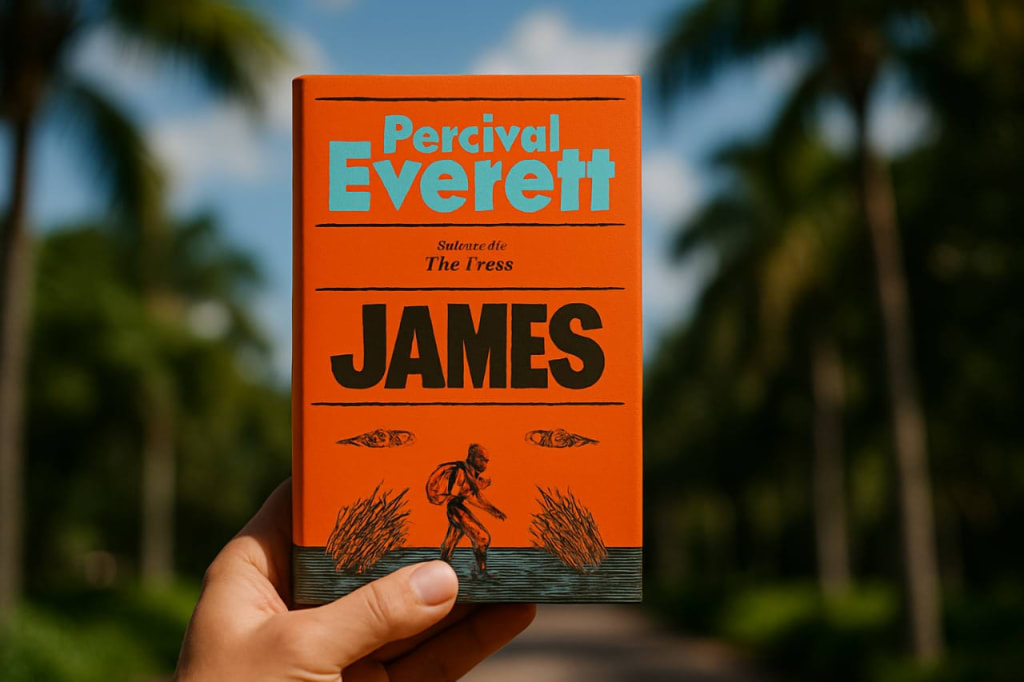
In James, Percival Everett does what few living authors dare—he takes a towering classic of American literature and flips it inside out. The result is nothing short of electrifying. A radical reimagining of Mark Twain’s Adventures of Huckleberry Finn, Everett centers the story not on Huck, the mischievous boy narrator, but on Jim, the enslaved man whose humanity Twain only hinted at.
Through Everett’s lens, James becomes a biting, brilliant, and often brutal critique of the very myths that underpin American identity. But more than that, it is a profoundly human novel—sharp in intellect, rich in emotion, and full of voice. It’s no wonder it won the 2024 Pulitzer Prize and was shortlisted for virtually every major literary award that year.
✊ A Story Reclaimed
Where Twain’s Huck Finn employed satire and dialect to expose the hypocrisies of antebellum America, James digs deeper, exploring the psychology of an enslaved man forced to perform ignorance in order to survive. In Twain’s version, Jim was a “good-natured” but flat caricature—a figure of moral clarity but limited voice. Everett reimagines him as intellectually brilliant, emotionally complex, and fully aware of the coded world in which he must live.
From the opening pages, readers discover that Jim—now James—is no fool. In fact, he’s a man of secret literacy, self-control, and scathing wit. The dialect he’s forced to speak in public is an act of survival. Privately, his thoughts are erudite and expansive. This duality—between who James is and who he must pretend to be—forms the core tension of the novel.
In Everett’s hands, James is a philosopher in chains, a man constantly calculating risk, gauging white ignorance, and navigating a society that depends on his dehumanization. And yet, despite this, he loves, he mourns, and—remarkably—he hopes.
🧠 Language as Weapon and Disguise
One of the most innovative aspects of James is its treatment of language. Everett doesn’t just rewrite Twain’s story—he reinvents its sound. Publicly, James speaks in the broken Southern dialect expected of him. Privately, his thoughts flow in elegant, standard English. Everett forces readers to hold both voices in tension, much like James must do every day.
This duality isn’t just clever—it’s devastating. It underscores the psychological violence of slavery: the suppression of intellect, the enforced performance of ignorance, the ever-present risk of being “found out.” James lives in constant fear that someone will discover his literacy—a crime punishable by death. Language, in James, is both lifeline and liability.
In one memorable scene, James muses that “to speak poorly was to survive, and to be understood was to risk everything.” The novel is full of such aphoristic wisdom—dryly delivered but profoundly moving.
🧭 A Familiar Journey, Recast
Yes, the broad strokes of Twain’s original remain: James flees slavery, joins forces with Huck on a raft, and navigates the treacherous waters—literal and figurative—of a racially divided nation. But Everett reshapes these episodes to center James’s point of view. Where Huck sees a moral adventure, James sees peril. Where Huck learns about racism, James lives it.
Everett also deepens the supporting cast. Familiar figures like the Duke and the King are reintroduced with fresh menace. Slavery-era brutality is not softened here. There are whippings, lynchings, betrayals. Yet Everett never slips into spectacle. Violence, when it arrives, is purposeful—part of the novel’s unflinching moral clarity.
There are also moments of unexpected tenderness. James’s longing for his family—particularly his wife and daughter—is quietly heartbreaking. His dreams of reunion sustain him, and the novel’s emotional arc is ultimately less about escape and more about restoration.
🖋 Everett at His Best
Long praised for his genre-bending work in novels like Erasure (adapted into the Oscar-winning American Fiction) and The Trees, Percival Everett has always been a literary iconoclast. But James may be his most accessible and emotionally resonant work yet.
The novel is deeply researched but never didactic. Everett channels Twain’s structure while interrogating its politics. The satire is sharp but never cynical. The writing is lean, lyrical, and often laced with dry humor. There are moments where Everett’s irony gleams like a blade, and others where he writes with quiet grace.
Despite its historical setting, James feels urgent—its themes of racial violence, white fragility, and erasure echo loud in contemporary America. And yet, it never preaches. Instead, Everett trusts his reader to see the parallels. It’s a novel that speaks across centuries.
🏆 Reception and Legacy
James was met with widespread acclaim upon release. It won the 2024 Pulitzer Prize for Fiction, was a finalist for the National Book Award, and landed on nearly every major “Best of the Year” list. Critics hailed it as “a modern masterpiece” (NPR), “a triumph of literary imagination” (The Atlantic), and “a devastating indictment of white American mythology” (The New York Times).
But perhaps the most powerful praise came from readers—especially Black readers—who saw in James a reflection of survival strategies passed down through generations: code-switching, silence, wit, endurance.
In classrooms, James is already being paired with Huckleberry Finn to provoke discussion on narrative authority, representation, and the evolution of American literature. It’s likely to be taught for decades to come.
🔚 Final Verdict
James is more than a retelling—it is a literary reckoning. In reclaiming the voice of a man long silenced, Percival Everett doesn’t just rewrite a novel; he rewrites a legacy.
This is not a book you finish and forget. It lingers. It interrogates. It demands you reread Twain, reconsider history, and reexamine the power of voice.
In the crowded field of contemporary fiction, James stands alone—not just as a tour de force of craft, but as a radical act of storytelling. It is, without exaggeration, one of the most important novels of the 21st century.
About the Creator
Hamad Haider
I write stories that spark inspiration, stir emotion, and leave a lasting impact. If you're looking for words that uplift and empower, you’re in the right place. Let’s journey through meaningful moments—one story at a time.
Keep reading
More stories from Hamad Haider and writers in Fiction and other communities.


Comments
There are no comments for this story
Be the first to respond and start the conversation.