

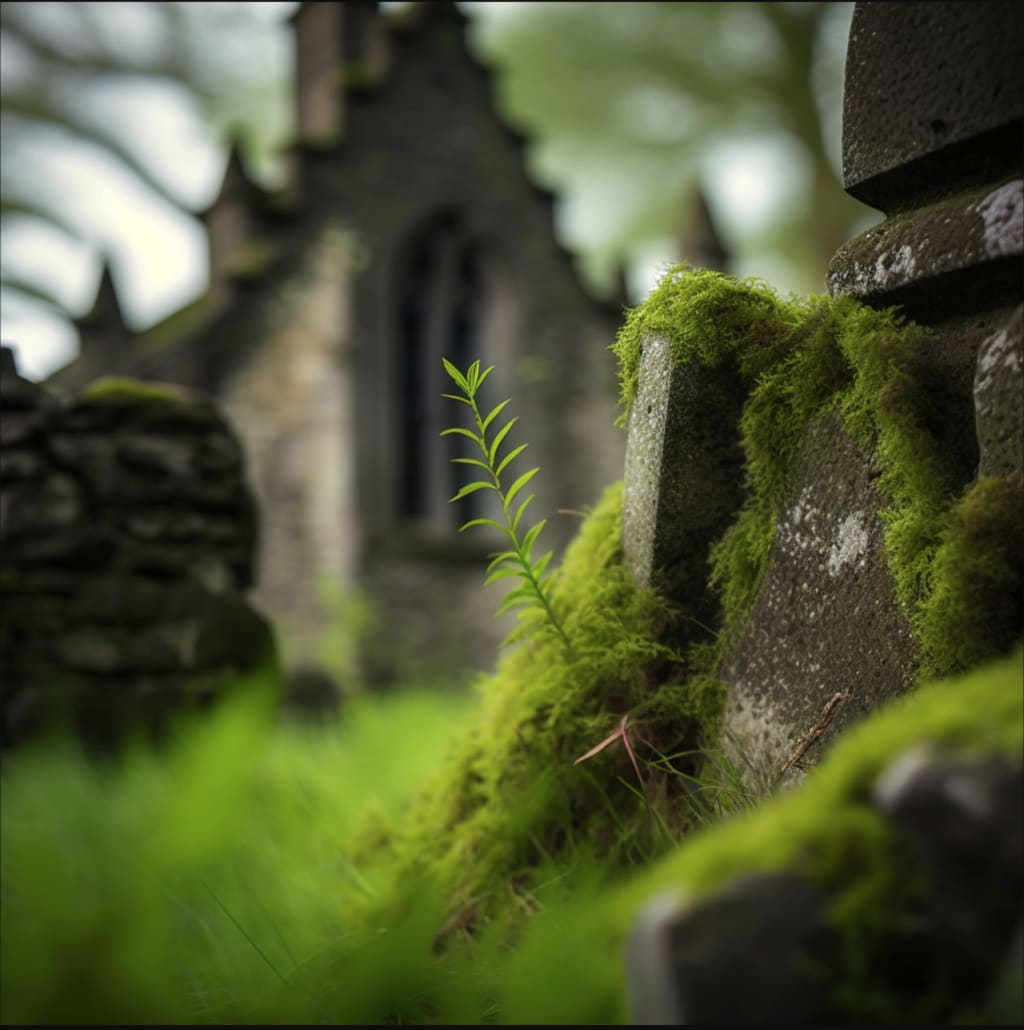
If walls could talk then, speaking as a wall, we could only tell one story and it would take a long time to hear what we have to say. Walls have ears, of course, and long memories that serve us well, but our voices are extraordinarily slow, lugubrious and woebegone; every single syllable slides on long, low frequencies rooted in earth and stone.
I am a wall around a churchyard in upland Cornwall. The air here is laced with the threat of thunderstorms - a warm day has passed, the humidity is high and the clouds want to connect with the earth. My shallow foundations will soak, droplets will pool, moss will grow and ferns spring forth in almost imperceptible motion. But we will say a single word in all that time. Eventually, anything that can happen, will happen. It may take a while, however. We apologise for any delay.
Parts of me used to form a stone circle and those parts talked at length - I already explained that there is no other way to talk if you are a wall - about how the purpose of stone rarely changes. Those menhirs, those stones; they have been revered in so many lives and yet they are just a part of a building. The men and women come, they talk about bread and blood and wine and the wounds of the One and then they leave, the same as when they came.
We do not absolve their sins, only absorb their sounds. We answer their questions in good time but they never hear. Do men and women have ears? They sure know how to talk, we don't know if they are patient enough to hear what the walls around them say.
We notice everything. You can’t get anything past a wall. We know everything because we catch every detail and nuance and, well, there is little else we can do in the circumstances, except nurture the moss, pool the water and be denuded of crystal to crumble just a little. It could take a moon's phase to recount the detail of a second of the storm that is to come and every stone of me takes part in the telling in order to describe it that quickly.
The one thing walls don't have is a lot of time to tell the stories. Men and women have less time, but talk very quickly because they are sure they do not have to listen. When a wall falls, the past that has not been heard and then recounted is lost forever. Every time the walls are destroyed by men and women, by war, revolution or recklessness, the history they held ready to be heard is lost. Nobody remembers how the menhirs fell. Not one soul can recall what happened before any of the dark age destructions. Walls do have ears, but sometimes there are no walls left to listen.
When walls talk, we consider every word, but it is the long, low tremble of our words, a subsonic ululation like a tremor of grief, the rumble of a pressure wave too slow for human ears to recognise. And it's just as well, because we don't think you'd like what we have to say.
I see you shuffle into church, I feel the weight of your burden, I hear your mumbled syllables of prayer. You kneel on cold stone and bow your heads, close your eyes and see even less than you usually do. You only hear the murmur of prayer, you ignore the symphony of stone all around you.
We hear everything of consequence in this place - you really have no idea how much we talk to the earth, to the sky, to the air. Long, low vibrations, deliberations of stone. These are the waves of sound you live your lives on. We tell stories, we talk. When will you hear us?
About the Creator
Ian Vince
Erstwhile non-fiction author, ghost & freelance writer for others, finally submitting work that floats my own boat, does my own thing. I'll deal with it if you can.
Top Writer in Humo(u)r.


Comments
There are no comments for this story
Be the first to respond and start the conversation.