
How About a Singing Black Hole in Our Galaxy?
BLACK HOLE SIGNAL
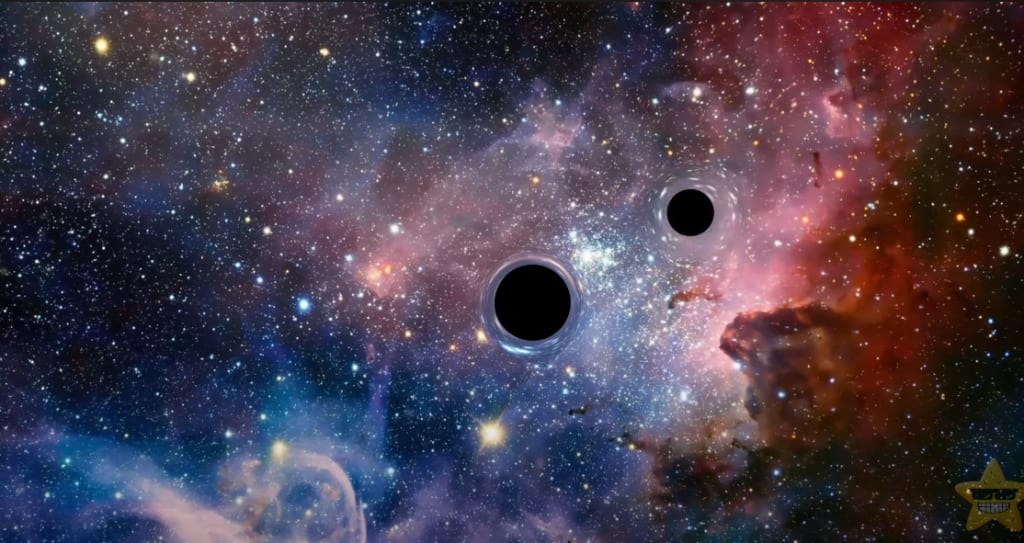
Space dark lifeless and quiet right well apparently it's not always true recently scientists have detected an eerie Echo coming from the main black hole in our galaxy it has high and low notes and sounds pretty otherworldly what does it mean should we sound the alarm Bell siren whatever Sagittarius A star is our own supermassive black hole sitting right in the center of the Milky Way galaxy where we live you might know that black holes are the true Monsters of our universe gobbling up everything that is careless enough to come to close if a massive black star runs out of its star fuel it sometimes becomes super dense and buckles under its own weight collapsing Inward and bringing space time along as a result the gravitational field of this new thing becomes so strong that nothing can escape it not even light and so goes a black hole we really can't see black hole since they devour everything even light but we can still figure out where they're located all thanks to the existence of accretion discs want an explanation well picture a black hole the starving thing consumes all the matter that Strays Too Close squeezing it into a superheated disc of glowing gas the black hole also bends light around it which creates a circular shadow that's what I mean we can't see a black hole itself but we can see the accretion disc surrounding it.
It happens like this first the material gets caught in the black hole's orbit and squeezed into a razor-thin spinning band friction heat electric and magnetic forces energize this disc which makes the material glow intensely the most massive black holes have such bright bands that they can outshine millions of galaxies inside this disc of glowing material particles rub against one another it slows them down and sends them straight toward the black holes Event Horizon if this friction didn't exist the material would be orbiting the black hole for billions of years like planets circling around their stars now let's get back to Sagittarius A star it's far less luminous than other black holes at the center of galaxies astronomers have observed it means that at the moment our Central black hole isn't actively munching on the matter surround it what is it catching some z's the answer is unclear there's no evidence received by NASA's ixb telescope it suggests that the seemingly sleeping giant woke up pretty recently about 200 years ago ooh that is recent it's snacked on gas and all kinds of cosmic debris within its reach why did it happen and what did the black hole do after that Sagittarius.
A star is the nearest to a supermassive black hole just 25 000 light years away from Earth its estimated mass is millions of times greater than that of our sun it sounds oppressive doesn't it so when scientists spotted relatively recent x-ray emissions of ginormous clouds of gas in the vicinity of the black hole they immediately called on the ixb telescope to figure out what it may mean what intrigued the most was how bright these clouds were you see most cosmic clouds called molecular clouds are dark and cold with their x-ray signatures very faint but that wasn't the case with this finding of course there are a few theories concerning this phenomenon one of the main explanations for why these giant molecular clouds are shining so bright is that they just Echo a long gone flash of X-ray light it could mean that our supermassive black hole might not have been that dormant some centuries ago after additional research astronomers figured out that the x-rays coming from the giant molecular clouds were actually reflected light and this light must have come from a short-lived and extremely intense flare that was produced either very near or right at Sagittarius A star and the most likely cause of it is the black hole suddenly consuming a huge chunk of the material surrounding it it happened around the start of the 19th century it was most likely a sight to behold whirlpools of particles were drawn toward the black holes Event Horizon also known as the point of no return the black hole started to ingest all this material which resulted in brilliant bursts of X-ray light and Echoes that we managed to translate into sound waves here on Earth this discovery is crucial for understanding the processes happening to and around our supermassive black hole we might also figure out what physical processes can potentially awake Sagittarius A star again even if this period of activity is just temporary supermassive black holes are the largest among all black holes out there their Mass can be hundreds of thousands or even Millions to billions of times the mass of our sun and two such Giants have been recently spotted with the help of the Atacama large millimeter sub-millimeter array of telescopes mercifully also known as Alma two gigantic black holes were growing alongside each other not far from the center of the coalescing Galaxy apparently these black holes came across each other when their host galaxies collided one of the black holes is around 200 million times the mass of our sun and the other is a bit smaller about 125 million times the mass of our star they aren't visible directly but are surrounded by bright clusters of warm glowing gas and stars tuck close by the black hole's gravitational pull time will pass and these black holes will start circling each other and eventually they will collide creating one probably even bigger black hole interestingly such immense merges are more typical for distant galaxies this makes it harder for earth-based telescopes to see them but the sensitivity of Alma helped astronomers observe these bright and compact regions where matter swirls around black holes imagine how surprised they were when instead of one black hole they saw two of them munching on the dust and gas stirred up by the massive space merger and if before experts thought that such Galaxy mergers didn't really happen in our neighborhood this discovery May mean that black hole binaries like this one may be much more common than we previously thought and if pairs of black holes are so common it can make it easier for us to study gravitational waves these waves also known as ripples in space-time occur when black holes Collide if we talk about the recently discovered pair of black holes it might still take them several hundred million years to crash into each other but by observing their behavior scientists can figure out how many binary black holes that are about to collide there are in the universe also this may give us more insight into what is going to happen when our home Milky Way galaxy collides with the Andromeda galaxy in about 4.5 billion years oh I can't wait now have you heard that we might be living in a black hole I'm not kidding such a scary Theory does exist see for yourself black holes pull inside everything they see but what if one black hole has already engulfed us long ago surprisingly some physicists deem this Theory somewhat plausible for example Dr nicodem poplovsky a theoretical physicist from Indiana University states that everything that a black hole swallows may turn into a new universe inside the hole or on the other side of it who knows maybe our universe used to be a quite different place until it got pulled into a black hole the theory of white holes is closely connected with the previous idea while black holes swallow all the matter so that not even light can escape white holes are something quite the opposite these formations are believed to spit out everything that black holes have pulled in in other words a white hole is the hypothetical area of space-time that nothing can enter from the outside but light and matter can escape from it as for a black hole on the contrary you can only enter it from the outside but can't get free afterward
About the Creator
Keep reading
More stories from Terema Remx and writers in Fiction and other communities.
A brief history of cannibalism
15th century Europeans believed they had hit upon a miracle cure: a remedy for epilepsy, hemorrhage, bruising, nausea, and virtually any other medical ailment. This brown powder could be mixed into drinks, made into salves or eaten straight up. It was known as mumia and made by grinding up mummified human flesh.
By Terema Remx2 years ago in Fiction


Comments
There are no comments for this story
Be the first to respond and start the conversation.