
Home Without a Map
Sometimes we find ourselves in the places we tried to forget

I spent a long time trying to leave the place I came from.
Not physically—though I did that, too—but emotionally. I tried to untangle myself from the soil that shaped me. As if I could uproot my past like a weed and toss it behind me, like it never mattered.
I wanted to be free. To be new.
I told myself stories about transformation. I believed change meant distance. That growth meant never looking back.
But the strange thing about roots is—they don’t really let go. Even when you try to run. Even when you swear you’ll never return.
They wait.
They wait in memories. In smells. In half-forgotten songs. In the shape of your handwriting. In the way your voice cracks when you say certain names.
They wait until the moment you’re quiet enough to hear them again.
For me, it happened on a Tuesday.
I was walking through a city I didn’t belong to—tall buildings, cold sidewalks, coffee cups with names that weren’t mine. I had become good at blending in, at being unremarkable. But on that day, a stranger passed me humming an old folk tune. One I hadn’t heard in years. One my grandmother used to sing while stirring lentils.
I stopped.
Not because of the song, exactly. But because of the ache it brought with it. It was the sound of a place I had convinced myself no longer mattered.
But in that moment, it did.
It mattered so much that I wanted to cry right there on the sidewalk, in my city clothes and borrowed life. It mattered because it reminded me that no matter how far I tried to travel from who I was—I still carried it. All of it.
I didn’t go home that day.
But something inside me did.
There’s this myth we tell: that healing means becoming someone else.
But what if healing is just remembering who you were before the forgetting?
What if it's not about building a brand-new version of yourself, but peeling away the layers that never belonged to you in the first place?
I started writing again after that day.
Not the polished kind. Not the kind you share. Just scribbles in a notebook. Sentences that didn’t make sense. Fragments of thought. Echoes.
But the more I wrote, the more I began to feel something shift.
The shame started to dissolve.
The embarrassment about where I came from—the simple language, the quiet customs, the small joys—began to feel sacred again. Like a map I had crumpled too quickly.
You see, I’d confused complexity with worth. I thought my small-town childhood made me less than. I thought simplicity was something to outrun. But now I understand—it was never the town that hurt me. It was the silence I put around it. The way I refused to speak its name.
But home isn’t about location.
It’s about recognition.
And sometimes, it only takes one sensory memory—a smell, a sound, a sentence—to remind you that you’ve been carrying home in your chest the whole time.
It doesn’t matter how much you’ve changed.
You are allowed to return.
I went back eventually.
Not just to the physical place, but to the feeling.
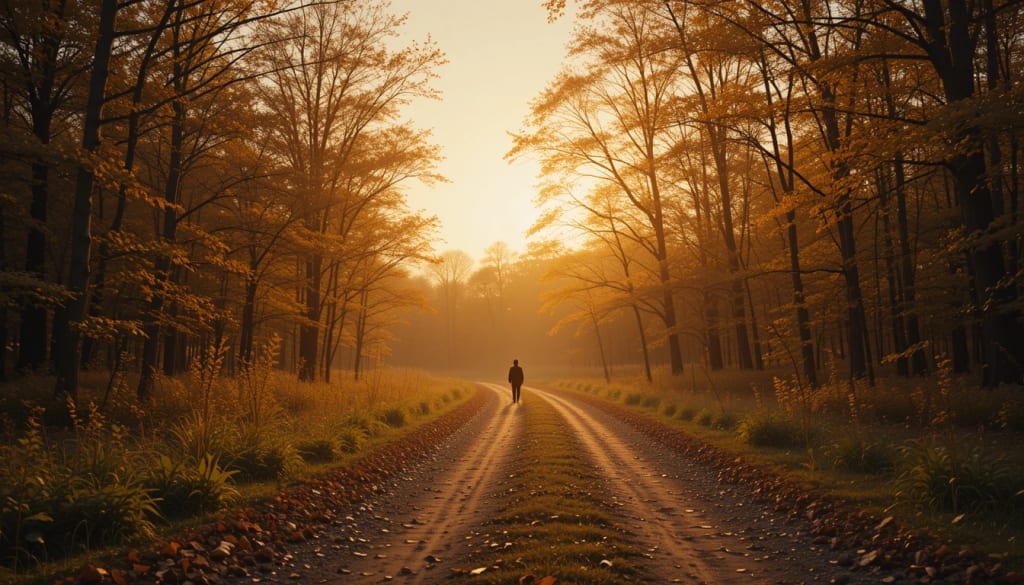
I walked the dirt path behind my childhood house. The one that used to seem endless but now only took five minutes. I sat under the tree that once held all my secrets. I let my hands trail through the creek I used to talk to when no one else would listen.
Everything had changed. But somehow, everything also remembered me.
Even the wind seemed to say, “You made it.”
And I realized: I had spent years searching for places to belong, trying to earn belonging like a badge. But this forgotten path, this forgotten life—it asked for nothing. It simply welcomed me. No conditions. No explanations.
Just a soft return.
Belonging, I’ve learned, isn’t something you find. It’s something you allow.
It’s the moment you stop proving. Stop performing. Stop pretending you were born in the middle of your “after” story.
It’s the moment you whisper: Maybe I didn’t need to leave so much of me behind after all.
Now, when people ask where I’m from, I don’t flinch. I name the town. I name the family. I name the silence that taught me how to listen.
I name the home that never stopped waiting.
Because we all carry places inside us.
And when we’re brave enough to return—not just physically, but emotionally—we often find that the things we thought were weaknesses were actually the seeds of our strength.
We weren’t running away from home.
We were running toward ourselves.
Author’s Note:
Sometimes, the map you’re searching for is drawn in the lines of your memory. If you're lost, look there. Not all roots entangle. Some simply wait for you to return.
About the Creator
Shohel Rana
As a professional article writer for Vocal Media, I craft engaging, high-quality content tailored to diverse audiences. My expertise ensures well-researched, compelling articles that inform, inspire, and captivate readers effectively.
Keep reading
More stories from Shohel Rana and writers in Fiction and other communities.
Formation
A Tale of Cracked Geodes and Inner Light The old cabin smelled of pine and ink, its walls groaning under the weight of a thousand unwritten stories. Clara sat at the scarred oak table, her fingers tracing the edge of a geode she’d found by the river that morning. It was rough, unremarkable, a stone that could’ve been kicked aside by any passerby. But she knew better. She’d always known better. Inside, it held secrets—crystals waiting to dazzle, if only you dared to break it open.
By Shohel Rana8 months ago in Fiction
Miss Persephone's Manual to a Seemingly Ordinary Life
Miss Persephone was found at the dining table, her blue eyes swollen, her tears arriving and retreating like the tides of the ocean. Earlier that day, her family had visited her in the retirement home where she had lived for eight years. It was her eightieth birthday.
By Imola Tóth5 days ago in Fiction


Comments
There are no comments for this story
Be the first to respond and start the conversation.