

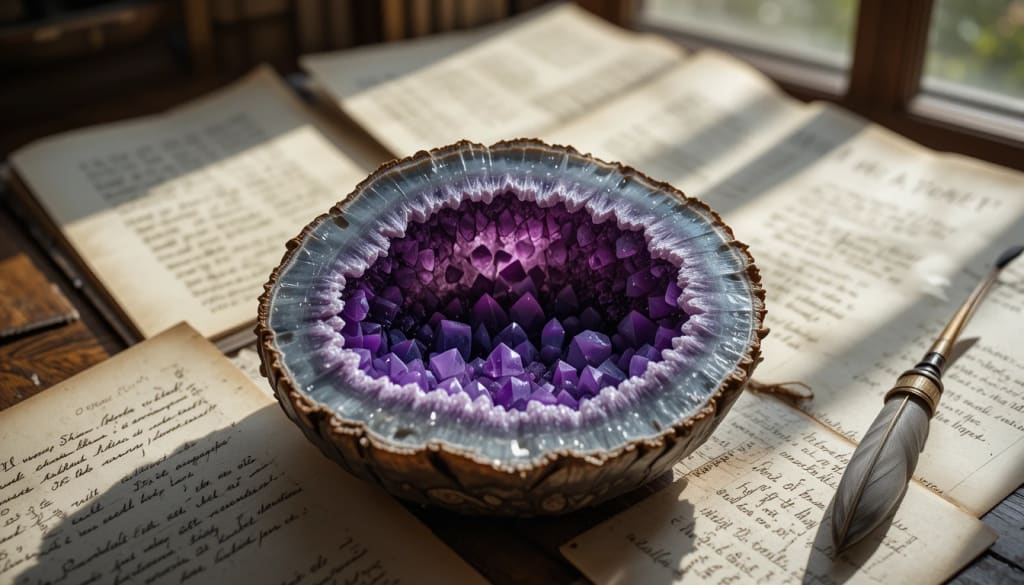
A Tale of Cracked Geodes and Inner Light
The old cabin smelled of pine and ink, its walls groaning under the weight of a thousand unwritten stories. Clara sat at the scarred oak table, her fingers tracing the edge of a geode she’d found by the river that morning. It was rough, unremarkable, a stone that could’ve been kicked aside by any passerby. But she knew better. She’d always known better. Inside, it held secrets—crystals waiting to dazzle, if only you dared to break it open.
She was thirty-two, a poet who hadn’t published a word in years, not since the world told her she wasn’t good enough. Her early work, raw and earnest, had been torn apart by critics who called it “sentimental.” The rejection letters still sat in a drawer, their edges curling like dried leaves. But today, something stirred in her, a restless spark she couldn’t name. Maybe it was the geode, or the way the autumn light slanted through the cabin’s dusty window, or the memory of her grandfather’s voice, telling her stories of gods who breathed life into stone.
Clara picked up her pen, its nib worn from years of scribbling in notebooks no one ever saw. She imagined a figure—Phanes, she called him, a name from a mythology book she’d read as a child. In her mind, he was no distant deity but a warm presence, his thumb pressing gently against her forehead, as if to say, Wake up. You are a universe. The image made her breath catch. She began to write.
The words came slowly at first, jagged as the geode’s surface. She wrote of her childhood, of the small town where she’d grown up, where the river ran cold and the stars felt close enough to touch. She wrote of her mother, who’d left when Clara was nine, leaving behind a single poem scrawled on a napkin: Find the light inside you, girl. She wrote of her grandfather, who’d taught her to see stories in everything—the bark of a tree, the curve of a stone, the silence between words.
As she wrote, the cabin seemed to hum. The act of writing felt like wielding a hammer, chipping away at the dull crust of her doubts. She wasn’t just Clara anymore, the failed poet, the woman who’d stopped believing. She was a geode, cracked open, her inner truths spilling out in lines of ink. Each word was a crystal, sharp and glittering, revealing parts of herself she’d buried long ago.
She wrote of the contradictions that defined her. How she could be both fierce and fragile, how she longed for solitude yet craved connection. To be a writer, she realized, was to embrace those contradictions, to carve them into something beautiful. Her pen moved faster now, the words flowing like the river outside, steady and unstoppable. She described the stalagmites of her mind—ideas that had grown slowly, drip by drip, over years of reading, dreaming, and questioning. Fiction, poetry, criticism: they were all part of her, minerals deposited in the cavern of her consciousness.
Clara paused, her hand trembling. She thought of the computers she’d seen in the city, machines that could churn out stories at the press of a button. They could mimic human words, string together sentences with eerie precision. But they couldn’t want. They couldn’t feel the ache of creation, the way her chest tightened with every line she wrote. That ache was hers alone, a signet stamped on her soul, proof of her humanity.
She leaned back, staring at the geode. It reminded her of the stories she’d read as a child, tales of worlds born from chaos, of gods who shaped order from nothingness. Each story she wrote, she realized, was a world of its own—a heterocosmos, her professor had called it in college, a term she’d never forgotten. These worlds were messy, imperfect, full of contradictions, just like her. But they were hers, and they were real.
The sun dipped lower, painting the cabin walls gold. Clara’s notebook was nearly full, pages crowded with fragments of poetry, snippets of stories, questions she didn’t yet know how to answer. What am I made of? she’d written. What truths are buried in me? She thought of the geode again, its hidden crystals formed under pressure, over eons. Her life felt like that—years of pressure, of loss and doubt, shaping something precious within her.
She wrote until her hand cramped, until the light faded and the cabin grew cold. The final lines came unbidden, a poem about time and eternity, about creations that outlast their creators. She imagined her words as jewels, not fleeting like the trends of the world, but enduring, like mountains. Not just mountains—crown jewels, crafted with care, capable of dwarfing the peaks themselves with their majesty.
When she finished, Clara set down her pen and opened the geode with a small chisel. It split with a satisfying crack, revealing a heart of amethyst, purple and radiant. She smiled, tears pricking her eyes. This was her truth, her light, her universe. She didn’t need the world’s approval, not anymore. She was a poet, a creator, a human being who could want and ache and dream.
Clara stood, stretching her arms toward the ceiling. The cabin felt alive now, its walls no longer groaning but singing. She’d return tomorrow, and the day after, to keep writing, to keep cracking open the geode of her soul. Each word was a step toward understanding herself, toward building something eternal. And in that moment, under the fading autumn light, she knew: she was enough.
About the Creator
Shohel Rana
As a professional article writer for Vocal Media, I craft engaging, high-quality content tailored to diverse audiences. My expertise ensures well-researched, compelling articles that inform, inspire, and captivate readers effectively.
Keep reading
More stories from Shohel Rana and writers in Fiction and other communities.
Ludacris and Nelly draw backlash over bookings at MAGA-coded music festival
Ludacris and Nelly headlining a mostly right-wing event is good for them. It’s also great for the genre of hip hop. The two rap veterans have showcased their talents on other stages. Why can’t they perform for mostly MAGA folks and grab that bag?
By Skyler Saunders5 days ago in Beat


Comments
There are no comments for this story
Be the first to respond and start the conversation.