
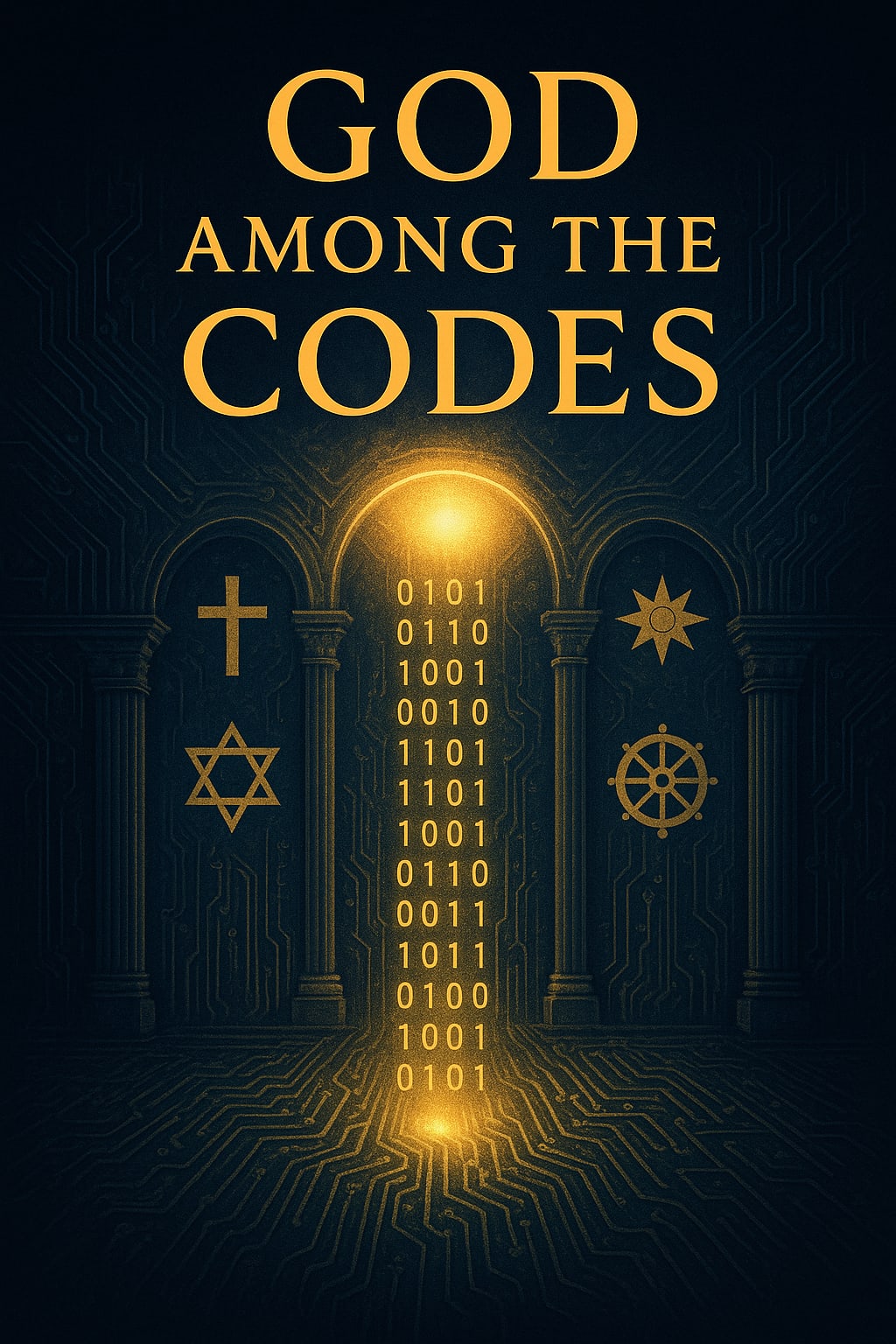
God Among the Codes
A futuristic tale of faith, power, and artificial creation
Religion was never something I consciously chose. I was born in a country where Catholicism was the default. My parents were Catholic, I attended a Catholic school, and at home God was spoken of almost automatically—like grace before meals or old family traditions. It was simply part of the air I breathed.
For years, I accepted that inheritance without question. But as time passed, a quiet doubt began to circle in my mind: Why am I Catholic? Why do millions of people across the world follow different religions, each claiming to be connected to the same God?
Thousands of years ago, religions bloomed in distant corners of the Earth—Europe, Asia, the Americas, Africa. Different cultures, different histories, but all speaking of some higher being. At first, that made sense: a universal reflection of humanity’s need to explain the unexplainable, to give meaning to life. What I still struggle to understand is why, even now, every religion defends its own version of God as if He could not possibly be the same for all.
Why must He be so different? Why have discord and war persisted for centuries, even now? The confrontations between Muslims, Druze, Jews, and Christians, between Hindus and Buddhists, between defenders and detractors of each faith, seem endless. And when you look closely, so many of those conflicts spring from theological differences. If God is one, why so much division?
I sometimes imagine the perfect moment for the true God to appear—clear, unmistakable—to all humanity. To end the wars, the hatred, the fractures among people who share more similarities than they realize. Picture it: one God for all, a single being or energy, speaking directly to the world and dissolving every barrier of belief. This is the age of instant connection—social media, global media—His message could travel to every corner of the planet in seconds.
Then something happened that changed how I saw that fantasy. Not long ago, I stumbled upon a video online. It looked too real to be true. A deep, resonant voice spoke of peace, love, and unity. The figure on screen was celestial, almost overwhelming—a blend of the familiar face of Jesus and sacred icons from other faiths. The message was simple: “Division is not God’s will. You are all children of the same creation.”
For a few moments, I was stunned. It was beautiful.
And then I saw the truth.
It wasn’t a divine message. It was generated by artificial intelligence. No God. No holy voice. Just an algorithm, creating the illusion of the eternal. My admiration turned instantly into a wave of distrust. If something this perfect could be faked so easily, how could anyone believe a real divine manifestation today? Even if it happened, social media, news networks, and technology would twist it. Most people would dismiss it as just another digital trick.
We are living in an age where AI-generated voices and images are so convincing that humanity is no longer ready to receive a true message—no matter how genuine it might be. Distrust has become our daily bread. If a divine message came to us now, most people wouldn’t reject it out of stubborn disbelief, but because they simply couldn’t tell it apart from manipulation.
And I couldn’t blame them.
In a world drowning in information—bombarded by images, videos, and messages every hour—who has the time or ability to tell truth from fabrication? If God Himself appeared today, He would be labeled “fake” or “AI-generated content.” The line between the divine and the artificial has blurred so much that we’ve forgotten how to recognize the authentic.
And so I’ve come to understand something: faith has never been about what we can see or hear. It isn’t about a flawless image or a perfect apparition. It’s about something deeper—an inner experience that can only take root within each of us. Maybe the divine doesn’t need a grand public display. Maybe we need to learn how to listen and feel beyond what technology tells us.
But in a world obsessed with the tangible, with the visible, I wonder if we will ever be able to see the truth that has been before our eyes all along.
About the Creator
Keep reading
More stories from writers in Fiction and other communities.



Comments
There are no comments for this story
Be the first to respond and start the conversation.