
Fossils and paleontology
Fossils are the preserved remains, imprints, or traces of organisms from the distant past.

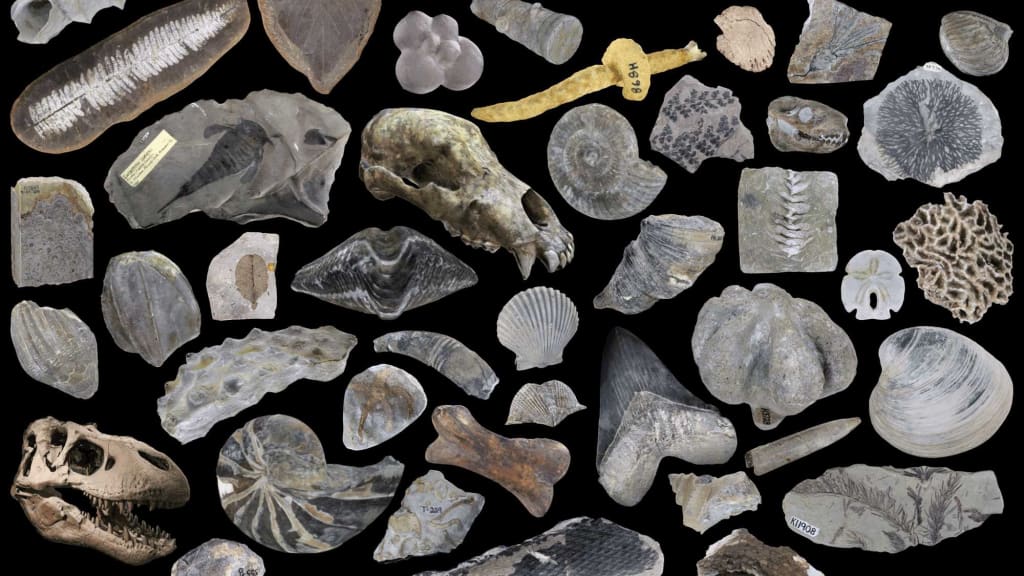
Fossils can range from the remains of ancient plants and animals to traces are footprints, burrows, or even fossilized waste. Fossils are invaluable windows into Earth's history, providing a direct record of life long before humans, and they form the foundation of paleontology, the scientific study of prehistoric life.
What are Fossils?
Fossils typically form when an organism’s remains are buried by sediments soon after death. Over time, these sediments harden into rock, and the organic material gradually decomposes, being replaced by minerals that preserve the shape of the organism. This process, called petrification, is how most fossils are created. Fossils can be found in a variety of forms, including:
Body Fossils – These include actual parts of the organism seemed bones, teeth, shells, and plant material.
Trace Fossils – These are indirect evidence of organisms, such as footprints, nests, or even fossilized feces, Known as coprolites.
Molecular Fossils – These are traces of organic molecules, often preserved in the rocks, which offer a glimpse into the genetic makeup of ancient organisms.
Fossils can range in age from a few thousand to billions of years old. The oldest known fossils are stromatolites, created by microbial life, which date back over 3.5 billion years.
The Role of Paleontology
Paleontology is the scientific discipline that studies fossils to understand the history of life on Earth. It blends aspects of biology, geology, chemistry, and evolutionary theory to explore the nature of ancient organisms, how they lived, and how life on Earth has evolved over time.
The main objectives of paleontology include:
Reconstructing ancient ecosystems: By studying the types of plants and animals that lived in specific regions and times, paleontologists can deduce what ancient ecosystems were like and how organisms interacted with each other and their environments.
Tracking evolutionary changes: Fossils offer insight into how species evolved over time. By examining fossilized bones, teeth, and other features, paleontologists can track changes in an organism's body structure, behavior, and even diet, helping to map out the evolutionary tree of life.
Understanding extinction events: Fossil records often show patterns of mass extinctions, when large numbers of species went extinct in a relatively short period. The study of these events helps scientists understand the causes, whether through natural disasters, climate change, or other environmental factors.
Methods of Fossil Discovery and Excavation
Fossil discovery and excavation require a combination of scientific knowledge and physical labor. Paleontologists begin by identifying areas rich in fossil-bearing rock, known as sedimentary rock layers. These rocks are often laid down in environments like riverbeds, lakes, or oceans, where organisms can be quickly Buried.
Once a potential fossil site is identified, paleontologists carefully excavate the fossils using a variety of tools, including small brushes, picks, and chisels. The fossils are then cleaned, analyzed, and sometimes reconstructed to determine the species and the environment in which it lived.
One of the most famous fossil discovery sites is the Burgess Shale in British Columbia, Canada. The fossils from this site, dating back over 500 million years, have provided an extraordinary snapshot of life during the Cambrian explosion, a period when many major animal groups first appeared.
Fossils and the Theory of Evolution
Fossils play a crucial role in supporting the theory of evolution, which was first proposed by Charles Darwin in the 19th century. By studying the fossil record, scientists can trace how life on Earth has changed over millions of years. Fossils show a gradual transition between species, demonstrating Now species have evolved to adapt to changing environments.
For instance, the discovery of Archaeopteryx, a fossil bird with dinosaur-like features, helped bridge the gap between dinosaurs and modern birds. Fossils of early mammals, such as Morganucodon, also show how Mammals gradually evolved from reptilian ancestors.
The fossil record also provides evidence of mass extinctions, where large portions of life on Earth were wiped out, only to be replaced by new species. These extinction events were crucial in shaping the course of evolutionary history.
Challenges in Fossil Study
Despite their importance, fossils can be difficult to study. Fossilization is a rare event, and only a small fraction of organisms are preserved. Most soft-bodied organisms, such as worms or jellyfish, leave no trace behind. Additionally, fossils are often found in fragmented states, requiring painstaking work to reconstruct their full form.
Moreover, the dating of fossils can be tricky. Methods like radiometric dating and stratigraphy are used to estimate the age of fossils, but the process can sometimes be imprecise due to Geological forces that have altered the rock layers over time.
Fossils and Their Cultural Impact
Beyond their scientific importance, fossils have had a significant cultural impact. Fossils like dinosaur bones have captured the imagination of people around the world. Museums and exhibits dedicated to paleontology educate the public about Earth's ancient past, and the discoveries of giant prehistoric creatures often spark curiosity.
Fossils also offer insights into the climate and environmental conditions of ancient Earth, helping scientists understand past climate change and offering lessons for the future.
IN THE END
Fossils are key to understanding the history of life on Earth. Through paleontology, scientists can uncover how life has evolved, how species have adapted, and how they’ve responded to environmental changes. The study of fossils continues to reveal new information about our planet's history, and with each discovery, we get one step closer to understanding the complex tapestry of life that has existed for billions of years.
About the Creator
Badhan Sen
Myself Badhan, I am a professional writer.I like to share some stories with my friends.
Keep reading
More stories from Badhan Sen and writers in Fiction and other communities.
The Path to Salvation
The late autumn evening air filled the monk's lungs, but it wasn't the season that chilled his bones. The heavy-handed presence of evil he had sensed upon entering the woods surrounding this mountain village had not bothered to conceal itself from him.
By Made in DNA7 days ago in Fiction




Comments (1)
Very nice post