

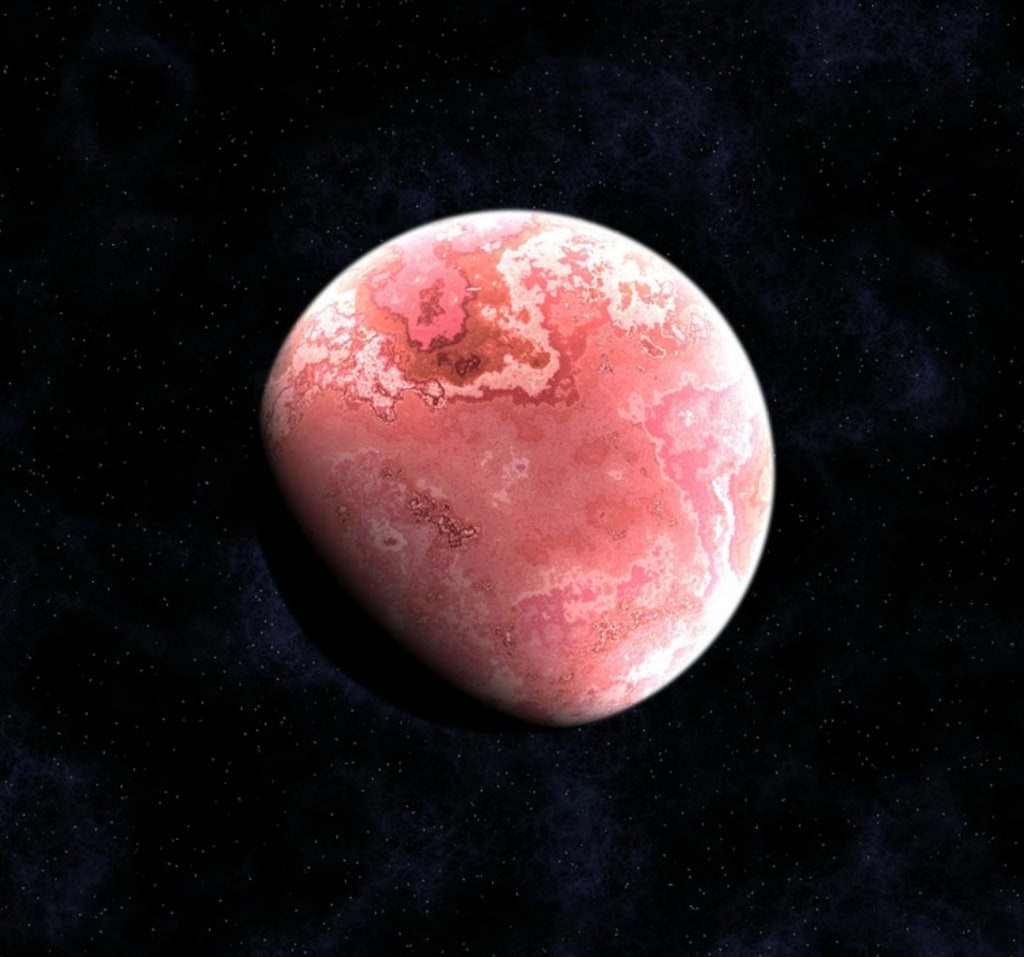
I grow weary of this planet. I gaze at its strange skies and unfamiliar landscapes, and I know this will never feel like home.
The gravity here is punishing - even walking is a test of endurance. Those that can manage it hunch over, each shuffling step an act of defiance against the invisible force grinding down on us. Most have surrendered their pride - they crawl on hands and knees like children. When night comes, we sleep in pools of water, the added buoyancy offering precious respite. And we are the lucky ones.
Many died in the crash. I can still recall the fear as our ship hurtled down through the atmosphere, our crew fighting the controls, our instruments too slow to calculate the metrics of this alien world. That kind of fear - it’s primal. You can’t move, can’t breathe. Like you’ve been crushed in a vice, your ribcage squeezing your heart so tightly it can no longer beat. We missed our landing site completely, smashing instead into the black ash of a volcanic valley, debris splintering from one end to the other as we cartwheeled to a stop. But again, we were lucky.
Had we touched down safely at our planned site, the grassy plains to the north, even more would have died. Victims of our own hubris, of thinking we understood this place. The first foraging teams we sent onto the plains came back gasping for breath, their lungs clogged with toxic spores. They did not die peacefully.
And of course, we are not alone here. Great beasts with savage teeth and claws hunt in packs and stalk us in the night. We've learnt to keep them at bay with fire, but still, they watch us, our dancing flames reflected back at us in patient eyes that pierce the darkness. The decision not to bring weapons on our exodus was widely supported, fuelled by a desire to leave our worst impulses behind. There have been many nights we cursed that choice.
Some say this planet does not want us here, that we should never have come. Such superstitions are unfounded, and unwelcome. The planet does not care either way. In any case, we had no choice. And now, we have marooned ourselves here.
This morning we dragged the last pieces of our ship to the mouth of the volcano. We watched silently, feeling the heat on our faces, as the buggy trundled up the crater. Its driver hesitated briefly at the top, then tipped over the edge, his payload hitting the molten rock with a wet smack. Small fires sparked immediately, flaring and hissing as the vehicle sank slowly beneath the lava.
We clung to the fragments of our life boat as long as possible - now we have used the planet itself to destroy them. We’ve accepted that we cannot go back. It was always our intention to not repeat the mistakes of our past, but facing the finality of our decision has been harder than I expected.
How can I begin to tell you what led us here? To condense into these scant pages a story played out over thousands of years, encompassing billions of lives - every one of them uniquely flawed and precious, every one of them an interlocking piece of this journey. It is an impossible task. We so rarely take stock of our lives while they are happening, and when they are over we care only for how they ended. So I will tell you, as plainly as I can, of our final moments.
At the peak of our civilisation, our home planet was consumed by conflict. Two armies, divided by ideology, threw themselves into a brutal war of attrition. Hundreds of millions died on both sides - most would struggle to articulate why. We were simply a society screaming at itself in a mirror.
Desperation led one side to attempt to end the war with a single act. Rumours had been spreading of an ultimate weapon, something so powerful it would render our conflict obsolete. When it was deployed without warning late one afternoon, a shockwave washed over us, a blast of air so sudden it took your breath away. It felt like the entire planet shook. I was at a field hospital when it happened, and we all rushed to the windows, wondering what it meant. We didn't have long to wait.
Within hours, our satellites began falling from the skies, blacking out our command and control networks. The guidance systems on our jets and missiles failed, sending our deadliest weapons careening into our own troops. Within days, we were struggling to maintain a communications system long enough to offer our surrender. But no one answered. And that was only the beginning.
Animals began behaving strangely - flocks of migratory birds flew in endless circles, lost and exhausted, while insects stopped pollinating our crops. High levels of radiation were detected, and many people became sick. We began seeing flashes of light, even when our eyes were closed. We felt like the whole world was going mad.
Our scientists came to a bleak conclusion: the enemy's device had destroyed our planet's magnetic field. Whether that was by design, they couldn't say. Could it have simply been an experimental device that blew up in their faces? Or were they so committed to our obliteration that they were willing to sacrifice the planet, and their own survival, to end us?
Without the protection of the magnetosphere, solar winds blasted the upper levels of the atmosphere, stripping away the very air we breathed. It was only a matter of time before the atmospheric pressure would drop low enough that surface water - our oceans, rivers, and lakes, would evaporate into space. Without air or water, existence on our planet would come to an end, leaving a lifeless rock suspended in the void. And there was nothing we could do to stop it.
But life is nothing if not resilient. We spent our remaining years and resources building a ship that could bring us here, to the only other habitable planet in the solar system. A last-ditch effort to preserve our species. Although conditions here are harsh, there is hope. Surveys report an abundance of clean air and water. From our temporary encampment in the valley, we face an almost endless frontier of land and resources. Given enough time, we will adapt to the increased gravity, we will build tolerance to the deadly plant life, we will tame the wild beasts. We will survive, if we can only survive our own nature.
This is why we we are burning everything in the volcano. Everything we brought with us and everything we have built here. All of our technology and all of our knowledge. Millenia of science, art, culture, religion, fear, hatred, and war. We are destroying our past so that you might have a future. Everything must burn. Even this diary. A diary that will never be read, dedicated to a person I cannot give it to.
My son.
I have seen you only twice. The day you were born - a kicking, mewling infant, the first of a new generation, the first of our people born on this planet. And again today, when I watched you from a distance, returning to the caves, spear slung over your shoulder, dragging a fresh kill. You walked almost upright, your muscles already stronger than mine will ever be. Your tribe gathered around you excitedly, while you stood still, sniffing the air - you sensed my presence. You turned and saw me on top of the cliff. There was struggle in your face, a mind trying to comprehend what it was seeing. Eventually you looked away, saying nothing to the other children. How could you? You were never taught to speak.
I know I broke the rules, allowing myself to be seen by you. But it is too late to punish me - the reset is complete. We cannot undo what has been done, and we cannot unlearn what we have learned. We can only give you a chance to start again. The universe does not tip the scales towards self-destruction. Our evolution happened with the same intention possessed by water trickling down a rock face - we took the path of least resistance. I hope that you survive, that you prosper, and that you choose a different path, unburdened by us. I will exist only as a vague memory, a figure once glimpsed on a cliff top.
I wonder if one day you'll recall that memory, and somehow recognise it for what it was. I wonder if, years from now, you'll gaze at the night sky and be drawn to the star with the reddish glow. Will you comprehend that it is actually a planet that was once like this one? Will you feel an inexplicable attraction towards it, a yearning to try to get there, some kind of genetic homesickness? Or will you see it for what it truly is? A warning.
I take a final look at the only photograph of you that will ever exist. One taken before you were even born - a black and white image of pure possibility. The light wind peppering my skin has coated the picture in a layer of ash, and I wipe it clean with my thumb. I wish you could know one thing - that you were loved.
I close the heart shaped locket and slip it into my clothes, against my breast. It brings me comfort to take a semblance of you with me on this final climb up the volcano. The pain will be beyond imagination, but so swift I will barely feel it. I’ll try not to be afraid, because I know it is necessary.
I know that this is not our world.
It is yours.
About the Creator
Miller Atlas
Emerson wrote that a mind once stretched by a new idea never regains its original dimensions. I aspire to write stories that challenge the way we see ourselves and our place in the world. I'm currently working on my first novel.
Keep reading
More stories from Miller Atlas and writers in Fiction and other communities.
Miss Persephone's Manual to a Seemingly Ordinary Life
Miss Persephone was found at the dining table, her blue eyes swollen, her tears arriving and retreating like the tides of the ocean. Earlier that day, her family had visited her in the retirement home where she had lived for eight years. It was her eightieth birthday.
By Imola Tóth5 days ago in Fiction
Identity and the Exhaustion of Grand Ideas
Over the past few decades, intellectual life has been shaped by a growing distrust of ambitious theories that once claimed to explain history and society as a whole. The fading influence of the radical projects associated with the 1968 generation produced a more careful and restrained scholarly atmosphere. Many historians and social theorists became skeptical of large narratives and universal categories, preferring limited scope and methodological caution. In Germany, this shift took a distinctive form through the rise of microhistory, an approach that emphasizes close attention to sources, local contexts, and everyday life. Microhistorians sought to revive the craft of traditional historiography while distancing themselves from older positivist assumptions. Their work often challenges broad concepts such as capitalism, industrialization, and the state, treating them as abstractions that obscure rather than clarify lived experience.
By Gopal Balakrishnan7 days ago in Fiction



Comments
There are no comments for this story
Be the first to respond and start the conversation.