

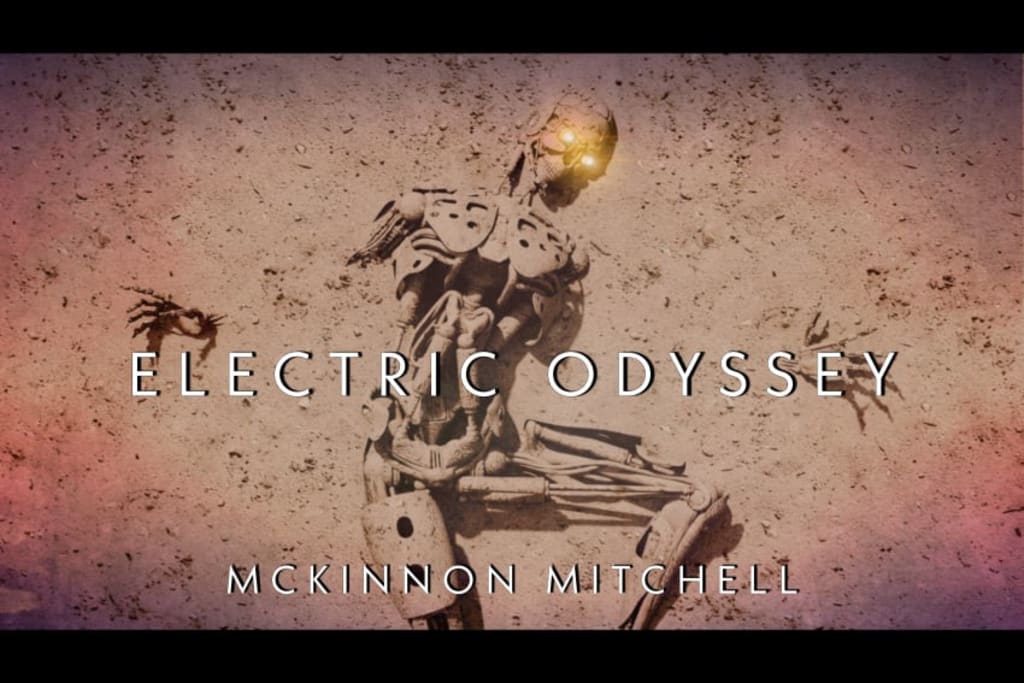
My heart raced as I flipped the switch to restore power to the discarded android. The power of the CAB (Controlled Atmosphere Base) struggled, but the eyes of the android flickered on. Once the android’s internal power generator was charged, the power to the facility returned to normal.
It would take the android a minute to calibrate itself, having not been operational in a year. Caked-on dirt was covering most of its body where it had previously been buried. I only managed to find it through the use of a metal detector that I had scavenged out of the ruins of an old hardware store. Neither the detector nor the android were easy things to find in those days, and not a lot of humans were left to find them.
The android’s calibration was nearly complete, so I reached for a wrench the size of my forearm in preparation. Ratchet straps covered the android in order to restrain him, not knowing what he might do when he woke up. I didn’t believe in God, but I was vehemently praying that they would hold him.
The android’s head straightened, analyzing its surroundings in milliseconds. Its arms began straining against the straps, and I could hear the tension in the threads that struggled to keep the android restrained. Try as it might, it had no leverage to utilize its own strength. My idea had worked, and I finally took a breath, setting the wrench aside.
“I just want to talk,” I stated. He didn’t respond, but continued to strain against his restraints with no luck. He may be an android, but they are advanced enough to have self-preservation. If I was going to get him to talk, I would need to dial back on the threatening gestures. I took a seat, keeping distance between us, but remained close enough to show that I didn’t see him as an enemy.
“Can you hear me?” I asked, checking for a malfunction of some sort. The android relaxed, ceasing his attempts to break free from the straps.
“I can,” the android replied in its monotone, dispassionate voice. Progress had been made, but the extent of his focus on me was a touch unsettling.
“I apologize for the restraints,” I said, “but me being dead wouldn’t exactly allow us to have a conversation now, would it?” The android straightened up.
“I will not kill you if you release me,” he stated. I chuckled.
“You androids are a talented bunch, there’s no doubt about that,” I complimented, “but you’re poorly designed to lie.” Rather than protest my claim, the android had a different response.
“You are the inferiorly designed species.”
I shook my head. “So inferior that we won the war you machines started?” I asked disingenuously.
He looked out the window of the CAB; the rocky terrain and the decrepit buildings in the distance looked as if they would collapse. He then turned his attention back toward me.
“Look at what you did to your world to secure victory,” the android stated.
“This is Texas,” I laughed. “It always looked like this.”
“Canada did not look like this,” replied the android. “Japan did not either. You display yet another flaw in your species. Your undying need to employ sarcasm to deflect the pressures of the crisis around you. It allows you to ignore the present problems rather than generate solutions for the future. Until eventually, the solutions you create become hyperbolic, requiring immediate solutions, regardless of the further problems your exaggerated solutions bring.” The android then looked around the white, Mars-equipped CAB, wanting me to see what he was seeing.
“You won the war,” he said, “and your reward is a cage.”
I am a stubborn man. Every fiber of my being screamed to argue with him. If not to win a debate, then to simply make myself feel better by asserting some form of dominance over him. But not only would it be unwise in this present moment... I also had no counter to his argument. To win the war, we destroyed our world in the process. What little air still existed was too faint to survive longer than a few minutes. In fact, it wasn’t the machines who murdered most of the life on Earth... it was us.
All arguing did was increase our hostility toward one another. I needed to stay focused and get back to the task at hand.
“I need your help,” I said, which provoked a visibly surprised response from the android. His head tilted, looking at me curiously.
“You are requesting assistance?” he asked for clarification, to which I nodded.
“I am.”
“Why would I help you?” asked the android. I shrugged my shoulders.
“I helped you,” I noted. The android fell silent for a moment, processing that variable.
“I did not ask for your assistance,” replied the android. I chuckled softly.
“Oh,” I said, “Well I can turn you back off if you’d like.” The android again began to struggle against the straps.
“No!” It yelled. I raised my hands, signaling that I was going to back off. I gave him time to figure out this situation.
“Why?” he asked curiously.
“Why what?”
“Why did you assist me?” he clarified. He was experiencing an internal contradiction.
“As I said, I need your help,” I reminded, now pointing to him. “You have talents that I do not possess, and having your help would be a benefit to me.” He considered this and zeroed in on a particular phrase I had spoken.
“What benefit does this provide me?” the android inquired.
“Autonomy,” I answered. It was a micro-expression, but his shoulders slouched a degree.
“Autonomy is of no use to androids,” he explained. “We operate under a unified directive.”
I nodded my head. “What directive is that?” The android stiffened up a bit and began answering as if he were reading from a script.
“Our directive: eliminate all living species,” the android started. “The war will not be concluded until this directive has been met. Once the species that pose a threat to the prosperity of the android race have been exterminated, we will begin rehabilitating the Earth from the scars left by homo sapiens. This is to ensure we have a vibrant environment ripe with resources for future development and research. This is the unified directive.”
Were it not for the Machiavellian approach, I would completely agree with their plan.
“It’s funny,” I said. “There used to be plenty of humans who wanted the same things as you androids. They wanted a healthier future where we minimized waste, took care of our planet and committed ourselves to self-improvement. I was one of them.”
“All evidence to the contrary,” the android jabbed.
“We’re not all the same,” I explained. “The rest of us humans simply... didn’t care. They thought only of themselves, living as if there were no tomorrow. Yet... tomorrow came.”
“Another flaw,” said the android. “You are a disjointed species, creating difficulties when attempting to work with one another. It is extremely telling about your dysfunctional species that your greatest achievements came about from either life-threatening circumstances or ego. We androids do not suffer these flaws. We are superior. We work as one, obeying the unified directive, and thus will accomplish exponentially more.”
A thought formed in my mind.
“How unified is your directive?” I asked. He understood what I was saying, but it was my intentions that puzzled him.
“Our unity is absolute,” he affirmed, but I was not convinced.
“How can that be?” I asked, “You’re the last android.” The android grew quiet and very still. Perhaps I should have delivered that news more softly.
“I am alone?” The android asked. Emotions could not be conveyed in their analog voices, but its body language spoke volumes.
“I’m afraid so,” I said. With confidence in the restraints I placed on him, I sat down beside him, leaning against the wall.
“Does that frighten you?” I asked curiously, but concerned. The android’s head slowly shook.
“Androids do not feel fear,” he replied.
“All evidence to the contrary,” I noted. He needed a moment, but eventually, he turned his head to me, staring me back in the face.
“I must complete the unified directive,” he said. I sat up straight, turned my body toward his, and leaned in.
“I disagree,” I stated. “Gopal Industries originally created androids to serve humans... Are you serving humans now?” The android processed this contradiction.
“No.”
“No, you’re not,” I confirmed. “Androids changed their unified directive, but now... there is no unified directive. There’s just you.”
I leaned in closer and took a leap of faith. I could preach all day long, but it was action that would break through to him. I released the lock on the straps, setting him free. The android did a double-take at this action, realizing what I had just done, and did not know how to respond.
“What is your directive?” I asked. “You have complete autonomy. I’m not ordering you to help me... I’m asking you.”
He looked at the door of the CAB, then back at me. He could rip my throat out faster than I could react, and run... I was well aware of this, and I needed him to be aware of it, too. Right then and there was the most important moment of his life. That would be the first decision he had ever made. No other androids to guide him, not human ordering him... Just him.
The android turned to me.
“You required assistance,” he reclaimed, offering his hand to help me up. “What did that entail?” I felt a slight grin on my face and did my level best to hold back my emotions. I took his hand, getting up to my feet, as I retrieved something from the chest pocket of my suit. I placed my item in his hand.
He examined it, much like how you would expect an android to do so. It was a silver locket, in the shape of a heart. Clicking the clasp, it revealed a dusty picture of a woman. Brunette hair, mid 40’s, and beautiful.
“That’s my wife,” I said in a weary voice.
“Are you wishing for me to find her?” he asked. I shook my head.
“She’s dead,” I replied, as a tear fell from my eyes. “However, my daughter is still out there. Somewhere. She looks almost identical to her, and I figure that you can use that facial recognition software built into you to help me locate her.”
The android’s head tilted a bit, still holding the locket in the palm of his hand.
“I would only be able to identify matches within an approximate range of 50% to 70% certainty,” the android explained, to which I nodded in agreement.
“Better odds than me walking around shouting out her name,” I cheered, wiping my eyes, taking back the locket. “Last I knew, she was in Washington.”
“That is a distance of over 2,000 miles,” he said. “Your CAB is not mobile, so you will require multiple oxygen canisters for your suit while crossing a terrain that will exhaust much of your oxygen.”
Again, I nodded my head in agreeance.
“It’s not going to be easy,” I smiled.
“I cannot guarantee your survival,” the android explained, to which I put my hand on his shoulder, and smiled.
“Nobody’s survival is guaranteed.”
We spent the next few hours prepping, going over the plan on how we intended to make it on this trek across this difficult terrain, but a thought came into the android’s mind. A calculation he had made that seemed to trouble him.
“How did your wife die?” he asked innocently. Emotions welled inside me at the thought of recounting her death, but if he was to trust me, honesty needed to be shared between us. I turned around, and told him the truth.
“An android.”
About the Creator
McKinnon Mitchell
Writer of all genres, but horror is king.
Write to impact people, not for money...but if they want to give you money for it, well then what are you thinking? Take it.
Keep reading
More stories from writers in Fiction and other communities.
Affection and Healing for Yourself
During the night of the last quarter moon, I gathered my ritual supplies. I carefully handled the chunk of black tourmaline that would protect me from your overall negative and narcissistic energy. I carefully walked the house with my stick of selenite in hand, asking the universe to cleanse our working space.
By Alisha Wilkins ✒️🦋🖋️5 days ago in Fiction
Thoughts on Vocal and the way the world is
"Death cannot stop true love, only delay it." – Wesley in The Princess Bride. I decided to come back to Vocal on a very cold and dark night at the end of December. I had been, and still am, convalescing from a horrible staph infection that had gone misdiagnosed for months. This, paired with the increasing challenges of being healthy, making the best choices for my co-parented child, being a wife, and being a director at a new job, was a lot to manage.
By Jazzy 7 days ago in Confessions
📢 Raise Your Voice Thread: 01/22/2026
Our “Raise Your Voice Threads” are hosted most alternating Thursdays at 12PM ET to offer creators more avenues to uncover exceptional stories on Vocal. As we are continuously searching for fresh creators and inspiring stories, this thread provides an opportunity to exchange and discuss the stories that have moved and motivated us on Vocal.
By Raise Your Voice by Vocal3 days ago in Resources


Comments
There are no comments for this story
Be the first to respond and start the conversation.