
Drone Attack Claim on Putin’s Residence
How Allegations, Denials, and Information Warfare Shape the Russia-Ukraine Conflict


Drone Attack Claim on Putin’s Residence: What We Know and What Remains Unproven
In recent days, headlines around the world have reported claims from the Russian government that a drone attack targeted the residence of President Vladimir Putin. According to Moscow, Ukrainian drones attempted to strike a location connected to the Russian leader, raising fears of a dramatic escalation in the ongoing Russia-Ukraine war. However, as with many events in this conflict, the truth is more complex than the initial claims suggest.
Russia stated that its air defense systems intercepted several drones near a residence associated with President Putin. Russian officials framed the incident as a direct threat to the country’s leadership and described it as evidence of Ukraine expanding the war deeper into Russian territory. The announcement quickly spread across international media and social platforms, where it sparked concern, speculation, and strong political reactions.
Ukraine, however, firmly denied any involvement in an attack on Putin’s residence. Ukrainian officials stated that their military does not target personal homes of political leaders and called the Russian claims exaggerated or false. Kyiv argued that such accusations are often used to justify further military actions or to influence international opinion during sensitive diplomatic moments.
Independent verification of the incident has proven difficult. No publicly available evidence has confirmed that a drone attack specifically targeted Putin’s home. Western intelligence sources, including U.S. officials cited by major news agencies, indicated that there is no clear proof that Ukraine attempted to strike the Russian president’s residence. These assessments suggest that while drone activity inside Russia has increased, the claim of a direct attack on Putin himself remains unverified.
This incident highlights a key feature of modern warfare: information has become a battlefield of its own. In the Russia-Ukraine conflict, statements from governments often serve political goals as much as military ones. Claims of attacks on leaders carry enormous symbolic weight, even when evidence is limited. Such announcements can rally domestic support, distract from setbacks on the battlefield, or send strong signals to foreign governments.
What is confirmed is that Ukraine has expanded some of its military operations beyond its borders. Over recent months, Ukrainian forces have carried out drone strikes on Russian oil facilities, military airfields, and supply depots. These actions are generally described by Ukraine as defensive measures aimed at weakening Russia’s ability to wage war. Russia, meanwhile, has continued missile and drone strikes on Ukrainian cities, infrastructure, and civilian areas.
The alleged drone incident involving Putin’s residence occurred amid heightened tensions and ongoing diplomatic efforts. At the same time, Ukraine has been seeking continued military and political support from Western allies, while Russia has been attempting to frame Ukraine as reckless and dangerous. In this environment, accusations of assassination attempts or attacks on leadership can quickly escalate rhetoric and harden positions on both sides.
For the global community, the danger lies not only in physical escalation but also in the spread of unverified information. Claims repeated without evidence can inflame public opinion, increase fear, and reduce space for diplomacy. This is why international observers, journalists, and analysts emphasize the importance of distinguishing between confirmed facts and political statements.
Another important aspect is the role of drones in modern conflict. Drone technology has lowered the cost of long-range strikes and increased their frequency. As drones become more common, incidents near sensitive locations are more likely to occur, whether intentional or accidental. This increases the risk of misinterpretation, where routine military activity is portrayed as an attack on national leadership.
So far, there has been no independent confirmation that President Putin was in danger or that his residence was deliberately targeted. Without verifiable evidence, the incident remains an allegation rather than an established fact. Even so, the reaction to the claim shows how fragile the current situation is and how quickly narratives of escalation can spread.
The broader lesson is clear. In a war already marked by destruction and loss of life, responsible communication matters. Governments, media outlets, and social platforms all play a role in preventing misinformation from driving further conflict. While the Russia-Ukraine war continues to evolve, separating facts from claims remains essential for understanding events and avoiding unnecessary panic.
As the world watches, the focus should remain on verified developments, humanitarian concerns, and efforts to reduce violence. Allegations alone should not define reality, especially when the consequences of misunderstanding could be global.
About the Creator
Wings of Time
I'm Wings of Time—a storyteller from Swat, Pakistan. I write immersive, researched tales of war, aviation, and history that bring the past roaring back to life
Keep reading
More stories from Wings of Time and writers in Fiction and other communities.
Ukrainian Strikes Inside Russia and the Putin Controversy
Russia-Ukraine Conflict: Ukrainian Strikes Inside Russia and the Putin Controversy In late December 2025, tension rose once more in the long-running Russia-Ukraine war after Russia claimed that Ukrainian forces had carried out a drone attack targeting Russian President Vladimir Putin’s residence in the Novgorod region of Russia. This accusation quickly became a headline in many countries, but independent information and U.S. intelligence assessments show there is no evidence Ukraine targeted Putin’s home. Reuters+1
By Wings of Time 2 months ago in Fiction
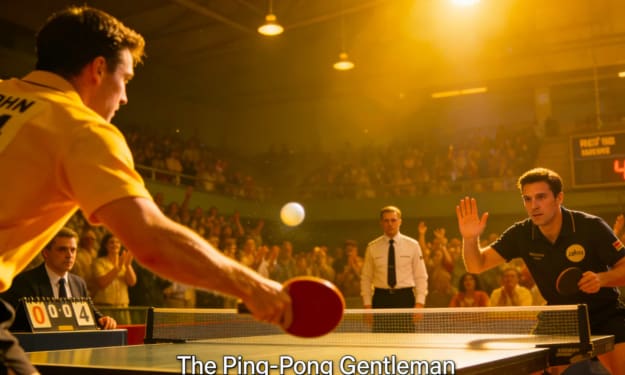
The Ping-Pong Gentleman
In a men’s table tennis match, John and his opponent were going toe-to-toe, dead even. With the score tied at 4-4, his opponent crushed a wicked smash. John stretched out to save it, but the ball nicked the underside of the table instead of landing fair.
By John Bruceabout 9 hours ago in Fiction



Comments
There are no comments for this story
Be the first to respond and start the conversation.