
CONFUCIUS & SOCRATES: THE DAWN OF A NEW WORLD
Chapter 2 - The Master of the East

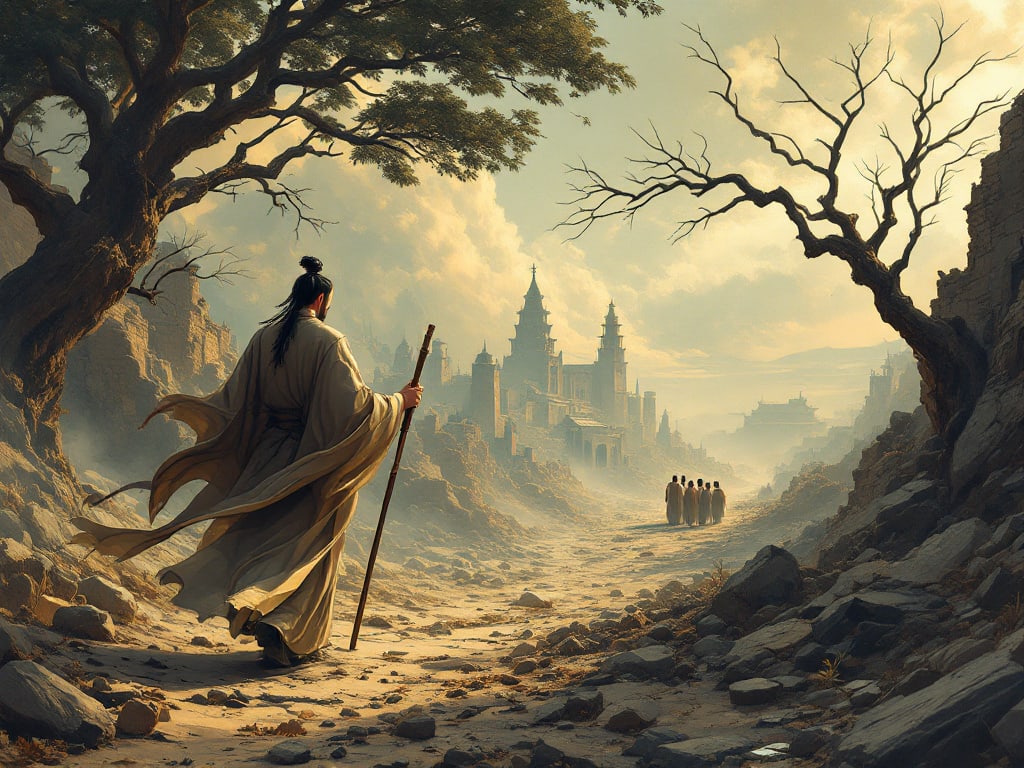
Long before his steps led him to the nameless city, Confucius had already journeyed extensively through the shattered kingdoms of his world.
He was born in a time of turmoil, when great states tore each other apart for a few acres of land, and oaths of friendship between lords weighed less than a handful of jade.
In his homeland, walls crumbled, rites faded, and men slowly forgot how to live together without sword or betrayal.
Kong Qiu — as he was then known — had come into the world in noble poverty.
His family, once powerful, had only its name left to pass down.
His father died while he was still a child, and his mother raised him alone, with the gentle rigor of ancestral piety.
From an early age, he loved to stand alone before the hills, listening to the wind slide over the dry grass.
He dreamed neither of swords nor of palaces, but of an ordered world, where everything had its rightful place, where every being would know what it was meant to be — without shame and without violence.
At sixteen, he had studied the ancient rites as others would study warfare.
Each gesture, each inclination of the body, each word spoken with precision seemed to him a victory against the creeping chaos.
By the age of twenty, he was already teaching the sons of fallen nobles, showing them that virtue was not a prince’s luxury, but a demand of the heart.
At thirty, he understood that his struggle would not be fought with soldiers, but would be a slower, harsher battle: to restore the invisible bond between man and Heaven.
His disciples followed him, sometimes across warring kingdoms, sleeping beneath trees, eating the scraps thrown to them by ruined villages.
Confucius offered neither wealth nor conquests.
He offered a more demanding promise: a life of righteousness, built on kindness, respect, and the constant effort to be worthy of the world.
He taught that true greatness did not lie in brute strength, but in the ability to keep a silent vow:
to become, for others, a living example of humanity.
For him, everything ought to be ritual.
Not in the sense of blind servitude, but in the belief that every human act — a shared meal, a spoken word, a lived mourning — should be infused with attention, awareness, and respect.
He believed that if one honored the form, the substance would gradually follow.
"Stand upright through the rites," he often said, "and the heart will follow."
Yet behind the serene wisdom he offered his students, Confucius carried hidden wounds.
He had seen too many good men fall into oblivion.
Too many rulers deaf to virtue, laughing at his patience, discarding him as one would snuff out a candle in the wind of a restless court.
He had known humiliation, exile, and hunger.
At times, in the cold nights beneath the heavy stars, he silently doubted:
— What if the world was not meant for harmony?
— What if virtue was but a dream for a few stubborn souls?
But every morning at dawn, he would reconnect with his deep faith, as one rekindles a flickering lamp.
He believed in the power of humble beginnings.
He believed that wherever a man stood upright, the world, though broken, regained for a moment its dignity.
When the call of the dream came — that strange vision of a city gathering the wisdoms of the world — Confucius knew at once he must go.
Not to persuade.
Not to conquer.
But to meet the one he felt, without knowing him, to be both his opposite and his brother.
The one who, perhaps, might teach him what even the rites could not reach:
the shifting secret of living doubt.
Thus, that morning, when he set foot upon the ancient stones of the nameless city, his heart beat not with ambition, but with a fragile hope.
Perhaps here, he might achieve what even the kings of old had failed to grasp:
to weave together discipline and freedom, respect and quest, into a world that would not collapse at the first storm.
On the horizon, beneath columns of light, he saw the other approach.
A small, sturdy man, with sparkling eyes and an insolent smile.
A man who, even now, prepared his questions as others might sharpen their swords.
Confucius took a deep breath.
He knew the true journey was beginning.
About the Creator
Alain SUPPINI
I’m Alain — a French critical care anesthesiologist who writes to keep memory alive. Between past and present, medicine and words, I search for what endures.
Keep reading
More stories from Alain SUPPINI and writers in Fiction and other communities.
Mastering French Without Losing Your Sanity: A Realistic Guide for Beginners
Learning French can feel like solving a Rubik’s Cube blindfolded. The tricky pronunciation, the never-ending grammar rules, and the surprising exceptions make it seem impossible. But don’t worry—equipping yourself with key expressions and effective strategies can turn frustration into fluency. Let’s simplify French and make learning enjoyable.
By Alain SUPPINIExclusive • 11 months ago


Comments
There are no comments for this story
Be the first to respond and start the conversation.