
CONFUCIUS AND SOCRATES: THE DAWN OF A NEW WORLD
Chapter 1 - The Stones and the Flowers

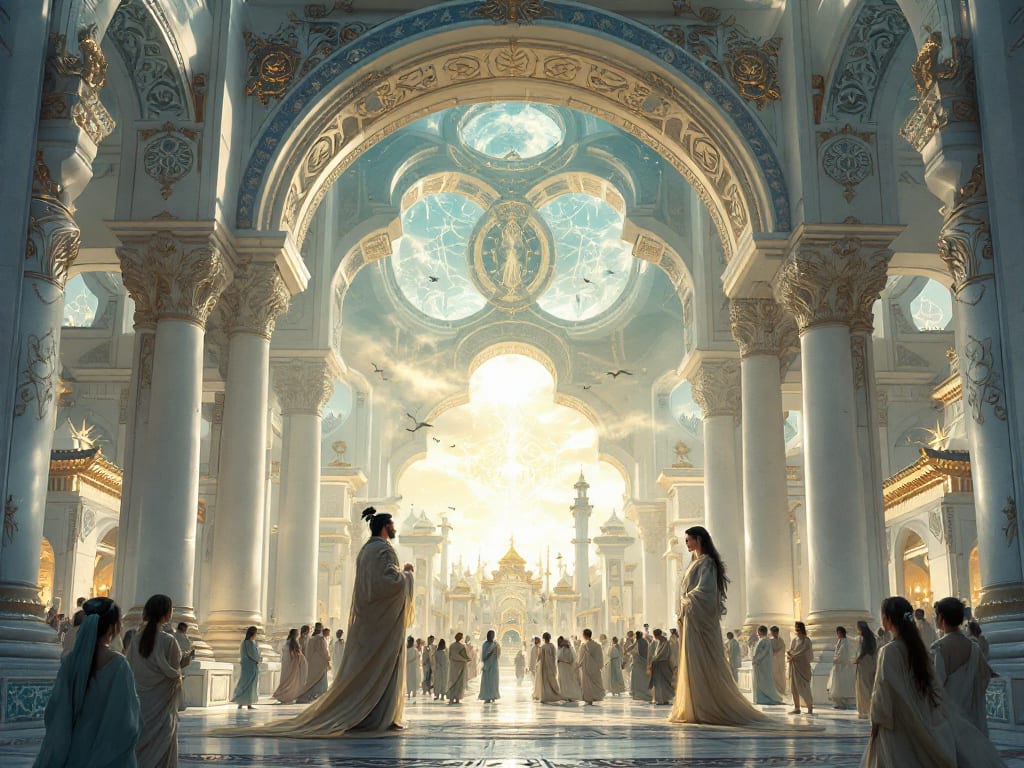
There exists, lost between the ages, a place that no traveler has ever been able to find twice.
A nameless city, set upon a forgotten land, where the stones of the squares are as ancient as the sky itself, and where flowers bloom in the interstices of the cobblestones, bursting into white corollas beneath the feet of the wise. A place where the wind, as it passes between the marble columns and the golden pagodas, sings a hymn that neither Greece nor China can entirely claim.
It is here that history begins.
The morning slowly lifted its veil over the grand central square. The light, as soft as milk, glided over the Ionic columns and the curved rooftops, caressing the faded frescoes and hanging lanterns. The cobblestones, worn by countless steps, echoed beneath the sandals of the disciples who gathered silently, their figures draped in simple fabrics, their eyes full of anticipation.
They came from distant lands—deep jungles, burning deserts, snow-covered mountains—drawn by a dream, a shared vision: two masters, two voices, two truths.
To the East of the square, an imposing man with serious features and a majestic bearing advanced. His beige silk robe floated around him like mist over the mountains of his homeland. His eyes, calm and deep, seemed to see beyond shapes, to the beating heart of things. His name was Kong Qiu, but the world would forever know him as Confucius.
To the West, with a lighter step, almost dancing, appeared another man. Short of stature, solid like an old oak buffeted by the winds, his bald head bathed in the gentle sun, he laughed softly, as if already tasting the irony of this destined meeting. His simple tunic floated with the rhythm of his breath, free and unconcerned with appearance. It was Socrates, the rebellious child of Athens, the scourge of doubt.
They walked toward each other, carried by a force greater than themselves, an echo from a future they would never know. And all around them, the world seemed to hold its breath.
The disciples, gathered in a circle, knelt in silence. No bell, no announcement. The long-awaited meeting had begun.
Confucius stopped first, placing both hands before him in an ancient gesture of respect. He slightly bowed his head, his face bearing that solemn gentleness that spoke of millennia of traditions and fallen kingdoms.
Socrates, true to himself, responded with a quick nod, almost a wink, a mischievous smile stretching his wrinkled lips.
They sized each other up for a long while, like two rivers from opposite horizons, recognizing each other without ever having crossed paths.
Then Confucius spoke, his voice as calm as a moonlit pond:
— Under Heaven, there is an order, eternal and benevolent. The virtuous man is one who learns to walk in harmony with it, without disturbing the flow of the world.
Socrates tilted his head slightly, like an intrigued bird, and replied in a deep voice, carrying the softness of the wind and the roughness of stones:
— But how can man know what this order is, if he does not first question it? For often, what is called harmony is merely the habit of the weak or the trickery of the powerful.
A shiver passed through the ranks of the disciples.
It was the first clash—not of violence, but of spirit. Two conceptions, two songs, had collided, without yet denying each other, but each bearing the fierce brilliance of its own world.
Confucius remained impassive. He almost imperceptibly smiled, as one smiles at a bold child. Then, with a slow gesture, he pointed to the circle formed by their students.
— Look, he said. Each being here has placed himself in his rightful place. Not by compulsion, but by respect for the natural order. Heaven teaches us that harmony does not destroy freedom: it gives it a framework in which to bloom.
Socrates squinted.
— Perhaps, he replied. But how do we recognize true order from imposed order? I prefer a free and wandering mind to a docile and falsely tranquil soul.
Silence fell. Not hostile, but dense, like an invisible fabric stretched between them.
The sun, now high, bathed the entire square in golden light. The flowers between the stones seemed to listen too.
The meeting had scarcely begun. But already, in the whisper of the wind and the shiver of the stones, one could sense that from this confrontation would arise neither victory nor defeat—but something greater: a fusion. A new path, woven from respect for the old and the ardor of doubt.
The disciples, in their circle, dared not move. They knew they were witnessing an event that would occur but once, at the confluence of dream and memory.
And somewhere, far above the city, the vast Heaven seemed to smile.
About the Creator
Alain SUPPINI
I’m Alain — a French critical care anesthesiologist who writes to keep memory alive. Between past and present, medicine and words, I search for what endures.
Keep reading
More stories from Alain SUPPINI and writers in Fiction and other communities.
Mastering French Without Losing Your Sanity: A Realistic Guide for Beginners
Learning French can feel like solving a Rubik’s Cube blindfolded. The tricky pronunciation, the never-ending grammar rules, and the surprising exceptions make it seem impossible. But don’t worry—equipping yourself with key expressions and effective strategies can turn frustration into fluency. Let’s simplify French and make learning enjoyable.
By Alain SUPPINIExclusive • 11 months ago



Comments
There are no comments for this story
Be the first to respond and start the conversation.