
COMPLETELY LOST
In a distant city, where I found myself

COMPLETELY LOST
A light rain started falling a few hours ago. Seconds trickle by like raindrops on grimy windows. The weather seemed to be mocking me. One, two, three... And then it hit me—I was completely, utterly lost. The realization didn’t strike like a bolt of lightning, but settled quietly, like dust. Lost—not just in the deserted streets of this village, a forgotten place tucked away in the vastness of nowhere, with its long-empty shopfronts where the scent of asphalt mingles with the faint toll of a church bell. No, I was lost somewhere deeper, in that corner of my soul where questions go unanswered and paths dissolve into the surrounding fog.
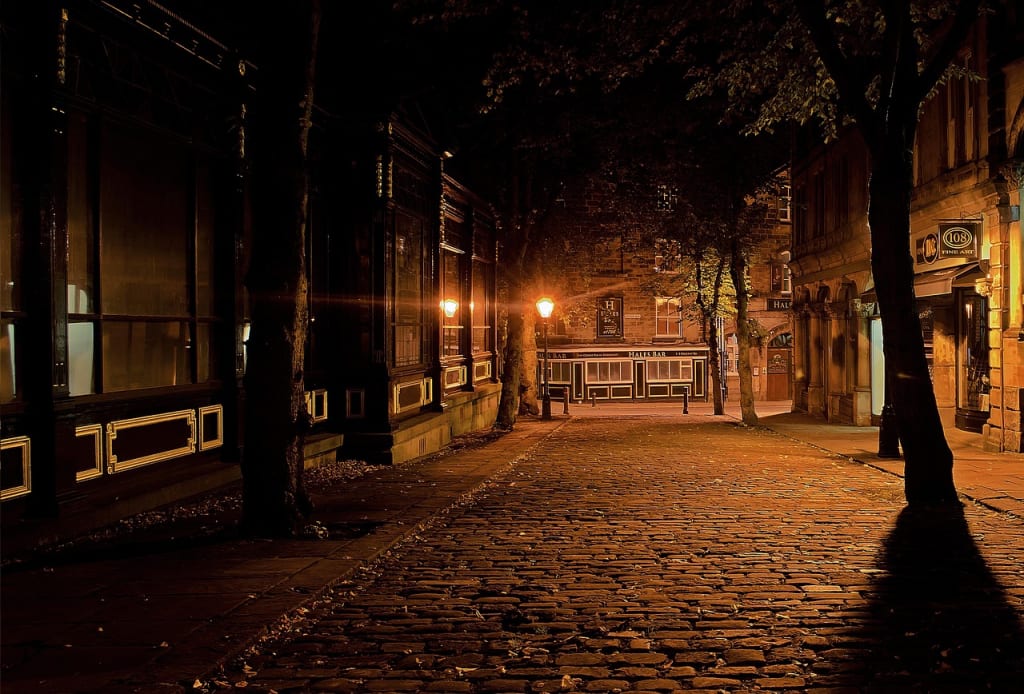
I looked around, hopeless. My reflection stared back from shattered windows, glinting dully under flickering streetlights. My gaze lingered on a few huddled figures seeking shelter beneath the awnings of abandoned stores— shapeless forms wrapped in thick, tattered blankets. I took in the dark houses, seemingly lifeless, lining the sidewalks, their windows asleep, plaster peeling in layers. Weeds pushed through cracked pavement, and along the main avenue, heavy branches sagged toward the ground, their leaves like fingers groping for something in the mud. The air carried the heavy aroma of decay, of something long gone and irretrievable.
And I, at forty-seven, with a backpack slung over my shoulder and a notebook clutched in my hand, realized my life had crumbled like a house of cards. I felt no fear. Strangely, for the first time, I felt alive, breathing deeply the air of freedom to be myself.
Yesterday, I walked away—from Sofia, from the apartment with faded wallpaper and the stale smell of faded memories. I left the office where no one would miss me—after all, I’m just a small, replaceable cog in the machine. I left the voices—family, friends, the clamor of a world demanding I be recognizable, settled, the same. The same: a word like a cold, heavy stone, meant to tether me to a life I no longer wanted. I’d yearned to break free, to drift with the current, to lose myself.
Now I stand at a crossroads, between two shadowed alleys. The gravel stirs memories of shattered hopes. This village—its name I never caught, nearly abandoned—lies somewhere in the south, perhaps near the border, where the land turns to dust and people, their faces etched with weariness and distrust, bear the weight of unspoken stories. Streetlights flicker, casting uneven glimmers on wide puddles. Graffiti scars the walls—jagged lines shouting defiance, presence: “I’m here, even if I don’t know where,” I silently reply to the scrawled words.
It’s hard, but I manage a smile. Deep inside, I feel something familiar reaching out, wrapping around my mind. There’s something almost magical in this—not knowing, not wanting to know where I am. Refusing the paths others map out for me. Defying a world that demands I have a place, a purpose, a role in the collective.
But still—why am I here? Was this moment of being lost fated? The answer isn’t simple. Perhaps it’s buried in the years I’ve lived, the choices I made or didn’t. Did I sense it back then, in the ‘90s in Bulgaria, but lack the courage to face it fully? In that time, in that world spiraling toward ruin, I’d begun to search for myself amid the wreckage.
In 1995, I was seventeen. A confused young man, chained by the big city. Sofia felt like a place abandoned by time. Streets were gray, sidewalks cracked, the air thick with the smell of gasoline from old Ladas. People, weary, stood for hours in lines for bread, milk, anything the few leva in their pockets could still buy. Everything was falling apart. The economy collapsed, hyperinflation devoured my parents’ meager savings, and the TV blared with politicians straining to make promises no one believed. It was a time of fracture, a nation caught between what was and what might be. Even then, I felt that rift deep within.
In my small room in Lyulin, I sought refuge and answers in music—not the nostalgic tunes drifting from national radio, but the kind that sliced through the world’s noise. I listened to bootleg Nirvana tapes, bought secretly from Slaveykov Square. Kurt Cobain’s raw, aching voice sang: “My girl, my girl, don’t lie to me/ Tell me where did you sleep last night.” It felt like a question to myself, one I longed to ask the world and those time had distanced me from, not in space, but in feeling. An enigma, its answers hidden in the concrete walls of my room. Where was I? Where had my dreams gone? Where was the life we’d imagined? Where was the freedom we craved?
I poured my heart onto checkered pages, wanting to write poems as answers. But wasn’t I just asking the same questions again?
I hid my writing from my mother, who often said, “Writing won’t feed you.” But I wrote—about freedom, rebellion, dreams impossible in a world where survival was all that mattered. And I was afraid. I couldn’t see myself clearly, but I saw others around me lose themselves—in alcohol, petty crime, despair—crushed by the weight of a transition too heavy for most.
Listening to “Where Did You Sleep Last Night” on my old cassette player, I first felt lost—not for abandoning my dreams, but for doubting I could chase them in this broken, gray world. Cobain sang stubbornly of his pain, his refusal to surrender. “In the pines, in the pines/ Where the sun don’t ever shine,” he pressed, and I pictured myself there, in the dark pines, searching for something I couldn’t name.
The years that followed felt like a dream I couldn’t wake from. I finished high school with average grades, losing any chance at university. What good would it have done? Just another system to teach sameness, to mold me, to make me fit others’ expectations. I didn’t want that. I sought only the freedom we’d been promised.
At nineteen, the system trapped me, forcing me into hard, dull, soul-crushing work. Life ensnared me in an invisible but tight grip. A hasty marriage followed, ending quickly in bitterness. Debts piled up. The few friends I had drifted away, citing “personal problems.” All the while, voices urged me to find my way, to “settle,” to be like everyone else. Each year pulled me further from the boy who wrote poems by lamplight. Life closed around me, a trap not of steel, but of endless expectations.
But I didn’t want to be the same—I never had. So when my boss said I’d need to stay late for another pointless project yesterday, something in me snapped. Not with sorrow—I just packed my desk, left the office keys with security, and walked away. For good. I barely noticed reaching the bus station, as if waking to the ticket clerk’s voice behind the counter.
“Where to?” she asked, her eyes like a seasoned psychologist’s, sizing up another lost soul.
“The farthest place,” I replied, not even considering a destination.
She studied her computer screen, shook her head with a faint smirk, and printed a ticket. Handing it over, she nodded toward my route. “Second exit, left. Third sector. Hurry, boy, if you want to catch the bus.”
“Hurry, hurry, hurry, boy…” her words echoed like a nagging refrain in my ears.
I ran as fast as I could, desperate to flee everything—Sofia, the routine, the sense that my life was a lie lived for others.
I boarded the bus at the last second. The driver, about to close the door, shot me a sour look as I waved frantically before the windshield of the old, battered Bova. I settled near the back, beside an almost eighty-year-old grandmother, clutching a small bundle to her chest. Only after we left Sofia’s outskirts did she turn to me, her eyes warm, offering a toothless smile.
“On a business trip, boy?”
“Not exactly, just traveling a bit,” I said, not up for confessions.
“You young folks love to wander the world. When you’re older, you’ll see there’s no place like home.”
“Or worse,” I thought, but kept silent.
“My husband passed last year, and my kids took me to live with them in Sofia, but a stone belongs where it’s from, mark my words.”
Over the next few hours, she shared stories—about herself, her late husband, her son’s family who took her in. She showed me faded black-and-white photos from bygone days, pulled from a plastic wallet tucked in her bundle.
“And you, can you manage alone in the village?” I asked as she stowed the photos.
“Why not? A soul needs little—a piece of bread, a roof overhead,” she replied, surprised, as if sensing a greed for life I hadn’t voiced.
“I’m not greedy for money, just thirsty for freedom,” I said sharply, needing to explain.
“I know that thirst, boy. It’s the lifeblood of our people, but politicians try to drain it. Soon they’ll chain our spirit and kill it.”
I couldn’t find words to reply. I gazed out the window at the passing landscape. Though late spring, the fields weren’t green, only scorched and barren hues stretched around.
I must have dozed off, because the driver’s shout jolted me. “Last stop!” he bellowed.
Disoriented, I looked around, feeling the weight of a hand-knitted wool vest she’d draped over me to keep me warm.
“No idea what you’re planning, but if you need a place to stay, ask for Grandma Gina the Healer. My house is at the village edge—I’ll find you a bed and a slice of bread. I’ve mended many souls and bodies; maybe I can help you,” she said, folding the vest with bony fingers, tucking it into her bundle, and heading for the exit.
I stepped off into the spring evening’s twilight and wandered aimlessly. And here I am, sitting on a curb in a nameless village, notebook in hand, mud on my shoes. Silence surrounds me, only the wind whispering, carrying the scent of rain and my longing for solitude.
I’d passed a small bookstore, shuttered perhaps decades ago, its dusty window plastered with old book posters, reflecting a stranger—a forty-seven-year-old man with eyes that had seen too many lies to trust in “the right path.” But in those eyes burned a new spark, lost and found again—the spark of that ‘90s boy singing with Cobain: “I would shiver the night through.”
I pulled out my pen and wrote. Words flowed like a river, endless. I wrote of betrayals that shape us, silently broken to live by others’ rules. I wrote of stories that lied, claiming one paved road to success, family, stability. I wrote of freedom that comes when you stop seeking the right way and just walk.
And this lost village, with its faint, ghostly sounds, seemed to whisper: “Keep going.”
I recalled a 1995 evening, sitting in the dusk on a bench outside my Lyulin building, scrambling for an excuse for my math grade. My mother would lecture me again about becoming “nobody” if I didn’t “pull myself together.” An old neighbor approached slowly in the dark, sat beside me, lit an Arda cigarette, paused, then said: “Life isn’t about finding yourself, but losing enough to know who you are.” He didn’t face me, as if speaking to the world. I didn’t get it then—thought he was drunk.
But now, sitting in the mud, notebook in hand, his words echoed back. Being lost isn’t weakness. It’s resistance, a refusal to fit a world that wants you packaged predictably.
I stared at the street ahead—narrow, winding, its cracked asphalt holding stories of other lost souls. A rumble sounded in the distance—maybe a storm nearing. I didn’t know where this road led or if I’d find shelter if the rain worsened. For the first time in years, I didn’t care. I didn’t want to know. No map, no compass—I just wanted to walk, write, and be. “My girl, my girl, where will you go?” Cobain’s words rang in my mind, asking my direction. I answered: “In the pines, in the pines/ Where the sun don’t ever shine.” There, in the darkness, I’d find my way.
I looked up at the heavy sky, still undecided whether to unleash its full downpour. Maybe the rain would strengthen, wash away all I was. I felt no fight. I was at peace. The drops seemed to urge me to let go of the familiar. I thought of Cobain, his voice, the edge of freedom he sang of. I opened a new page and scribbled: “I’d rather be hated for who I am, than loved for who I am not.” I tore it out, folded it into a tiny boat, and set it sailing in the rainwater at my feet. I hoisted my soaked backpack, tucked the notebook into my jacket, and started down the street. I didn’t know where it led—maybe to Grandma Gina’s house, maybe far beyond. It took a few seconds to realize I was completely lost. And a few more to know this was the only place I wanted to be.
About the Creator
Elira Valenor(Aya Chilikova)
I’m not a writer, I’m a storyteller!
I love words, numbers, and the magic of the past!
Every day of mine is filled with a new idea!
Keep reading
More stories from Elira Valenor(Aya Chilikova) and writers in Fiction and other communities.
The Secret Behind the Mask
Was she my hero, hidden behind a mask, trying her whole life to shield me from the truth? I don’t know. The years are like a faded tapestry, its threads unraveling but never revealing the full picture. My mother had wrapped her life in layers of ordinary routine, yet it carried the scent of something unspoken—nostalgia, pain, and a secret heavy as a stone around my neck.
By Elira Valenor(Aya Chilikova)5 months ago in Fiction


Comments
There are no comments for this story
Be the first to respond and start the conversation.