
Caught in the Crossfire
: What the Charlie Kirk Assassination Means for America’s Political Landscape

Caught in the Crossfire: What the Charlie Kirk Assassination Means for America’s Political Landscape
On September 11, 2025, conservative activist and commentator Charlie Kirk was shot and killed while speaking at an event at Utah Valley University. The assassination shocked the nation, leaving his supporters devastated and his critics unsettled by the brutal nature of the act. Regardless of one’s political beliefs, the murder of a public figure raises difficult questions about the state of American society, the dangers of political polarization, and the future of public safety.
A Nation in Shock
According to Utah authorities, Kirk was delivering remarks at a public gathering when he was approached by a 22-year-old man who fatally shot him. The suspect was arrested two days later after reportedly confessing to his father. He is now in custody and being held without bail.
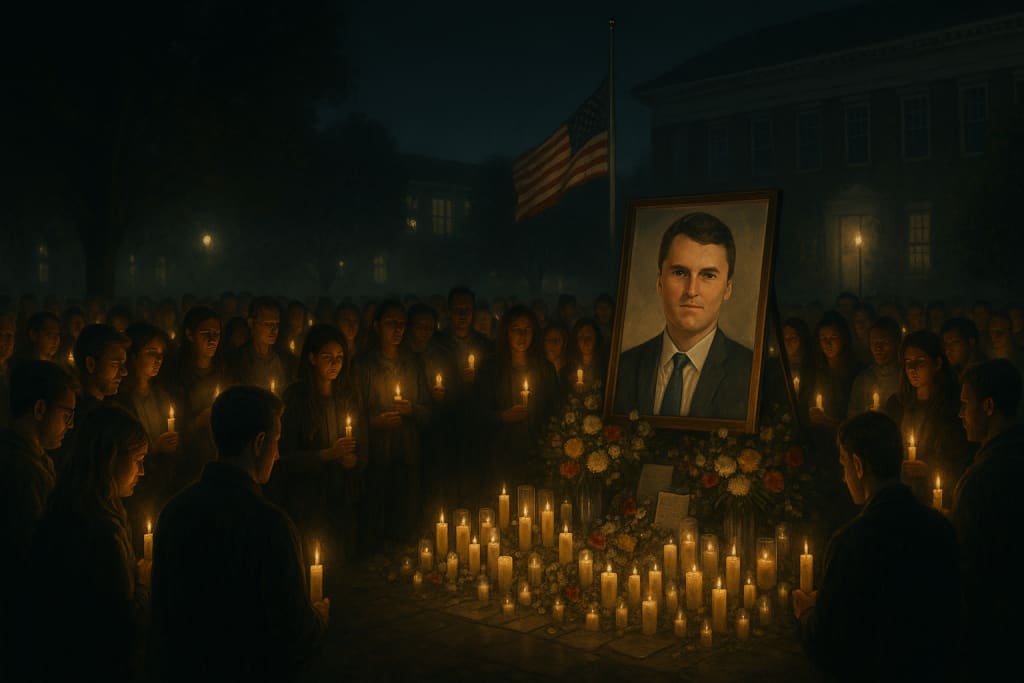
The speed with which news spread was remarkable, but what came next was even more telling. Vigils and memorials began to take shape in Utah and across the country, with thousands gathering to mourn. Social media was filled with tributes, prayers, and debates about the meaning of this loss.
Kirk’s widow, Erika Kirk, made her first public statement shortly after the arrest. She spoke not only of her personal grief but also of the need for peace and justice. Her words resonated deeply, painting a human picture of the tragedy behind the headlines.
The Security Question
The assassination has reignited a critical debate: how safe are political events in America today?
Public figures thrive on connection with their audiences, but those very gatherings can be vulnerable. Security protocols are often robust for high-profile politicians, but for activists and commentators—especially those operating in polarizing environments—the line between safety and exposure is thin.
The Utah Valley University event was not a massive rally with layers of federal security; it was a relatively open environment. That openness gave Kirk the chance to connect directly with students and supporters, but it also provided an opportunity for tragedy. Moving forward, institutions may rethink how such events are managed, balancing openness with the need for protection.
Violence and Polarization
The killing of Charlie Kirk cannot be separated from the broader atmosphere of political polarization in the United States. Over the past decade, political rhetoric has intensified, with fiery debates often crossing into personal attacks. While most disagreements remain verbal, history shows that hostile climates can lead to violent outcomes.
For some, Kirk was a hero who championed conservative values and gave voice to younger Republicans. For others, he was a lightning rod for controversy, often at the center of heated cultural battles. But disagreement—even fierce disagreement—should never translate into violence. His assassination illustrates the danger of allowing political hostility to fester unchecked.
Justice and Accountability
As the investigation unfolds, many questions remain. What was the shooter’s motive? Was this a personal act of violence, or was it driven by ideology? Did anyone else play a role in planning or encouraging the attack?
Law enforcement officials have promised transparency, and the courts will ultimately determine the suspect’s guilt and punishment. But justice in cases like this extends beyond the legal system. For many, accountability also means addressing the cultural climate that enables political violence. Leaders from across the political spectrum face pressure to condemn the act, not just with words but with actions that promote civility and safety.
A Divided Moment in National Mourning
Tragedies can sometimes bring people together. After the assassination of President John F. Kennedy in 1963, America grieved as one nation. But in today’s fragmented climate, national mourning looks different.
While thousands have expressed sorrow and unity, others have filtered the tragedy through partisan lenses. Some see Kirk’s killing as proof that free speech is under attack, while others worry it will further deepen political divides. The way this moment is remembered will depend in large part on how leaders, media, and communities choose to respond.
Looking Ahead
The assassination of Charlie Kirk is not just a personal loss for his family or a political loss for his supporters. It is a wake-up call for America.
Security protocols will almost certainly change for activists, commentators, and political figures across the country.
Conversations about polarization will intensify, as Americans wrestle with whether the tone of public discourse has become too toxic.
The justice system will play a critical role in determining accountability, but the broader society must decide whether it can learn from this tragedy.
Why This Matters
The death of Charlie Kirk is a reminder of the fragility of democratic discourse. A man was killed not for what he did privately, but for what he represented publicly. That reality should alarm everyone—regardless of political affiliation.
For some, his legacy will be defined by his activism and his role in shaping conservative thought. For others, his legacy may serve as a stark example of what happens when political tensions boil over. But for all Americans, his assassination forces an uncomfortable truth: freedom of speech and civic engagement cannot thrive in a climate of violence and fear.
The coming weeks will determine whether this tragedy becomes another bitter dividing line, or whether it sparks meaningful reflection. America has been given an opportunity—born out of loss—to confront its divisions and reaffirm its commitment to peaceful discourse. The question is whether it will take it.
About the Creator
LONE WOLF
STORY
How to Succeed at the Benson Directory®
Congratulations and welcome to the Benson Directory® employee #22391! As our newest call handler, you will have the privilege of speaking with dozens of unique and interesting people on a daily basis as well as the opportunity to earn bonuses for high performance. Contained within this handbook you will find a set of ease to follow instructions designed to help you settle in to your new role and begin paving the way to success.
By S. A. Crawford2 days ago in Fiction
My New Book is Finally Here
My poetry collection Beautiful and Brutal Things is done. It's actually done and finally published over 270 pages. Over a year of my life went into this book. More than a year, really. Long days at my computer, sometimes seven days a week because I couldn't stop even when I probably should have. Then two months of editing that felt harder than the writing itself. But it's finished, and I'm still standing, and the book is real.
By Tim Carmichael2 days ago in BookClub



Comments (1)
I think one of the biggest takeaways for me is that universities have always been safe spaces for opinions, regardless of how mundane or extreme they are. We, as a society iety, have lost one of the last safe spaces for intellectual freedom, and it is tragic.