
Called Me Home
Train to Nowhere

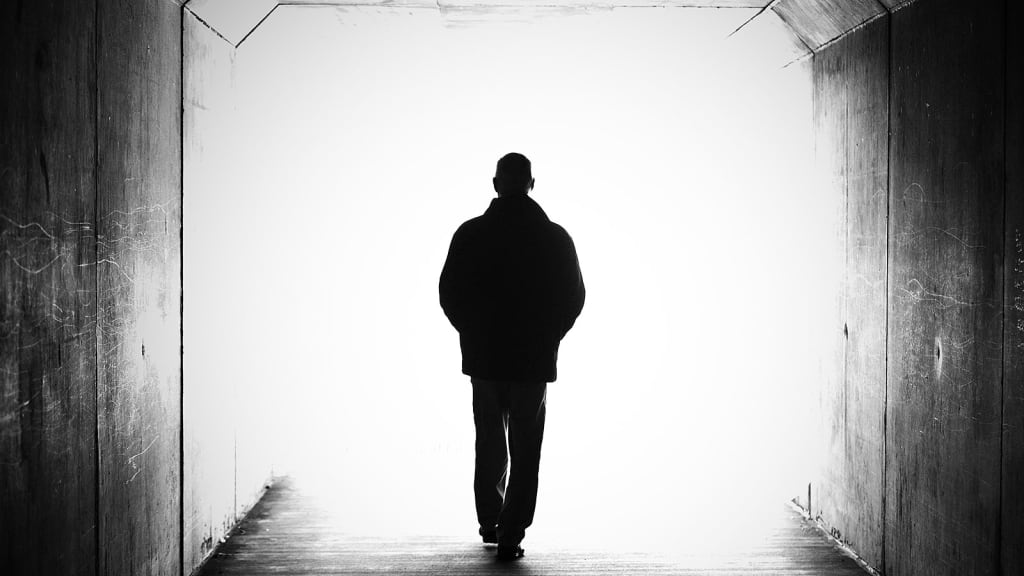
My eyes blinked open. I don't think I was asleep; it was more like I was awakening back to reality from a daydream. But I don't remember what I was thinking about. I just came to, and I was sitting on a train. By myself. On a front-facing, maroon-colored seat. And I hadn't the slightest clue why I was there. I don't remember getting on a train, nor could I think of what reason I could possibly have had to get on one. I drive everywhere.
Everywhere.
I patted myself down like I was a customs officer at the airport, though, unfortunately to no result—the pockets of my jeans were empty. Just as my green army parka was. My wallet and phone were missing, and even more confusing than missing the two items I never leave home without; I had no ticket. So where was I going?
In the corner of my eye, the slight movement of another passenger aboard the otherwise empty carriage caught my eye. I wasn't alone. A dark-haired woman—not quite middle-aged, rugged-up in a heavy woolen overcoat and white scarf draped around her neck—sat huddled against the window across the aisle opposite me. She was silent—her head turned away and she sat staring out the black tinted window into the darkness.
Only briefly after noticing her did I almost lunge out of my seat in a panicked act of desperate urgency. My hands reached out and touched her shoulder. She jumped in fright as her head reactively whipped around in alarm.
I stood back, hands raised; partially shocked, myself, at frightening her.
"Whoa, sorry—I didn't mean to scare you. I was just wondering if—" my voice trailed when I noticed her big brown eyes seemed almost black and dull, as if they were spray-painted a flat matte black. There was no wet glimmering shine eyes usually have glazed over them. They were dull, empty, drained eyes sitting within sunken, tiresome, sockets on a gaunt, expressionless face that could only be described with one word: defeated. "I'm...I'm sorry to bother you, I just...I just wanted to know where this trains heading?"
The woman just stared.
The lifeless gaze was unsettling to meet. I felt my nerves rattling my body. A shiver traversed my spine, and my heart beat that little bit harder. Something was off about her. Just as I opened my mouth to ask if she was okay, she turned back to the window; losing whatever was left of herself to the dark blur passing by outside.
What was she looking at?
I returned to my seat and leaned in against the window. Only then did I notice what was outside. Above the darkness, high up in the sky, the stars shun bright; scattered like glowing paint spattered against a canvas. Vibrant, rich nebula clouds colored the sky with dusty shades of purples and blues and reds surrounded by greens. Larger stars and planets shun white and golden yellows amongst a galaxy cast across space in the sky above.
When my eyes accustomed to the dark outside the train, the sky almost seemed to expand before my eyes as though the darkness was slowly being peeled away to reveal that the train was travelling through space. The bright-burning stars and planets and colorful dust clouds emerged, hidden within the veil of darkness and grew until completely lit—illuminating outside the train. But the bright colors were a blur—blazing backwards like jumbled array of fluorescent-colored lines that created a surreal horizon speeding by.
The train was moving fast. Faster than it should.
It was then bright enough that I could see the black steel tracks—laid upon a crushed gravel base—that stretched out into more darkness ahead. I watched uneasily at each of the rotten hardwood sleepers beneath the tracks fly underneath the train. It was almost too fast to see. The train soared across the tracks, going nowhere in particular, further into darkness.
I slumped back into my seat. Where the hell was I going? I thought to myself, completely bewildered by the question I hadn't an answer to. I just didn't have one. At that moment my head throbbed. It felt cloudy. I tightly squeezed my eyes shut and dropped my head into my hands—my fingertips and palms massaged relief from the pain.
Then the pain subsided.
When my eyes flicked opened, I saw a figure—past all the empty seats—through a window behind a closed door at the end of the carriage. I jumped up. First marching with composed intent, then my stride developing into a desperate, racing dash for the door. I reached out and grabbed the door-handle. I jiggled it over and over—the door rattled but wouldn't budge. It was locked. I banged a fist on the window to attract the attention of the train driver standing in the driver's cab. His heavyset shape in grey overalls filled the entirety of the window—the top of his head where a black hat sat was only half visible atop the window.
"Hello?" I yelled against the glass as my fist came down in a series of aggressively dire thumps. "Hey, you—can you hear me? Hello?"
I stopped. My hands fell onto my hips, and I stood frustrated and confused. At that moment the space behind me shortened, and I felt a presence creep up on me.
“He can’t hear you,” a voice announced at my back. It sounded seasoned and stern and somewhat wise, in a way. “If he can, he’s never listened. Not to no one.”
When I faced the elderly man behind me, his gaze seemed neutral—almost unfazed, compared to the woman who sat miserably by herself staring out the window. He was old. Maybe in his late seventies, or even into his eighties. I wasn’t quite sure. But he looked the kind of age where one became tired and weak. It showed in his face. He looked like he had enough, like he had lived a long, satisfied life that drew closer to its end. His eyes told it. Their sky-blue glow sat between heavy, drooped eyelids and puffy, wrinkled cheeks. They were a window to a youthful vigor within a body slowly dying of age—still glimmering with life but glazed with a knowing acceptance to an inevitable end in which approached.
“What the hell is going on? Where am I?” I asked.
“On a train, son. You’re just another one that’s come.”
My faced screwed up, “what do you mean, another one? Come where?”
“Here. On the train. People come and go. Most don’t stay long.”
“What do you mean go? Where do they go?” I asked, growing more confused by the second. Could the old man be any vaguer?
“They just vanish. One second, they’re here. The next, they’re not,” the old man said as he turned his back to me and strolled down to the rear of the carriage.
“Vanish? People don’t just vanish,” I argued as I followed him. He dropped his old, fragile frame into the last seat on the right.
“They can. They did. Although some have left.”
“They got off the train?”
“No. The train never stops,” he said, peering over his right shoulder and indicating to the door at the rear of the carriage.
My eyes shot to the door. The black tinted window on the carriage door showed only my reflection and the area in which I stood. Even stepping closer to cup my hands against the glass and attempt to look through only bore a closeup of my stressed, desperately-wide eyes.
“It’s just another carriage, isn’t it?”
“I wouldn’t know. I’ve never been able to go through it. All I know is they never come back.”
“What?” I asked. I closed my eyes again as the pain came striking back—throbbing in my head like a drill burrowing into my brain. I rubbed my temples furiously with my palms. But the pain continued to pulse through my head. Then I opened my eyes and glared at the old man for answers. “What’re you on about?”
“When I first woke up here, I could open the door,” the old man began as he sat staring forwards. “I must’ve tried going through it a hundred times, expecting to end up on the other side at least once. But I never did. Each time I went through it, I would just step back into this carriage. Then I stopped trying. For a long time. The next time I tried it, the handle wouldn’t even budge. At least not for me. It never opens for me now.”
“You’re not making sense,” I said, shaking my head. The sharp movements only made my head hurt more.
“None of it does. Not since I got here. However long ago that was.”
Slowly the pain diminished and escaped my head like dust scattered in a breeze.
“How long have you been here?”
The old man moaned. His eyes darkened; the blue radiance dulled like a summer sky doused with the shadowy clouds. “A long time. Far too long. I don’t think I will ever leave this place.”
I stared at him. He didn’t seem fazed earlier. But now he seemed pained. Sad. Even afraid. His eyes told me that he was afraid—that he worried about death and dying here. I felt sorry to have to remind him that he was stuck, though I didn’t know. I still didn’t know; what was going on. But I did know that I wasn't sticking around long enough to become stuck myself.
I had to leave that place.
I turned and approached the carriage door. My eyes fell to the scuffed metal handle that sealed the rattling, windowed escape-way, then flicked to the old man.
The old man looked up at me with eyes glazed with hope. “Good luck, son.”
I gave him a nod. Then, reaching out, I took hold of the door handle, and with ease, cracked it open. Light from the fluorescent globes on the ceiling in the next carriage burst through the opening gangway. I stepped through, pushing the door closed behind me.
It was another carriage. The door had opened, I stepped through, and I didn’t step back into the same one. This one was much the same as the last. The seats still scuffed black frames, covered in maroon upholstery. The windows tinted. The fluorescent long globes spanning the middle of the ceiling in intervals provided ample light to the carriage. Though there were more people in this one.
A few seats up on the left sat a single man. On the right, not quite opposite, was a young woman. A couple sat side-by-side about mid-way on the left in a booth seating. Two children—a boy and a girl, both under ten—sat opposite them in the booth. At the back of the carriage, on the right-hand side, a young teenager sat leaning forward into the aisle. They were all different. Looked different. The single man was in an expensive three-piece blue suit and black overcoat—a wealthy businessman or entrepreneur maybe? The woman, possibly a college student. The family looked very average middle class. The teenage kid at the back stood out the most. He was a long-haired misfit—skinny, with black hair, black clothes and piercings. Though, all of them had one thing in common—they were all defeated. Staring out the windows, they all wore the same empty, lost expressions as though they had given up—as though there was no hope or fight left in them.
“It’s just another carriage,” I muttered to myself.
I walked down the aisle steadily, looking at the passengers as I passed them. None of them looked at me. I couldn’t see the businessman’s face, but he seemed stiff, slumped in his seat like he had been there for a while. The woman was sobbing and holding herself tightly; attempting a self-comforting position pressed into the corner of the window and seat. Her hair fell over her face, covering tear-stained cheeks. I thought about reaching out to her but stopped myself. I wasn’t there for other people. As bad as that sounded, I needed to focus on getting out of there. The family was unsettling. The husband and wife on one side of the booth and two children on the other side sat upright and still like realistic intricately sculpted statues all staring out the window. It was strange.
I passed by them and came to a stop in front of the teenager leaning forward with elbows rested on knees, half-blocking the walkway to the next gangway door. His straightened black hair fell over his pale white face. When he looked up, his eyeliner was smudged beneath his eyes and ran to cloud his cheeks, but the tears had long dried up; leaving his face stained familiarly with the same defeat.
“You alright, kid?” I asked, breaking an awkward silence. He didn’t look as though he had any words on the tip of his tongue. He didn’t look like he had any words left in him.
He didn’t. The goth kid nodded.
“Been here long?” I asked. What else was I meant to ask? I doubt he had the answers. I doubt anyone had the answers I needed.
“Yeah. Long enough.”
“I don’t suppose you know where we are or where this train’s headed?”
He laughed through his nose and shook his head, “no. No one does. The train just rolls on. It doesn’t stop.”
“You haven’t left?” I asked sincerely.
“Does it look like I’ve left?”
I held up my hands defensively, “easy kid, I’m just asking. I’m clearly just as confused as you.”
“Yeah, well—join the club. Unless you’re one of the lucky ones that is sitting here one minute then the next just disappears, then you’re in for one helluva boring ride,” the goth kid said as he sat up and slid back against the window. “So, kick back—you’re gonna be here for a while.” He frowned, bearing the same eyes as the old man, unwillingly accepting a fate thrust upon him like an unwanted Christmas gift.
“You tried the door?” I asked, pointing to the gangway door.
“Doesn’t open. I’ve tried it,” he replied. Though he seemed uninterested in the idea, and the tone in his voice made me wonder if he was ever interested in the idea of leaving. He gave the impression like he had given up before he even tried.
“How many times?” I approached the door and inspected it. It looked the same as the other one. And I couldn’t see through it either.
“Just once.”
My head shot back to him. I felt my brows furrow in surprise. “You didn’t try to jimmy it open? Kick it a little?”
“A locked door is a locked door. If it doesn’t open, it doesn’t open.”
“Doesn’t sound like you tried very hard. Don’t you want to leave?” I asked.
The goth kid sighed. His gaze fell to the floor with a futility that told me I was right. He didn’t care. “No. I didn’t. Maybe I don’t. Who knows? Who cares.”
“What made you try it the first time then? Obviously, a part of you wanted to leave to begin with.”
“I only tried it when Em went through.”
“Em’s who? Your girlfriend?” I asked.
He nodded. “When she started hearing voices calling to her, she chased them through the door. Then when I tried the door, it was locked.”
“Voices?” I asked. Things just kept getting weirder and weirder. I wondered if it was a mistake talking to people. I thought maybe if I went through another door not to stop and talk the next time.
“She heard her sister. Said she could hear her in the next carriage. She really wanted to go. She begged me to come with her. She didn’t want to stay here. Then she left,” the goth kid explained. His eyes widening as he glared holes in the ground.
He had sounded reluctant. Disinterested toward leaving. Toward following his girl. It was strange. It didn’t make sense. What kind of person willingly submitted to confinement with little to no effort at resistance?
“Right.” I looked back at the door. I could almost picture her rushing through it, eagerly chasing a loved one calling her whilst leaving him behind.
“I saw two others go through the door after I tried. I looked the first time when it opened. I didn’t see her in there. But I never tried again. Maybe it’ll open for you? If you want it to.”
If I want it to. Is that what it was? Was it a matter of will? It couldn’t have been—the look in the old man’s eyes told me that he really wanted to leave this place but couldn’t. So, what was his excuse then? Why couldn’t he leave?
I wanted to leave.
I had heard enough in that carriage. I didn’t want to turn back and speak to the rest of the passengers, the look on most of them unnerved me, and I doubt they would've been helpful. Just like the woman in the first carriage.
I approached the door. Grabbing the handle, I opened the door with ease and followed it through into the next carriage. With a flick, it slammed shut behind me, and I was standing in the third carriage. Again, it looked the same. There was only one person on that carriage—a young girl with blonde, black-streaked hair. She wore a black shirt, black denim jacket and black leather skirt with black and purple knee-high, striped socks that rose out of black combat boots. She stood in the middle of the train, staring at the rear carriage door in complete silence.
The girlfriend, I figured.
“Em?” I asked, softly calling her name as to not frighten her. She turned around slowly, hugging herself. When she faced me, I saw her blue eyes wet with tears. Her eyeliner ran down her cheeks crowded by the long, black-streaked, blonde strands of hair that hung down the sides of her face. “Emma, is it?”
She sniffled and wiped the tears from her eyes, “It’s Emily.”
“My name is John. John Matthews,” I said as I approached slowly, reaching a hand out to her shoulder. “Why don’t you take a seat, sweetheart. You look terribly upset.”
I helped Emily into a seat. Her head fell into her hands as she sat sobbing, hunched over on the edge of the seat. I knelt in front of her and swept her hair from her eyes. Then she threw her arms around my neck and buried her head against my shoulder. I comforted her, holding her tightly and patting her back gently.
“Easy, love. It’s okay. You’re fine.”
“They’re gone. They’re all gone,” Emily said through sobs and sniffles.
“Who's gone?”
“The voices are gone. I can’t hear them anymore. Everything is just silent,” she said then broke into hysterical, wailing cry.
“Who was calling you?” I asked, inquisitively.
Emily sat upright. “My sister,” she said once she calmed herself enough to speak. “Then it was my mother. And my dad. I heard them talking to me. Calling to me. I followed after them into this carriage, then they disappeared.”
“When was this?” I asked. It seemed like it was only recent, though the kid next door had insinuated she left a while ago.
“Just now. I ran through the door and when it shut the voices just cut off. It’s so quiet in here. I can’t even hear the train rolling on the tracks. The silence…I hate it—I just hate it so much. It’s so quiet.”
The silence. Between her sobs, when she stopped making noise, there was nothing else. I hadn’t even realized it until now. There was no noise in here. Not even the train. I couldn’t remember whether I could hear it on the other carriages or not. I guess I was that wound up and focused on getting out I didn’t take it all in. It was quite peculiar.
“I just spoke to your boyfriend,” I began, pointing my thumb over my shoulder to the door. “He said that you left a while ago. He didn’t seem like he minded that you left.”
Emily wiped the tears from her eyes and exhaled, deeply. “I just left. He didn’t care about leaving. I tried to get him to come with me, but he wouldn’t go. I don’t think he wanted to go.”
“He tried to open the door after you, but it was locked, he said.”
“All the doors are locked,” Emily said, looking down the carriage at the rear door. “He did want to leave, at first. But I think after a while, he remembered why he did what he did. Now he’s got his wish. And I was so stupid, because now I’m stuck here with him.” Emily collapsed into her hands and began tearing up again.
“Did what? What’re you talking—,”
The rear door tore open, slamming against the wall in the gangway. A frantic man came running into the carriage screaming the same two phrases repetitively, “—NO WAY OUT. THE TRAIN DOESN’T END. THERE’S NO WAY OUT. THE TRAIN DOESN’T END!” his voice bellowed up the carriage, startling Emily and me.
My head snapped to the side, and I sprung up to see a raggedly-dressed man with greying shoulder-length hair and long greying beard, fall to his knees and grasp his head as if containing its implosion into a million pieces as he yelled at the ceiling. His grease-stained blue mechanics overalls had a name stitched in white on the torso: Mac.
I raced over to him and grabbed him by both shoulders and began shaking him, “hey, buddy, calm down, alright. Relax.”
“—NO WAY OUT. THE TRAIN DOESN’T END!”
“Buddy, relax. What’s going on—what do you mean it doesn’t end?” I asked, holding him back so he looked in my eyes.
He stopped shouting. His eyes defended against red venous lightning that struck at the dull, widened browns in the center. He looked both aggressively animated and worn-out at the same time. Like a man tipped over the edge into an abyss of madness. He’s lost the plot, I thought.
“There’s no way out,” he whispered, staring into my eyes. Unblinking. Shaking his head as he told me. “I can hear the voices. They’re so loud, I can’t hear anything else. But I can’t get out. The train doesn’t end, man—it just. Doesn’t. End.”
“What voices? What’re they telling you?” I probed, desperately seeking answers.
His gaze drifted away, over my shoulder. Past me. He stared blankly, almost soulless in a barely living husk, “my family. My friends. They call me home.”
He slumped back on his feet. Hunched over. Head drooped. And fell silent.
I stood up and stared at him for a moment. I was so confused. So...lost. Everyone was mad, and I felt like I was going mad listening to them and trying to understand what was going on.
Then I heard her. My wife. Calling to me.
John? Her voice echoed in my head.
“Kel?” I called out, gasping. Taking a step forward. I felt my eyes awakened. My jaw dropped, and I began to tremble.
I miss you, baby. I miss you so much, you know. Every night I cry myself to sleep thinking about you and how you’re not with me.
“Kelly? Can you hear me?” I called out louder.
I dashed for the rear door, chasing her voice. I jumped through the door into another carriage, ran down that one, past a few silent, defeated passengers into another carriage. Then another and another. Each time I went for a door leading through a gangway to the next carriage, the handles became stiffer and harder to open. But I pushed, and pushed. And one by one they would force open.
Why won't you come back to me? Please, just come back. I don't want to do this all alone.
The carriages were endless. I must've passed through ten, maybe fifteen, before the doors began to slow me down. By that time the carriages were empty, too. There was no one, no sound; but the single voice in my head. Her voice. My beautiful wife Kelly. She was my world, and her voice called me home.
I wish that this didn't have to happen, baby. I'm so sorry, her voice shook as it trailed. Then she paused. I could hear a gentle sob. She was in pain. Hearing it in her voice pained me. I could feel my heart racing after every word she spoke.
Then my head began to throb. And the drill started again—burrowing deeper into my head. At that moment Kelly's sobbing erupted and rung in my ears alongside the throbbing pain like it was the sound of the drill working its way to my brain.
"Kelly!" I yelled.
I think I was at the twentieth door, I'm not entirely sure. At that point it seemed like I was slowly going mad chasing a ghost through an unending, recurring nightmare. Every time I stepped into another carriage, I remembered what the old man had said and wondered whether it was the same one or not. It was empty. It looked the same every time. How would I know? I stopped in the middle of the twenty-fifth, or was it the twenty-sixth? I wasn't exactly counting at that point. It could've been the thirty-sixth for all I knew. I looked back the way I came. The only way I'd know for sure if I was continually entering the same carriage over and over was if I went back the way I came. But I'd have to run through twenty or thirty-odd carriages to where I had left Mac and Em.
John?
My attention drew back to the end of the carriage, the way in which I ran, the direction I followed and chased Kelly's voice.
John if you can hear me, please come back. Come back to me, John. Come home.
I wondered if it was some sort of trick. I wondered if I would end up like Mac—chasing ghosts down the train to nowhere. I looked back the way I came. I should turn back, I thought, before I lose myself. It wasn't working.
John? Her voice called me again. It was soft. Weakened. Afraid. And alone. Hearing my name said by the only woman I've ever truly loved and wanted in my life made the choice disappear. I love you, John. Please, come home.
I faced the rear door and dashed at it. The last few were difficult to open. I had stood there for a minute or so on each, wriggling the lock. Bashing the door. This one I charged at. When my shoulder hit it, the door budged slightly open and I heard her voice loud and clear: "John." It didn't ring in my head, in my thoughts—it was spoken. Out loud. Bright white light burst out through the opened door. Then the door flung back, shutting tightly again. I grabbed the handle and pushed. Shoving the door. Barging the door. Harder and harder. I could hear the hinges grinding, the door rattling. The glass of the tinted window sounded like it was cracking.
I heaved once more. Harder. The glass cracked outwards from the center. I barged the door again. Then harder, again. And Again. Each time the door would open partially, the light beamed through the narrow openings around the frame like high beams at night on an open country road. Her voice called to me: "John? John? JOHN!" It grew louder each time the door pushed open, just that little bit further.
Then one last forceful push and the door was thrown open. The tinted window shattered—glass shards scattered across the floor—then the white light burned through into the carriage, blinding me. I turned away, shielding my eyes.
"JOHN?" Kelly's voiced sounded desperately excited. And wanting.
BEEP. BEEP. BEEP. BEEP
I faced the white fog blaring through the doorway. All I could see was brightness that blurred my vision when I looked into it. I squinted, and stepped through.
My eyes flicked open. And I was laying in a bed. Tubes ran from my nose and arm to connect to several beeping machines on wheeled trolleys beside the hospital bed.
In the corner of my eye, a woman gasped in shock, "John?" My eyes turned to see her, standing over my hospital bed. "You came back. You came back to me," Kelly cried, holding a hand over her mouth. She fell on me. Enveloping her arms around me. I felt her warmth. Her love. As she held tight and didn't let go.
Then she sat up, and kissed my lips.
When I looked into her bloodshot, hurt-filled, sorrowful eyes, they were immediately overcome with happiness. With fulfilled hope. And love. I was gone—laying in a hospital bed, asleep in a coma—and she was the reason I came back. It was her voice that called me home.
About the Creator
Keep reading
More stories from Luka Marks and writers in Fiction and other communities.



Comments
There are no comments for this story
Be the first to respond and start the conversation.