
Caja of the Stone Cave
Chapter 1: The March That Stirred the Stone Witch


"There is belief here — belief deep as stone. And it does not fear iron, or fire, or the voices of men.” — Vaelen, The Seer-Keeper
Captain Orthos stood at the edge of the tree line, boots sunk half an inch into soft moss and loam. The path behind him coiled through dense pine and elder ash, a quiet, watchful forest that had narrowed with every mile. It felt now like stepping out of the throat of something old — into a clearing that should not have existed.
It was too open, too unbothered. No fortifications, no barricades, no signs of military readiness — only soft earth, homes that looked half-grown, and villagers who moved as though nothing had changed. To a career soldier, this was not peace — it was a provocation of absence. His instincts clawed at him. Where was the defense? Where was the resistance? And why, in the hollow of his chest, did it feel like he was the one trespassing into something inviolable?
The so-called village had no palisade, no lookout towers, not even a sharpened post in the soil. Just open earth and stone, as though its people had never known fear.
Low dwellings lay nestled between thick roots and moss-ringed stones, their shapes more grown than built — wood-bound with bark still clinging, rooftops softened with furrowed thatch, and smoke curling from clay vents with the rhythm of breath. No symmetry, no right angles. The place looked like it had grown up from the bones of the forest rather than been carved into it.
And yet, life moved within it.
Men and women walked the open paths in silence — not panicked, not even cautious, but calm, as if they’d already known he was coming. A boy with sun-darkened skin carved bone beside a stream. An old woman hung runed cloth from a limb that still bore spring buds. Someone — he couldn’t tell who — was softly humming, the sound winding like incense smoke between the trees.
Animals were everywhere.
A fox slept on a sun-warmed stone near the village center, tail curled over nose. Squirrels danced along lintels. A deer, pale as snowmelt, drank openly from a basin beside one of the huts — its flank close enough to brush a passing villager. Birds darted from eave to eave, unstartled even by the glint of Orthos’s armor. He could have sworn one perched momentarily atop a carved effigy beside the well, as if to bless it.
There were no guards.
No signal horns. No drawn bows. Just that unbearable sense of stillness. Not the stillness of peace, but of watching or being watched.
Orthos shifted his grip on his blade and took one slow step forward.
The moss did not even crunch beneath his heel.
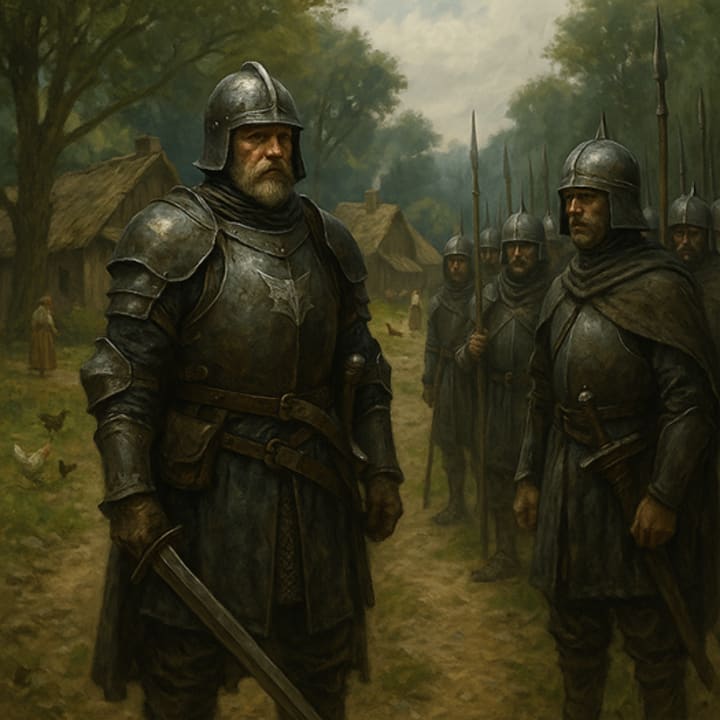
Behind him, thirty men stood in disciplined formation — armor dulled with ash and pine soot, helms low, eyes sharp beneath their visors. Each carried the mark of Gindrath: a silver fox stamped upon leather cuirasses or burned into the shaft of a spear. These were not soft garrison men — they were woods-hardened, veterans of mountain border raids and famine wars, men who could kill in silence and vanish just as swiftly. Even now, they breathed in unison, boots rooted in the earth like iron-grown trees.
They moved only when he did. And right now, they were still.
To Orthos’s right stood his lieutenant — a nameless man to most, known only by rank and obedience. Leaner than the rest, with pale eyes and a scar that split his lip at an angle, he was a blade without hilt or ornament. He said little unless spoken to, and when he did speak, it was always in absolutes: Clear it. Burn it. Leave no survivors.
To Orthos’s left was something more unsettling.
Vaelen.
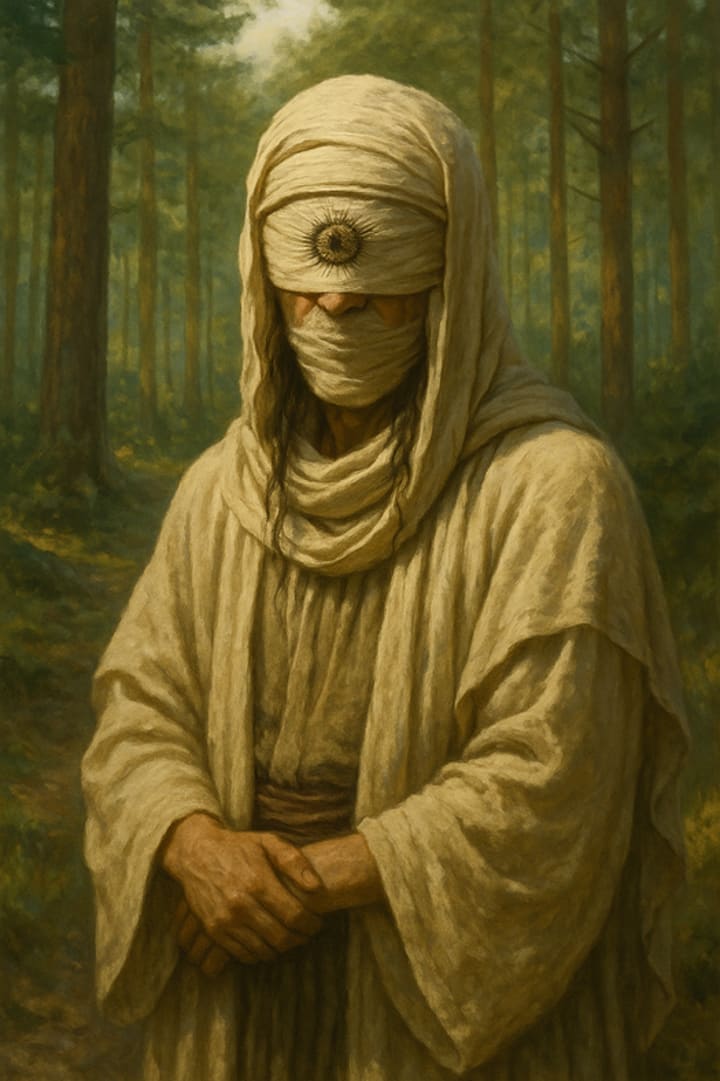
Swathed in thread-bound linen, face partially veiled in bone-colored cloth, the Seer-Keeper stood barefoot in the pine needles. Where his left eye should have been, a relic pulsed — a hollow socket stitched shut with strands of dyed sinew and spider-thread, inside which nestled a small, glistening spindle of carved bone and polished obsidian.
Orthos’s gaze caught the subtle twitch beneath Vaelen’s brow. The air around him seemed to bend for a moment — not from heat, but as if something unseen passed between them.
The Threaded Eye.
No one alive knew who had crafted it, or what it once belonged to. Some said it was a shard of a god’s kneecap, others, the fossilized pupil of a caveborn serpent. What mattered was this: the Eye did not see as men see. It unraveled the world into threads — of thought, of truth, of veiled intent — and mapped them like a loom of fate across the air.
Fine filaments trailed from the socket into Vaelen’s flesh — down his temple, along his cheek, disappearing into the neckline of his robe like silken veins. When magic stirred, the threads would tremble. When lies were spoken, they would stiffen. When something sacred was disturbed, they would hum like tuning wire beneath his skin.
His hands were tucked into the wide sleeves of his robe, and he made no pretense of deference. Where the soldiers watched the village for signs of resistance, Vaelen watched the space between things. The hush. The patterns. The silence that settled between crow calls.
He did not need to be told this place was not ordinary.
The Eye had already begun to itch.
He had not asked for this mission, but he had accepted it. And if he felt any reverence or dread, it did not show.
Orthos knew each man behind him would kill at his order.
But only one — Vaelen — could tell him if the killing would matter.
Still facing the village, Orthos raised a single hand.
Thirty men shifted as one, the sound of armor and breath folding into the forest. And still, no alarm came from Vareth-Anuun. No child cried. No door slammed shut. Just that quiet, unbearable rhythm of life unbothered.
The message was clear — they do not fear us.
And that, more than any blade or spell, put the weight of tension into Orthos’s shoulders.
Captain Orthos stepped forward, iron heel striking root-bound stone. The air seemed to swallow the sound.
He drew his posture tall and let his voice carry, sharpened by training, amplified by the stillness. No bard or bell preceded him — only the weight of authority.
“By order of the Baroness Elyra Valebend, Sovereign of Gindrath, Keeper of the Silver Pines and Defender of Crowned Lands — this place, and all who dwell within it, are hereby placed under baronial rule.”
His voice rang clean through the open space, startling nothing. Even the fox on the stone did not stir.
“From this day forth, you are subject to tithe and census. The woods and water, your crops, crafts, and beasts — all shall be accounted. You will present your belongings for assessment and taxation under decree of the Crown’s Reach Act. Failure to comply will be considered sedition.”
Still nothing. A woman finished tying herbs in a drying rack. A child fed a crow from his hand.
Orthos’s tone hardened.
“Any resistance will be met with force. Swift. Final. Unapologetic.”
His hand hovered briefly over his sword hilt, not drawn — but clear. He searched the still village for even a flicker of fear, a muttered curse, a sign of understanding. Instead, a squirrel bounded past his boot to snatch a pine nut.
“You will bring forth your offerings now. For inspection.”
No one moved.
His jaw twitched. His lieutenant shifted behind him, a breath away from command. Vaelen said nothing, but the threads along his jaw trembled faintly.
Orthos raised his voice one final time, the authority curdling into frustration:
“You will acknowledge your new place — beneath the barony — or be made to understand it.”
And still, the village remained.
Breathing.
Moving.
Living.
As if the forest itself had turned its back on his words.
Only the boy by the stream lifted his gaze — bone knife still in hand, fingers flecked with pale shavings. He squinted at Orthos, head tilted slightly, as though watching a strange bird bark at a tree. Then he giggled — a soft, wind-chime sound — and went back to carving, unhurried.
No doors slammed. No heads turned. A woman resumed her weaving beneath the lean of an alder tree. A pair of goats ambled past one of the soldiers, completely at ease. The fox on the sun-warmed stone yawned, flicked its ear, and rolled onto its side.
Even the wind seemed unwilling to stir.
It drifted lazily through the trees, warm and honeyed, as though drunk on pollen and dew. It tousled a few leaves, flirted with a linen curtain, then gave up and settled again. Above, the sky wore a clear, indulgent blue. The sun was gentle. The scent of woodsmoke, herb-wreaths, and late berries clung to the air like a lullaby.
Orthos stood there, proclamation fading into the soil, wrapped in armor and rising tension — while the world around him simply… declined to notice.
Orthos shifted in his stance, eyes narrowing on the village that refused to react. The warmth of the day clung like a veil, sweet and unearned. A squirrel leapt from one thatched roof to another. A dog barked once in the distance — playful, not alarmed.
His voice came low, edged with disbelief and rising anger.
“I have marched on legions of men and beasts and saw fear within their eyes. I have decimated gangs of highwaymen and scores of rioters — and seen more apprehension at my coming during a parade than I see here.”
He looked again at the boy by the stream, now carving a second pattern into the bone, humming to himself.
“They don’t even blink.”
The lieutenant, half-helmet tucked under his arm, scoffed.
“Perhaps these simpletons don’t understand. Do they even speak the common tongue?”
There was a short silence — until the air changed, not in sound, but in weight. It was Vaelen who spoke next.
His voice was measured, soft, like parchment tearing.
“They understand perfectly.”
The Threaded Eye pulsed at his brow, a faint gleam of obsidian glinting beneath the cloth. The filaments along his jaw had gone still, no longer trembling — but tight, as though something unseen held them taut.
“There is no fear here because nothing within this place recognizes us as a threat.”
He turned slowly, facing the village, eyes half-lidded. A crow cawed from a branch above them, then fell into silence.
“We are not predators to them. We are… insects brushing the hem of something vast.”
The lieutenant shifted his weight uneasily.
“You’re saying it’s illusion? Some trick of the mind?”
Vaelen did not turn.
“No. I’m saying there is belief here — belief deep as stone. And it does not fear iron, or fire, or the voices of men. There are forces at work that will not be cowed by rank or decree.”
His voice lowered, almost reverent.
“Something sacred watches us. And it does not flinch.”
“Then they will watch as this place burns.” Orthos’s voice snapped like iron drawn across flint, raw and edged with a frustration he could no longer contain. There was a brittle crack beneath his words, not weakness — but the strain of a man whose authority had found no ground to stand on. His fingers twitched at his side, jaw clenched so tight a vein rose beneath his ear. A few of the soldiers behind him exchanged wary glances, their disciplined calm beginning to fray at the seams. He turned. “Lieutenant.” Orthos’s voice snapped like iron drawn across flint.
He turned. “Lieutenant.”
The man straightened, hand rising in practiced gesture, about to give the order — when a voice, deep as river stone, cut across the air.
“I warn you, would-be tyrant…”
The words came from the very heart of the village, not shouted — but spoken, and somehow heard by all. Even the breeze paused, as if to listen.
“…the forest, myself, and Caja of the Stone Cave will take much offense if you come here to do harm.”
They turned — and there he stood.
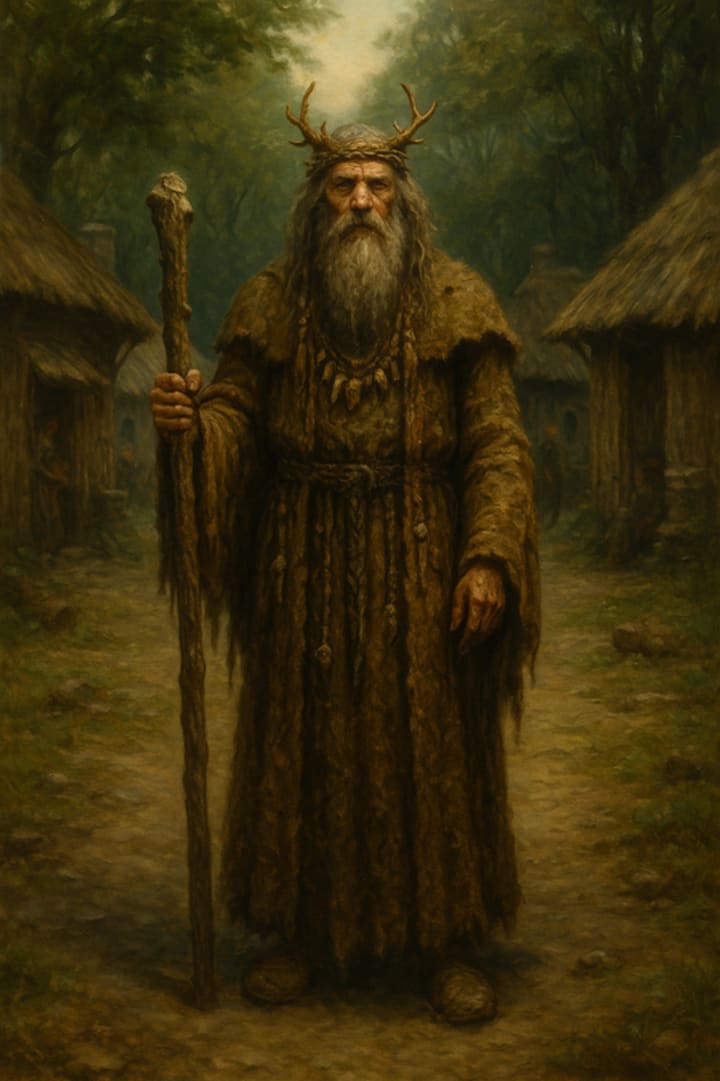
Dorenth.
No one had seen him approach. One moment, the square was empty. The next, he was simply there, as if the roots had uncoiled and lifted him into place. The air had shifted just before — subtle, like the hush before a storm or the reverent breath drawn in a cathedral. A scent of moss and crushed sage lingered faintly in the air, and the animals in the village, so at ease before, bowed their heads or shifted slightly toward him. The fox lifted its snout as if to greet an old friend; the deer dipped one leg. Even the crows, watching from above, fell into stillness — as if acknowledging a presence older than fear.
He stood tall, not imposing but anchored, wrapped in bark-dyed wool and moss-threaded robes. His skin was the color of old soil and granite, lined and weathered with age and knowing. A heavy staff, gnarled and partially petrified, rested in one hand — its surface etched with spirals and bone runes that caught the light like water glinting from a cave mouth. His beard was thick, streaked with ash-grey, braided with tiny bones and dried herbs. A crown of small antlers circled his brow, woven with thorn and feather.
His eyes… were still.
Not defiant. Not fearful. Just deep, like old wells in forgotten places.
Orthos froze mid-breath. His hand remained raised, but the call to violence now hung unanswered.
Vaelen stepped forward slowly, his voice quiet — measured, but urgent.
“That is no hedge wizard or temple priest. That… is a druid.”
He turned toward Orthos, voice low enough to pass for prayer.
“They do not serve gods or lords. They serve the land itself. They are not men of doctrine — but of consequence. The trees know his name. The stones listen when he speaks. To strike in his presence is to invite the forest to remember you as an enemy — for generations.”
Orthos’s eyes narrowed. He lowered his hand.
“Then speak, Druid. If you wear no rank and bear no seal, then by what right do you speak in defiance of the Crown? Identify yourself.”
Dorenth gave a small, quiet laugh. Not mocking — just ancient. Worn smooth with use.
“I am of no importance.”
He stepped forward, just enough that the spiral carvings on his staff shimmered.
“But the one I serve is.”
He turned slightly, gesturing not toward the cave, but to the village — to all of it.
“She watches this gathering. She holds it in grace. And her protection… is absolute.”
He paused, letting the truth breathe between his words.
“I do not tell you this in challenge. I do not threaten. I only speak it aloud, so that your next actions cannot be excused by ignorance.”
His gaze locked with Orthos’s, not hostile — but heavy with rooted truth.
“You are free to proceed, Captain. But know what you walk toward. And who watches.”

Author’s Note
Special thanks to AI VISIONS OF EMOTION for the incredible visual inspiration behind this piece. Their work evokes mood, mystery, and the kind of mythic energy this world was built on. Visit their gallery to see why I keep returning to their images as story seeds.
If this piece resonated with you, drop a comment. Share it. Or just sit with it.
More chapters are coming.
🕸️ www.blkspyder.com | @dblkrose | Black Spyder Publishing
#DarkFantasy #MythicTales #FantasyFiction #AntiColonial #DruidLore #FantasyDebut #SeerMagic #AIStorytelling #BlackSpyderPublishing #Dblkrose #CajaOfTheStoneCave
About the Creator
Dblkrose
They call me D. I write under Dblkrose. My stories live in shadow and truth. I founded Black Spyder Publishing to lift my voice—and others like mine. A brood weaving stories on the Web. www.blkspyder.com | [email protected]
Baron Midnight: Unearthed
Mama Noire’s parlor pulsed with the scent of copal and cinnamon — a thick, sweet veil curling through the room like the breath of ancient spirits. Candlelight flickered across walls adorned with relics: withered black roses sealed in glass bottles, faded photographs pinned within hand-carved frames, bone beads looped around wooden crucifixes. At her feet, chalked veves glowed faintly, humming with old power.
By DblkroseExclusive • 8 months ago


Comments
There are no comments for this story
Be the first to respond and start the conversation.