
The Caliche Curator
On Maintenance, Memory, and the High Desert

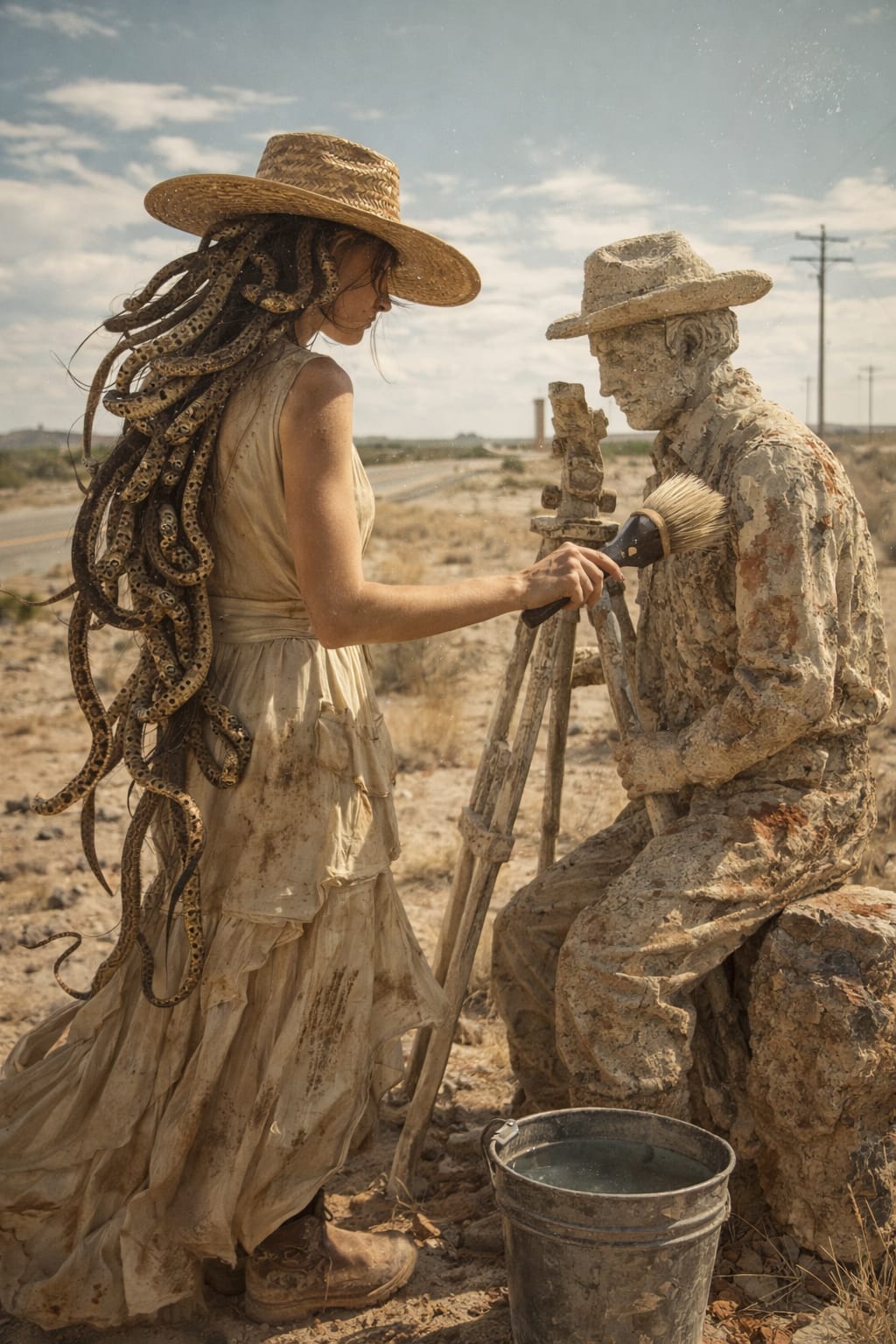
The myth says I hide in the dark, but there is no dark in the high desert—only the long, cruel reach of a sun that wants to bleach the world white.
I was out in the south pasture by 10:00 AM, before the heat began to shimmer off the Highway 90 pavement. I had a bucket of grey water, a stiff-bristled brush, and a heavy heart. My current project was the 1974 Land Surveyor. He'd been standing near the arroyo for fifty-two years, and the West Texas wind had not been kind. The red dust had settled into the porous limestone of his cheekbones, and a family of swifts had tried to build a nest in the curve of his petrified Stetson.
I dipped the brush and scrubbed. Scrape, rinse, repeat.
My hair shifted under the brim of my straw hat. They were sluggish in the morning chill, their scales clicking like dry seed pods. People think they hiss. They don't. They rattle—a dry, electric hum that sounds exactly like the power lines vibrating outside of town.
The myth simplifies the "curse" into a moment of terror, a flash of light, and a permanent statue. It ignores the maintenance. It ignores the fact that stone, like anything else in Marfa, erodes. If I don't scrub them, they turn into featureless pillars of salt and silt within a century. I am not a monster. I am a groundskeeper of the forgotten.
I thought about the night before at The Pony. I'd sat in the dim amber light of the bar, hat pulled low, nursing a tequila soda while a touring band from Austin played to a room full of people in $600 vintage pearl-snaps. Ty had nodded to me from behind the bar—a silent, local code. He knew I didn't want to be "discovered." I just wanted the cold glass in my hand and the rhythm of the bass to drown out the constant, psychic vibration of the snakes against my skull.
In the bar, I was just another Marfa ghost. Out here, I was the only thing standing between a "hero" and a geological timeline.
A cloud of dust appeared on the horizon. It was moving fast, a white bubble of German engineering bouncing over the cattle guard. I sighed, the sound rattling deep in my chest.
"Hush," I whispered to my brim. The snakes settled into a tight, dormant coil.
The SUV screeched to a halt twenty yards away. Out stepped the Tourist. He was a vision of curated ruggedness: a crisp linen shirt, designer boots that had never tasted cow manure, and a wide-brimmed felt hat he'd likely bought at a boutique on Highland Avenue for the price of my monthly grocery bill.
"Oh my god," he said, his voice bright and expensive. He was already holding his phone up, scouting the "vibe." "Is this a Chinati installation? I didn't see the marker on the gate."
"The gate said 'Private Property,'" I said. My voice was like two flat stones rubbing together. "And 'No Trespassing.'"
"I mean, yeah, but in Marfa, that's usually just part of the aesthetic, right?" He approached the Land Surveyor, tilting his head with an air of practiced critique. "This is insane. The detail on the denim? The way the surveyor's chain is fused to the rock? It's so visceral. It's a commentary on the anthropocene, isn't it? The petrification of the working class?"
"It's local caliche," I said, dipping my brush. "And he's not an installation. He's just someone who didn't listen."
The tourist laughed. It was a sharp, delighted sound. "I love that. The 'Reluctant Artist' persona. Are you a local? Did you grow up out here in the silence?"
"I grew up in it," I said. "And you should go back to town. Go look at the Marfa Lights. People love those."
He scoffed, waving a hand toward the horizon. "The lights are just atmospheric reflections. Everyone knows that. I'm looking for something... authentic. Something that hasn't been tagged a thousand times."
He didn't realize that the Marfa Lights weren't reflections at all. They were the leftover heat of my sisters' eyes, vibrating in the dark long after their bodies had been claimed by the scrub. The myth calls it a "Gorgon's Gaze," simplifying it into a weapon. The truth is much more precise: it is a thermal memory. A lingering hello from a family the world turned into monsters because it couldn't handle their specificity.
"Just one shot," the man pleaded. He didn't look at me directly; he looked at the world through his screen. "One shot of the 'Curator in the Habitat.' It'll be huge for my feed. I'll tag it as 'Undisclosed Location.'"
"Look at me then," I said, my patience finally eroding like the limestone under my brush. "But don't say the lighting wasn't right."
He did exactly what the myth predicted, updated for the modern age. He didn't use a polished bronze shield; he used the front-facing camera of his iPhone 15. He turned his back to me, extending his arm to frame us both.
"Perfect," he muttered, thumb hovering over the filter options.
On his screen, the distortion began. The mirage—the heat haze of the high desert—warped my reflection. The snakes under my hat woke up, their rattles becoming a rhythmic, tectonic thrum. He saw them through the glass, but to him, it was just a glitch in the software, a beautiful, terrifying lag in the reality he was trying to capture.
"Whoa," he whispered. "The CGI on this app is getting crazy..."
He didn't finish the sentence.
The myth says the turning is a flash. It isn't. It's a heavy, cooling sensation. I watched as the color bled out of his linen shirt, the fabric hardening into a stiff, grey sedimentary layer. His thumb, poised to capture a moment that would never be posted, fused forever to the glass.
The SUV was still idling, the air conditioning humming a lonely tune.
I took off my straw hat and let the snakes stretch in the dry noon heat. They tasted the air, disappointed; the man had tasted mostly of sunblock and unearned confidence.
I looked at the new statue. He was standing right in the middle of my path to the tool shed—a consequence that didn't quite fit, a modern blemish on an ancient landscape.
"Great," I muttered, picking up my bucket. "I'm going to need a tractor to move this one."
I walked back to the ranch house. Tomorrow I would bring the brush. Tomorrow I would start the long work of keeping him.
Far off on the horizon, the first light appeared—small, amber, trembling in the last heat of the day. Then another. Then a third, drifting slow and purposeful across the dark flats, the way they always did when the sun finally gave up and went home.
Not reflections. Never reflections. Just my sisters, keeping their long watch. Calling out across the dark in the only language the world left them.
I stood at the fence and watched until the cold came, and then I went inside.
About the Creator
Leslie L. Stevens Writer | Marfa, Texas
Her work blends personal essays, folklore-tinged storytelling, and emotional realism, often rooted in the West Texas landscape. She publishes fiction and nonfiction across Medium, Amazon KDP, and reader-driven platforms.
Keep reading
More stories from Leslie L. Stevens Writer | Marfa, Texas and writers in Fiction and other communities.
ELEVEN
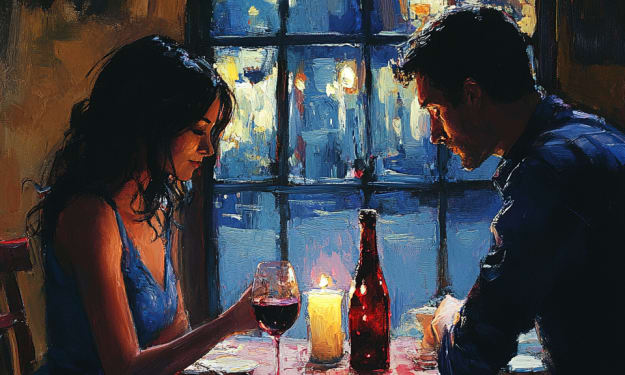
Marco made the reservation himself this year. He'd done it two weeks out, which was not like him — Giulia usually called, usually remembered, usually tucked the confirmation into his coat pocket with a note in her handwriting that said Saturday, don't forget, dress nice. This year he'd opened the app in the parking lot of the hardware store and done it before he could think about whether he should. Same table. Eight o'clock. The one by the window where the candle in the wine bottle threw light across her face in a way he had photographed once, years ago, on a phone he no longer owned.
By Leslie L. Stevens Writer | Marfa, Texas5 days ago in Fiction
Flower Bloom 369
FLOWER Bloom 2/25/26 Wednesday By Mariann Carroll Karen had been with Tony for 7 years. Tony started acting strangely after her surgery. He would mow the lawn in the rain and be on his cellphone. He started pushing Karen away. Tony came clean about seeing someone. Karen moved out two months later. Karen moved in with a friend. She felt betrayed.
By Mariann Carroll5 days ago in Fiction
Cassie and Johnny
I’m the kind of dame you notice. I’m no femme fatale, but you can’t ignore me, at least not until I warn you about what’s coming, then everybody ignores me. Hell, they usually blame me afterwards and give Johnny all the credit for saving the day, but my Johnny couldn’t save a seat at the movies without my help. Sure, he’s brawny, but brainy? Not so much. Like that time I asked him to spot me five bucks, and he said he didn’t see it anywhere on me, and believe you me, he looked but good.
By Harper Lewis5 days ago in Critique


Comments
There are no comments for this story
Be the first to respond and start the conversation.