
By Firelight
The Forbidden Origin of the People of the Flint

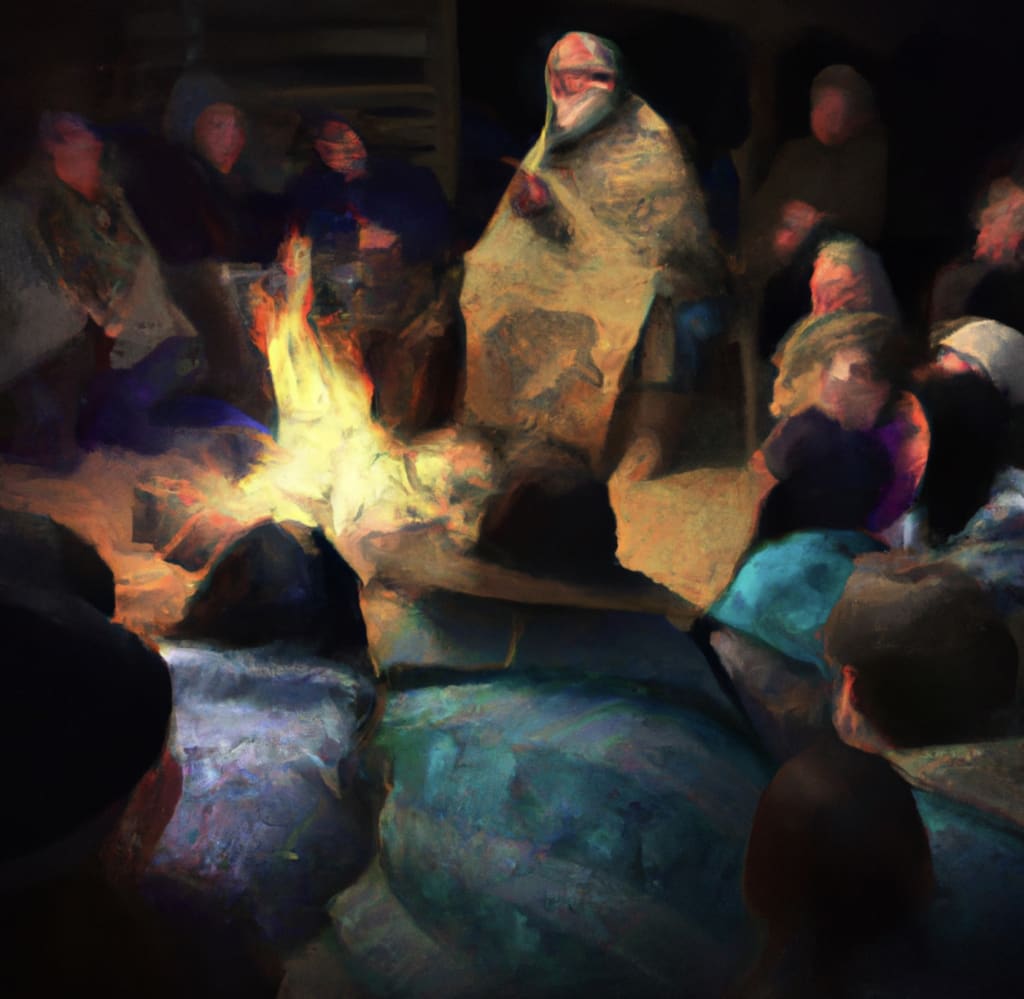
Shadows danced on the wall of the long house as an old man made the slow walk to the stone circle surrounding the central fire. He was shrouded in a reverential silence spread by his passing. Even the children knew the importance of this walk and followed the silent lead of their elders.
The old man, back bent under the weight of decades, walked with slow solemnity. His stick thumped against the bare earth of the long house, sounding almost like a drum beat to mark his passage. It was rare that he would tell a story these days, most of his responsibilities had been passed to his apprentice during the spring planting feast.
With aged dignity, he sat on the edge of a raised sleeping pallet and looked around at the sea of eyes reflecting the firelight before him. Having never lost the passion for his craft, he always relished the time before a story began, the expectant eyes and the anticipation were sweet like maple syrup to him. But an old man can only subsist on the eagerness of the young for so long.
“Tonight,” he began, not yet having slipped into his proper story telling voice, “I am going to tell you all a very special story. I don’t know if anyone in this house would have heard it before, my memory not being as it once was, but I expect you will enjoy.
“We have lived in this land a long time, shorter than perhaps the other elders would have me claim, yet longer than any of you might believe. When Sky Woman received the gift of tobacco to give thanks to Turtle for becoming our land, she did not dwell where we are now. Our canoes are strong and deep, they carry us for many leagues, and we used them to come to this place so long ago that even the trees have forgotten when we arrived.
“But in the time before the foundation of the clans, or the lighting of the fire in the heart of the Confederacy, the People of the Longhouse were scattered.”
There was a gasp and a shuffling closer to the flames of the central sacred fire as the old man threw out his hand and scattered a cluster of pine needles amongst the coals. They flashed and sparked as he shifted his voice to the finest narration to which his age still granted him access, briefly illuminating the dark eyes of the youngest children staring at him in wonder.
“We lived in a place where the air was wet and hot, more akin to breathing stew than air. Where biting insects brought pestilence, and where monsters lurked beneath the water waiting to pounce,” some of the youngest children flinched back or buried their faces in their mother’s skirts. “So we fled,” his voice was sombre now, as though he remembering something painful. “We gathered our families, our dogs, and our crops into our canoes, and moved north.
“The lands we discovered there were far from empty, other peoples who spoke strange languages barred our way and the People of the Flint, at the head of the generations-long migration, earned our name from our weapons of war. We moved by way of mighty rivers of sweet water that descended from mountains taller than anything seen in the flat marsh lands from which we had come. We traded where peoples would treat with us, and learned where they would teach us, and conquered where we could not pass freely.
“But the winters were hard on us, and the peoples of the forests and mountains would not share their secrets. Their demons feasted on our children and their raiding parties took our people as slaves when the world grew quiet and we were forced to learn the word for snow.”
Eyes from all around the fire shifted to the covered smoke hole in the ceiling, through which scattered flakes of snow fell gently as the wind gusted outside and quickly melted. It was a hard night, and the sentries on the palisade would be miserable; of a sudden the audience was grateful for the fire’s light and warmth.
“One winter, as we hid from the war parties and the demons, a child was forgotten in the haste in which we moved. She wandered through the frozen forest, following the footprints of our flight, knowing to stay hidden and move quietly lest the vengeful spirits of the snow and the dark find her, but she was not silent enough. Something noticed her passing and followed her with interest.
“It trailed her for two days as she foraged without success, and watched as she wept when the hunger gnawed at her belly. The thing that followed her wondered when she shivered at the cold, or cried out for her parents to find her; it marveled at her strength.” With gnarled fingers, the storyteller formed shadows on the wall behind him. An enormous shape materialized, thrown against the tightly bound wood by the strength of the fire. “A dragon, that is the word for it, had found the girl whose name was Aarushi.”
Murmurs rose around the fire as the whole population of the long house chewed on his words. Aarushi, whose name meant the first ray of the sun, was the legendary first clan matriarch. She had returned to the People of the Flint from the winter woods after fifteen years away and brought them sacred knowledge. Herself she made the matriarch of Wolf Clan, the mightiest of the clans and the one that held the spear that protected the Eastern Door of the Confederacy.
It was almost sacrilege to speak her name, yet here was the Storyteller sharing with them a story that challenged the oral histories. What could he mean by this?
“The beast showed himself to the frightened girl and named himself, though the name has since been lost in the telling,” despite the claims of the purists, some things are lost from generation to generation. Whether by artifice or by the ultimate frailty of all things human, pieces of knowledge disappear over the long stretches from happening to recitation. “He was a fearsome creature with the head of a wolf, the long sinuous body of a snake, scales each like the shell of a turtle, the antlers of a moose, and the wings of a bat. He also possessed four large legs that ended in the claws of an eagle. All these things blended together beautifully, if in a way that frightened the child, to form the dragon.
“It could speak to Aarushi, though in doing so it never opened its canine jaws. As though the words drifted to her on the wind, perhaps less words than feelings and the memories of dreams, she learned that the dragon did not mean her harm and touched his muzzle. Encouraged, she reached up to scratch his enormous pointed ear as though he were like the dogs her family kept, and so the last of her fear was done away with.” Around the long house, children and adults alike all reached down to rub the ears of their loyal dogs, eyes still locked on the Storyteller.
“At the urging of the dragon, Aarushi climbed onto his scaly back and held tightly to the fur of his head as he raised his great wings and bore her away. To a sacred place, the location of which was never told, he brought her, and there he warmed and fed her while they spoke in their own odd way. She told him proudly of her parents and wept that they were apart. The dragon sympathized, and shared with her a vision of the future. This vision was to be kept secret, a story that she herself only could know; but it was as clearly a message from the Creator as it was that the dragon was something divine.
“The vision, as with all true knowledge changed Aarushi from the child she had been into something more. A great destiny was upon her, so she made the decision she could not have made before and stayed with the dragon. Armed with an ability to learn that far outstripped her youth, she sat with him in his high perch and learned all that he would teach her.”
“YOU LIE,” the shout came from the back of the group. Kanontienentha, the rage on her face poorly hidden behind the long curtains of her hair as indignation at the story flowed like rivers from her hunched shoulders; around her, people gasped and pulled away, leaving her an island in the crowd. Interrupting a story teller at work was a serious business, but the apprentice healer held a special station; her space in the women’s circle when she was old enough was all but guaranteed.
“To tell a story is not to lie,” said the Storyteller placidly. “You may choose to believe or not, as the fancy takes you. Were we not all told the stories of the Algonquin Wendigos as children? Do we not ourselves know of many demons from the frozen waters?” Around the fire some heads nodded, others maintained their stony expressions. “What I say is merely what was once repeated to me, and now I choose to repeat it to you, on a night much like the one on which I first heard it.” Again his voice shifted, “near the black of the moon close to mid winter, when storm winds brought snow from the lakes and-”
“Continue then, old man,” the words were too contrite to be a snarl but the young woman put out a good effort.
That one, thought the Storyteller as he recalled his place in the tale, is well named; Pushing Mountains indeed. A future force on the council and benefit to the people, if she can learn to argue with more thought and less dogma.
“You have heard that Aarushi returned after fifteen years, so much is true,” he said, returning easily to the forbidden story. The story, he knew, would either be forgotten, or remembered only as a pleasant way to have once spent a winter's evening and with no greater importance. Such a pity that people had so little interest in their own true histories these days. With a small chuckle, he remembered his own master lamenting the very same to him a lifetime ago, feeling the weight of years on his shoulders. “And when she returned, she brought to us sacred knowledge from the Creator himself. But you do not know how this came to pass.
“Since Sky Woman first stood on Turtle’s back, the dragon had watched the world. It’s origins are unknown, for either it did not care to share them, or else previous tellers have kept it to themselves, but it was old when it met Aarushi and even older now if it still flies somewhere out there.” From his pouch, he brought out a handful of winter leaves and berries and threw them onto the fire. As they burned, they filled the longhouse with the scent of snow and high places and bitter winds. “The dragon kept her and taught her for fifteen years. After the vision, she was no longer the little girl who had been lost in hasty flight; her mind was older, and more capable of learning. She chose to stay with him each mid-winter when he asked if she had rather depart.
“Those years passed to her as though they were only seen as the blurred shapes through a blizzard. While high in the dragon’s roost, she discovered the hidden ways of the world and devised the clans. Wolf to be the guardians of the People of the Flint, Turtle to be our artisans, and the rest. She learned from watching from that place of the way that certain plants shelter and protect others, learned how one might twin its vines up the stalks of an other to no detriment, and so came into the knowledge of how we now grow the Three Sisters. She even had the first inklings, burned into her mind and passed down through the decades, of the Confederacy; that one day all the People of the Longhouse would come together into one commune of many nations.
“The dragon shared his knowledge with her, having seen something in his own visions from the Creator that singled out this one girl above the rest. When Aarushi asked questions, the dragon answered and thus she delved into the vastness of his knowledge to claim some for herself.”
More muttering among the listeners, and the story was nearing its end. The Storyteller felt the ache in his bones that heralded still more snow. He would be called by duty to tell more stories this night, and in the fresh light of day, how many would remember his lessons told by firelight? Enough and yet not enough, most likely. There were always those who retained more than he thought they would, yet less than he thought they should.
“The dragon,” he continued, making his shadow creature fly again, “taught Aarushi other things too. Imparted upon her secret knowledge that I cannot tell you for I do not know it. But it came down to us in the ancient traditions. Given her stance as our founding Grandmother, it is likely she educated us of survival in winter — at which the dragon excelled. She is also known to have come back to us with still more knowledge with which I won’t bore you now.” There was some exclamation of disappointment at this, but the old man was tired and the most important aspects were already imparted.
“One day — and this comes from a different account, though it is part of the same story — near to the time that we now know of as First Planting, a lone warrior stood at the edge of the small piece of land we had claimed. There were rivers for fish, and woodlands for hunting and foraging; we had even been there long enough that the first fields were cleared for farming — though we had not yet mastered the art.
“And out of the woods strode Aarushi. Her journey from the dragon’s roost must have been long,” the scent of winter berries was gone now, replaced by the crackle of the fire and the wafting odour of supper.
“The warrior did not know her and demanded that she identify herself. ‘I am Aarushi’ she said as the sun crested the tops of the trees. ‘I have been long away, but take me into the village, for I have returned.’ And so the warrior, realizing with shock that she spoke his language, did so and brought her before the Women’s Circle. This woman from the woods who arrived with the first light of dawn caught his attention by speaking. Our language is different to those of the peoples around us such that we cannot easily comprehend one another. But she spoke to him as though born to it.
“Once within the central tent of the village, she explained herself to the council, who of course did not believe her. We had many enemies in those days, more foes than friends of the People of the Longhouse roamed these lands. She must therefore have been one of theirs, a spy sent against us. But Aarushi called to her mother and father whom she recognized thanks to a gift of memory from the Creator.”
People’s attention was wandering; Aarushi’s return was well known, and though they treated the Storyteller with all due reverence, this tale was no longer new. Yet, true to his duty, he forged on, determined to complete the tale using his skills to bring their attention back. “She implored her parents to recognize her, reminding them of the names they had called her and holding up a doll given to her when she was small, a gift kept throughout her time with the dragon.
“Aarushi’s mother wept, the last of her own walls torn down by the proofs offered by the daughter and threw her arms around the returned child’s shoulders. Her father too, a noble warrior of some repute, listened to his wife and wept as he embraced her. But Aarushi was not finished. She still needed to earn the trust and the attention of the council.
“To prove her worth, she insisted that the council listen to her and let her teach them. She would give to them knowledge without asking anything in return to prove that she was who she claimed to be. Or at least, in case the did not believe her even then, a friend to the People of the Flint. The council assented, and teachings began. She showed the builders the secrets to the Longhouses, and the knowledge spread to all of our people who had come north with us. In the weeks that followed, she gifted us knowledge of the Three Sisters, and food became abundant.”
One last thing was needed, just one. The final piece of the truth needed to be imparted, if not to the people as a whole, then at least to the hidden audience who would remember and pass on this story in their own time. “The warrior who had discovered Aarushi spoke on her behalf to the council. Not only would he vouchsafe for her, but he believed her story — as far as she told it because to the end of her days she kept some of the time with the dragon close to her heart — so much that he would leave his family and marry her if she would have him.
“Joining with her family, as has always been our way, he and Aarushi formed the first of the clans. Wolf clan, the warrior clan that defends the confederacy now and bought our land with the flint of their axes and spears. Aarushi was finally home, inexorably part of the Nation now that she was married and the first of her children was born not long after, a daughter thus cementing the clan’s lineage.
“From there the story is well known. The First Matriarch returned to the People of the Flint and imparted upon us her sacred knowledge. We burn tobacco every First Planting to give thanks for her return, and at every Harvest to give thanks for her knowledge. Our thanks go also, though we do not know it, to the dragon in his high roost, to let him know that his deeds are not forgotten. Even if we have forgotten that he belongs to them.”
Three Sisters soup was passed around as the story ended, and the audience — though appreciative of the entertainment — drifted away to their usual employments. The People of the Flint were accustomed by now to the long dark hours of winter and knew that there would be much work to do before the First Planting. Soon enough, a new Wampum bearer would be chosen to bring news of their survival to the other villages, and the Great Parliament would take place again. The Great River flowed ever on, and time stood still for no man.
Thoughts on the changing of the seasons, the Storyteller stood, wincing at a pain in his back. He felt pride at his work, and accepted a share of soup when it was given to him. Enjoying the heat in his aching knuckles, he looked around the long house enjoyed the feeling of completeness from having shared his story. It would be forgotten by most, as it had been when he was young; but then that was better in some ways, else the most foolishly brave take it into their heads to seek the dragon.
The Storyteller smiled, giving a knowing nod to his apprentice. The boy was staring with rapt awe at his master, eagerly absorbing the whole of the tale as he had been taught. After the evening stories were done, he would have to tell the boy the same thing he had been told when he had been the apprentice. That this story could only be told once, because the Matriarchs Council and the Great Parliament in Onondaga forbade it to exist. They would recite it together, though; several times to ensure the lad had it in full. Ancient traditions were the only way to maintain knowledge, after all.
At last, the Storyteller caught the eye of his oldest living friend, a man with whom he had shared most of his life and smiled at him too. The other man was gazing at him sadly, he knew what it meant that this story was being shared again, and that soon the Faceless Society would come to bear the Storyteller’s body away. It would not be long now. The Storyteller was old, and despite his love of the first flowers of spring, the man knew that the Storyteller would not live to see them again.
*Disclaimer*
Although I am Mohawk and a member of Wolf Clan, the above is a product of my imagination and is not meant to serve as either a cultural or historical source/reference piece.
About the Creator
Alexander McEvoy
Writing has been a hobby of mine for years, so I'm just thrilled to be here! As for me, I love writing, dogs, and travel (only 1 continent left! Australia-.-)
"The man of many series" - Donna Fox
I hope you enjoy my madness
AI is not real art!
Reader insights
Outstanding
Excellent work. Looking forward to reading more!
Top insight
Compelling and original writing
Creative use of language & vocab
Keep reading
More stories from Alexander McEvoy and writers in Fiction and other communities.
The Call of the Void
Keeper’s Log: Standard Date 2206–05–30 “No one can hear a scream in the vacuum of space, or so they say. True enough, as far as those sayings go. Sound needs a medium, right? No good without one. Personally, I’ve always been more interested in the one about trees falling in forests. Does it make a sound if it happens, but no one’s around to hear it? Here I am, floating in the silent void, wondering if I’m making a sound. I live in a bubble of habitability, kept alive by machines built by humanity… alone. If I scream in my air bubble, isolated in the cold vacuum, would it make a sound?”
By Alexander McEvoy3 years ago in Fiction
The Mediation, Friday, November 9th, 2012
Anton sat at the large oak table in the mediation services office. He had already been there for twenty minutes. He was fifteen minutes early and eager to get this over with. He already knew that she wasn’t going to agree to anything. If Karin thought he killed it at the first court date, wait until she sees what’s about happen here.
By Anton Mathias Heft a day ago in Fiction



Comments (3)
Oh, Alex, I love the message here. The ephemeral nature of stories, the forgetfulness of humanity in hearing them, the eagerness of stories to dissipate, and the effort it takes to keep them alive. What a brilliant structure for demonstrating this. I feel it in my bones. Also, her name is awesome. It ties into the changing of the seasons, the end of the storyteller's time, and the beginning of the Wolf Clan. What a great choice! (All the names I choose for my stories have symbolic meaning as well. It's one of my little rules for myself, that the names have to mean something important to the narrative.) I expected the heckler to come back into the story, to challenge the narrative more, perhaps one on one with the storyteller. But I like the way you chose to end it. The focus on him made it so much more tangible. I see many parallels to our culture now, especially in the people's inclination toward consuming and then moving on. I wonder why the story was forbidden, though. It seems like the kind of story that would be treasured. Seems like it could be to prevent people going on a fool's errand, the find the dragon and gain infinite wisdom. Super vivid atmosphere, and I enjoyed seeing the audience fidgeting, reacting to the story. I want to dive deeper into Aarushi's time with the dragon! Maybe get a first person account of it and that whole relationship. I got "3000 Years of Longing" vibes, specifically the third story the genius tells (I don’t know if you've seen that movie). Great recommendation!!
Alex, I love the intense way you set the scene in the first couple paragraphs! It carries the weight that an important story is about to be told! You have such a beautiful balance in the way you use descriptive language, it’s vivid with imagery but also not too heavy as to take away from the story! You paint such a vidi picture through the story, it’s incredibly captivating and engaging! I love your description of the dragon, it had me picturing one of those dragons that are often depicted in Chinese culture! Fascinating! Overall such a beautifully told story about the passing of knowledge and the importance for sharing ones wisdom!
I loved this. I could see him very clearly 😁