
Bleeding Tree
from Melodramatic Maladies of the Mystical Mind
In the mornings, sunlight would enter my window at an angle that cast large shadows of toys on the floor. The long shadow arms of the action figures reminded me of orangutans. I didn’t see any shadows that day, because my dad didn’t wake me up at the usual time. In fact, he didn’t wake me up at all. Instead, my growling stomach did, and so I went looking for him. He’d been making me breakfast for the past two years since Mom got taken away. Sure, I was old enough to make my own, but his just tasted better.
I searched for him in all the usual spots: the couch, the hammock out back, his favorite chair in the sunroom, but he wasn’t there. That’s when I remembered it was visitation day at the Grove. I got excited because this meant we could see mom, it also let me know where he was. I found him asleep on the floor next to his bed, on what used to be my mother’s side. A picture album lay open on his chest. I asked him once why he never slept in the bed, and he just said it didn’t feel right.
“Come on, Dad! We have to go see Mom!” I said, shaking him.
As I did this, a few of the beer bottles next to him clanked together and spilled their remaining drops on the carpet. There were always a few extra bottles the night before we went see her. He groaned and brushed me away, still asleep. So I shook him more.
“It’s time to see Mom!” This time he sat up, rubbing his bloodshot eyes.
“Good morning, Kiddo,” he said with a coarse voice. He wasn’t moving fast enough.
“Come on, Dad, let’s hurry,” I said jumping around. He looked down at his watch as if it hurt.
“You’re right. We probably shouldn’t have stayed up so late watching TV.”
This was an attempt to take the blame off his drinking, but I let it slide because he was partially right. The night before, as we ate dinner, I hadn’t touched my food. My stomach used to get upset the nights before visitation day.
But when a dinosaur appeared on the TV, it caught my attention, and I took a few bites. My dad noticed, so he moved dinner to the living room where I finished all my food, and then we stayed up late watching the show. Moments like these, I didn’t care that he drank.
“Why don’t you go get ready while I take a shower,” he said.
I hurried off to my room. We were allowed to see Mom in the Grove every three months, and for the past two years I looked forward to every trip. But today felt off. My dad seemed sad, even though he didn’t do anything differently. I figured if I dressed myself real nice, it would make him feel better. So I grabbed one of my nicest shirts, a green button-down with some teddy bears on it, and tucked it into my dress pants. I finished by tying up my polished shoes and looking in the mirror proudly.
When he walked into my room, he smiled at me, and for a moment I thought my plan worked—but then I realized he was wearing a blue shirt. That was Mom’s favorite color, and I felt dumb for forgetting. I tried to change, but he said we didn’t have time and hurried me to the door, leaving behind my guilt.
“If we don’t get there soon, the hooded lady won’t let us in.”
I was scared of the hooded lady back then. I felt like she took my mother away, and I resented her for this. But the truth was that she saved her—in a way. It was on a day we went to the beach as a family. I was young and don’t remember much, but there was a turtle I kept following. My mom worried he would lead me into the ocean. It’s a silly memory, but my last good one of her. On the ride home, a truck lost control on the road and swiped our car, sending us into a nearby forest where a tree impaled itself into the front bumper.
The horn wouldn’t stop honking. It’s all I heard as my dad pulled me out of the car and sat me on the damp forest floor. My body was limp and confused, but I was okay. Then I watched as he rushed to the passenger seat to get my mother. It was dark, and I only saw his frantic silhouette until he carried her and placed her in view of the headlights, where her vulnerability was on display. I saw him crying, and his hands shook as he held her. He pulled out his phone and tried to make a call, but when it didn’t ring, he threw it into the dirt.
That’s when the hooded lady appeared from the forest as if by magic. She talked to my father, who waved his hands in protest. I don’t know what she said to him, but he settled quickly. He came to tell me not to look back, and we walked away—until three months later when we saw Mom’s bleeding tree for the first time.
The hum of the air conditioning was the loudest thing in the car. My dad didn’t say much, which made everything take longer. I watched as he kept squeezing the steering wheel and letting go. I grabbed the leather seat beneath me and squeezed, quietly mimicking him. But it didn’t do anything for me, so I ended up playing with a loose thread on my shirt until we got to the grocery store.
It was tradition to stop there before the Grove for flowers and a snack. At the flower display, my dad went back and forth between a bouquet of yellow lilies and red roses.
“Why not both,” I said. He smiled and placed them both in the cart. I left him to grab a strawberry milk—my favorite—but when I went to meet him at the register, he was missing. I found him at the newspaper stand. His face was white.
“You ready?” I asked, oblivious to his emotion. He didn’t move until I said it again.
“Uh huh,” he mumbled while grabbing the paper and heading to the checkout.
He handed me the milk and told me to go wait in the car while he went to the bathroom. He always did this, and I wondered why he didn’t just go before we left, like he made me do. This time he took extra long, and I started needing to go myself because I had just chugged my milk. So I left the car, and as I entered the bathroom, I saw him quickly put a flask in his pocket. I asked what it was, and he brushed it off. I didn’t press him, but now I understood he probably never used the bathroom.
As we walked to the car, he kept the newspaper pressed under his arm, and now I really wanted to know what was in it. But, he was walking faster than usual, and I kept stumbling trying to keep up. I could tell he was mad, but I didn’t know why.
Once the ignition was on, he put the paper on the center console. I tried to grab it, but he snatched it. The quickness in his movement scared me.
I sat with my hands in my lap, waiting for a scolding that never came. He was too distracted. His hands were choking the steering wheel like before. So I watched and waited until his grip was looser.
“Why’d you get the paper today?”
“Because these idiots want to close the Grove,” he said, turning to me with a face of immediate regret. I wasn’t supposed to hear that—but for a moment, he forgot he was a dad, and instead of a son, he needed a friend.
“Does that mean we won’t get to see Mom again?”
“Don’t ask stupid questions.”
I knew it wasn’t stupid, but I still tucked my head down low enough to hide behind the teddy bears on my collar. That was the first time I realized just how hard the trips to the Grove were for him. I didn’t say anything else, and neither did he. The only thing that broke the silence were the cars passing in the other direction.
The forest grew denser and cast permanent shade over us. This meant the Grove was close—as well as the crash site. Dad always sped up here, and I looked away until we reached the parking lot which always seemed out of place to me. I thought nature agreed, because the concrete slab was littered with vines and overgrowth. But regardless of how we felt, it was always full on visitation day.
Dad grabbed the newspaper, and we walked to an old, shabby booth tucked away in a wall of bushes and vines. He told me to wait on a nearby bench while he went to talk to the hooded lady. As soon as she exited the booth, he waved his arms emphatically, and I knew he was talking about the possible closure. No matter how elevated his voice got, the hooded lady remained calm. I don’t know what she told him, but when he walked back to me, he was calmed—still unsettled, but calmer. I thought this might be a chance to learn more.
“Dad, why do people want to close the Grove?” He paused and reflected for a moment. He wouldn’t forget his role as father this time. He kneeled down to my level.
“When people are too far away, they can’t always see things clearly.”
“What do they see?”
“They see…” He hesitated, unsure of this next part. “Pain, instead of love.”
This confused me. I wasn’t used to thinking about things like that.
I gave my father a nod as if I understood—but I didn’t.
We met back up with the hooded woman, who stuck her hand into the wall of vines and began mumbling. The vines started recoiling into the rest of the wall until a passage was clear. It was cool the first time I saw it, but now I just wished it would go faster so I could see Mom.
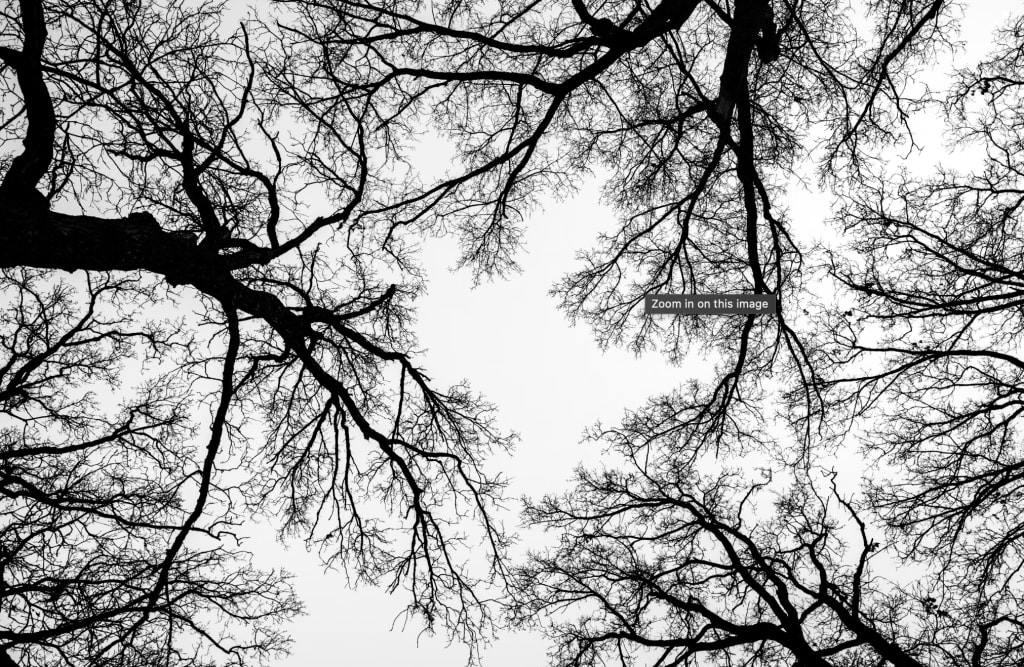
As we entered the Grove through this viney gateway, the dense forest cleared, and the trees were evenly spaced apart, standing in organized rows and columns. It looked like a bunch of headstones in a cemetery, but no one was dead — just waiting. The sun was still blocked out by the thick green canopy, and in the dim lighting, your eyes couldn’t help but gravitate toward the sparkling crimson blood running down the trees.
We continued following the hooded lady into the rows. Row four was where Mom was, and where we passed other families I recognized from past visitation days. I watched them perform their usual routines. One was having a meal around the tree trying to make it feel as included as possible. The other group was singing hoping to bring comfort. Closer to Mom’s tree, I noticed a new family I had never seen before, standing awkwardly by a tree whose blood was fresh, and arguing. As we got closer, we heard one of the women.
“It’s not right!” she yelled, and then ran away, right past us, crying. I looked at my dad for some answer and could tell he didn’t know what to say.
“You excited to see Mom?” I thought I was.
We arrived, and the hooded woman motioned us forward, but my dad stayed back to talk. I went on. When I saw her face enveloped in the tree, I couldn’t help but run to her, and wrap my arms around her. But I forgot about the crimson blood that ran deep in the bark, and I stained my shirt. I looked at the mess, then back at her. She stretched high into the canopy. I used to see this as strength, but now I wondered if it hurt.
“Sorry, Mom. I got my shirt dirty,” I said, looking at her eyes. They didn’t move, but there was a sparkle in them that looked like tears. According to my dad, this is how you knew she was happy to see us. But that day, they reminded me of the times I fell and cried on the playground.
“Are you okay, Momma?” I asked, brushing a strip of her blonde hair from her face. But there was no answer—never was—and the hair fell back in place, covering a part of her.
My father’s conversation ended, and the hooded woman left us. He placed his hand on my back and brushed the piece of hair out of my mother’s face like I did, but he hooked it on some bark so it would stay. He stared at her a little longer today, took more time as he bent down to place the flowers at her base. He didn’t even notice the stains on my shirt—or didn’t say anything.
We sat down in our normal spot, which was on the ground where two sets of roots overlapped into a natural park bench. My dad always said she built it for us.
“Why don’t you tell her how school’s been.”
And so I began talking—telling her how I was ready for summer just so I didn’t have to do math anymore. I talked about the friends I made and the things I learned. That quickly turned into a story about a recent visit to the park, and then that turned into a discussion of the dinosaur special I watched the night before with Dad.
My father just sat back and listened to me excitedly sharing my life. It was the most peaceful he had been all day. When I said all I had to say, we sat in silence. I began playing with some of the fallen leaves, being careful not to break them in my hands.
“You okay?” Dad asked. I paused and just held the leaf.
“You think Mom is in pain?”
“Of course not. Look, she’s so happy to see us.” Her face was blank, and I wondered how he knew.
“Don’t start sounding like those people in the newspaper,” he said angrily and walked away.
I sat on the root bench alone and looked at my mother for a while. I missed the way she used to be. From where I sat, she was all I could see, and the rest of the Grove was just a blur in the distance. I began to wonder if people who were too close didn’t always see clearly either.
⸻
A month later, my dad woke me up in an unusually happy mood.
“I have a surprise for you in the kitchen.”
I rubbed the sleep out of my eyes and looked at the shadows cast by the sun—only toys, no orangutans. After dressing, I headed to the kitchen, where banana pancakes and strawberry milk—my favorite—were waiting for me. My eyes lit up.
“There’s more.”
He held up the newspaper, pointing to an article.
“The Grove isn’t closing!”
I stared for a minute before spitting out, “That’s great,” with a forced smile. I tried to match his energy, but deep down, I wasn’t sure if I should celebrate. I didn’t finish my pancakes, and I left half a glass of milk.
We returned to the Grove every three months for the next ten years, until all her blood finally ran down the tree. Every time, I remembered that girl who ran out saying, “It’s just not right.”
But we kept going, and I made sure Dad brought extra flowers.
About the Creator
Keep reading
More stories from Melodramatic Maladies of the Mystical Mind and writers in Fiction and other communities.
Fishing at the Edge of the World
I was disappointed when I caught a star-tinged guppy at the edge of the Earth. A space whale, or at least something bigger than my hand, would have been nice to show my village. But that’s not how the day went, and looking back, I should have been thankful I didn’t die out there. I was young and naïve, thought I could do it all alone. Boy, was I wrong.
By Melodramatic Maladies of the Mystical Mind2 months ago in Fiction




Comments
There are no comments for this story
Be the first to respond and start the conversation.