
Fishing at the Edge of the World
from Melodramatic Maladies of the Mystical Mind
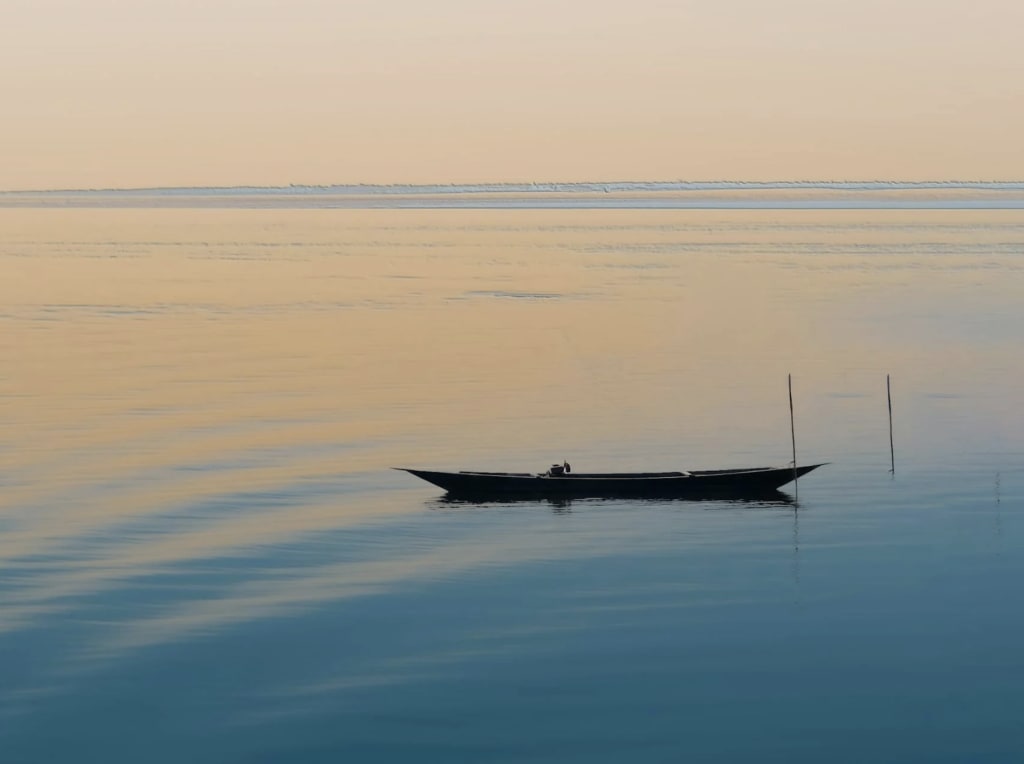
I was disappointed when I caught a star-tinged guppy at the edge of the Earth. A space whale, or at least something bigger than my hand, would have been nice to show my village. But that’s not how the day went, and looking back, I should have been thankful I didn’t die out there. I was young and naïve, thought I could do it all alone. Boy, was I wrong.
See, I lived in a small fishing village near the edge of the world. We called it The Edge for short. It’s a beautiful place, but when people go, they don’t always come back. Regardless, it is a necessary journey because our primary export is space fish and all the valuable resources they provide. That’s why every boy in the village needs to learn the practice. But our population is small, so the elder made a rule that no boys under thirteen were allowed to go there, and out of this rule came our tradition: Floundering Day.
It occurs on a boy’s thirteenth birthday. He goes to The Edge with his father and has the opportunity to prove himself to the village. Whatever he catches, he brings back and is celebrated for it. However, there is an important condition that must be followed: the fathers can’t help their sons unless the situation becomes dangerous. This often leads to a long day of fathers watching their sons flounder about—and so the day is named.
I didn’t want to be that floundering son. Pop was one of the best fishermen in the village, and I wanted nothing more than to follow in his footsteps—to make him proud. I was a bit of a bookworm back then, and so, prior to my Floundering Day, I spent most of my time in the village’s library reading through books like Salmon from Saturn and Fundamentals of the Comet Trout. These books, many older than me, were collections of writing by our village elders. I would learn the hard way that reading was no replacement for experience. Pop would have been a better resource, but my stubbornness kept me from asking him.
One day in the library, I came across a dusty old book: Space Whales: The Universe’s Quiet Gargantuan. It captivated me. The stories and rumors of this leviathan fed my imagination—maybe a little too much—because now I had resolved to catch one. What better way to prove myself than to show up with a space whale on my Floundering Day? It was such a foolish thought. After all, only a handful of men had seen them, and Pop insisted half of them were lying, but it didn’t matter—my mind was made up.
This idea got me harassed quite a bit. The boys in my school would call me Whale Boy or Ocean Whisperer. Even the adults would stop me and talk about it. “They’re too big,” some would say, while others asked, “How do you expect to capture a messenger of God himself?” They had a point. I had no idea how I would do it. And after Pop insisted I focus on smaller fish, I gave in. Well—not completely.
That’s why on the morning of my Floundering Day, I couldn’t leave my whale book behind. Everything was packed, and I was about to leave my room, but something pulled me back. It felt wrong to leave the whale book. I slid it into my bag between my tackle box and another book I packed for reference. I’m glad I did.
In the kitchen, my mother laid out a hearty breakfast for me, like she often did for Pop. I began shoveling bite after bite into my mouth. If I wanted to fish like Pop, I had to eat like him. That thinking only ended in a stomachache. Ma noticed my struggle.
“Hun, you don’t have to finish it all.” I shook my head in disagreement as I continued staring at the food in front of me. She seemed to sense my nerves in a way only mothers can.
“It’s going to be okay.” She rubbed her hand through my hair. “I’ll tell you the same thing I always tell your father before he leaves: If you aren’t catching anything, and you get frustrated, repeat to yourself, breathe, and the fish will come.”
“Yeah, yeah, Ma, I know,” I said—but it probably sounded more like “ya ma mmm,” because I had just stuffed my face with the last remaining sausage. I remember Pop peeking up from the newspaper at my mother, giving a slight smile and shaking his head. My mother sighed, walked to the kitchen counter, and returned with a sandwich packed in a small bag. “Don’t forget your lunch.”
Rubbing my belly with regret, I told her, “Ma, a bagged lunch is for kids. I’m going to catch my own, like Pop does.” My mother gave Pop a stern look. That’s when he stood up, tossing the newspaper on the table. “Looks like the weather will be great for your Floundering Day. Time to head out.” I learned later that as I turned to grab my backpack, he gave Ma a wink and snuck the sandwich into his small storage chest.
We arrived at the docks. My hands squeezed my backpack’s shoulder straps as I watched the sea of villagers waiting for us. It’s tradition that the village sends the boy and his father off on their Floundering Day—but I could have done without it. As we reached the edge of the crowd, Ma stopped to give me a hug. I tried to squirm out of it early, and when she finally let go, I rushed away, hoping no one would see. I didn’t get far before she lured me back in.
“Don’t you want your lucky kiss?” she asked, looking back at me, surprised. I looked around at the crowd before sheepishly walking over and pointing at my cheek in an exaggerated, cartoon-like manner—like I always saw Pop do. It was a daily ritual they shared.
“Put one right here for good luck.” Despite my apprehension about public affection in that moment, a small part of me believed my mother’s kiss was magical. I would have been dumb not to take it. A few boys from school sniggered, but I tried to ignore them.
The mockery continued as Pop and I walked through the crowd to our skiff. I could hear people saying, “Can’t wait to see a space whale.” Pop tried to put his arm around me for comfort, but I wiggled out, puffing out my chest. I tried to stand confidently—but then I saw Petey.
He was a nice kid and genuinely wished me luck. He said some other words to me, but I couldn’t hear them. All I could think about was my feet. See, a few weeks ago, Petey had his Floundering Day, and when he was in my position, he slipped in front of the whole crowd. However, he brought back a big fish, so for a moment I thought maybe I should slip—but I couldn’t stomach the embarrassment. I watched my feet the whole way. It made me walk funny, but at least it kept my mind off the jeering crowd.
Our boat—a small skiff with paddles—was a family boat passed on through generations. To many, it wouldn’t have seemed like much, but to Pop and me, it was more than enough. We shared many normal fishing trips in this boat, and it felt like home. But as we settled into it with our supplies, I felt nerves instead of comfort.
Once settled, the village elder approached us with hands raised and began a prayer. Everyone had their heads bowed; I knew because I was looking around anxiously. All these people will be here when we get back. I need to show them something incredible. The elder finished, and I quickly pretended to pray as if I had been doing so the whole time. He blessed us with incense, and I excitedly grabbed the oars, ready to shove off—but he wasn’t finished. He leaned over and got close to my face.
“You are more important to this village than any fish. Be smart and safe, and you will be welcomed back as a hero for that alone.”
I still remember those words every time I go to The Edge. They anchor me and remind me that my true purpose is here with my family. But as I rowed away that day and the sea breeze hit my face, it washed all the words away. I was focused on one thing: proving myself.
As the noise of the crowd faded, I adjusted to the quietness. It was just me and Pop now. He was right about the weather. The temperature felt perfect, and a crisp breeze flowed through me. It fueled my childhood imagination and made me search the distance for something exciting. I hoped to see some magical splashes from a pack of orbiting dolphins, or maybe some driftwood that was really a Jupiterean shark. My mind was racing, and at the heart of it was a yearning to see something special. I’d get that soon enough.
The sky grew dark. The blue morning melted into a purple, and that purple eventually settled into a black sprinkled with the brightest stars I’d ever seen. The moon looked down on me, and the craters on it were so clear. I remember noticing how they were shaped into a smile, created from thousands of happy collisions with asteroids. While I gaped at this new world, Pop sat calmly. He had seen it all before. While my neck was fixed skyward, he spoke to me with a seriousness I was not used to.
“Be careful,” he said. “Don’t let the beauty distract you.”
“Right,” I replied, retracting my neck. Pop wasn’t supposed to intervene, but I quickly understood why he did. We were at The Edge, and in front of me lay a waterfall that continued in both directions as far as the eye could see. The way it effortlessly flowed into space made me feel like I was sitting at the right hand of God amidst creation. It made me feel small—but I felt even smaller when I realized that had Pop not said something, I would have rowed us off the edge. It was my first failure.
I quickly adjusted, using the oars to stop our forward momentum, then went to drop anchor so we’d stay in place. Surprisingly, it was heavier than what I was used to. I didn’t realize Pop used a larger anchor for space fishing. I struggled with it, nearly losing my balance. Pop noticed.
“I’ll help with that when we leave,” he said. I shook my head in acknowledgement.
Next, I readied my line. I’d waited thirteen years for this moment, and when I finally cast, I was not disappointed. My line passed the crest of the waterfall and flew off the edge. Because gravity is different here, it didn’t immediately crash down. Instead, it did a magical dance before slowly sinking into the beyond. I was optimistic the rest of the trip would be just as magical. Naïveté can be a wonderful thing.
Hours passed, and nothing happened. Pop sat alone at the front of the skiff with his eyes closed—maybe meditating, maybe sleeping. I wanted to give him something to look at. So when my line finally tugged, I jumped up excitedly to get his attention. It was a good back-and-forth, worthy of Pop’s notice. I eventually won, and the fish fell aboard. Like I said earlier, I was disappointed. Pop gave me a small smile of encouragement and closed his eyes again. I wish he had never opened them.
After that, the day seemed to start speeding by without my consent. I recast my line what felt like a thousand times, trying new spots and new techniques. Every second I didn’t catch something, my frustrations grew. I leaned into what felt comfortable for me—my books. Flipping through the pages, I hoped to find some technique or hint, anything that would help. But all I discovered was my hunger.
It had been a long time since breakfast, and my stomach let out a growl. It was the first time Pop had moved since I caught the guppy. He reached into his small chest, pulled out Ma’s sandwich, and tossed it at my feet. He closed his eyes again, and I went back to fishing. I was starving, but I wasn’t going to eat it. I didn’t earn it.
However, it did remind me of Ma, and in my desperation to catch something, I remembered her advice. Just keep breathing, and the fish will come. I wanted a little bit of her magic to be true, since so far her kiss wasn’t working. I kept repeating this to myself as I sat there quietly.
I didn’t sit there long until I was interrupted by Pop.
“Time to go. Pack up everything, and then I’ll help with the anchor.”
I was crushed. I looked at the star-tinged guppy in my chest. A hundred more of them couldn’t fill it. I packed up slowly, checking my line every so often, hoping for a last-minute bite. I slid the books into my backpack next to the bait and put the whole thing on the edge of the boat. The whale book seemed like a real waste of space at that moment. My line still sat there untouched, and there was only one thing left to do: the anchor.
I was about to ask for help, but then I got what I thought was a brilliant idea. If I couldn’t impress Pop by catching fish, I would at least show him I was mature and strong by bringing up the anchor on my own. At first, it wasn’t that bad. My hands wrapped tightly around the chain, and I pulled some of it up with a reddened face. The excess chain clanked on the boat, and Pop turned quickly toward me.
“Hold on, boy! Wait before touching that!”
But it was too late. I didn’t wait, and the next bit of chain I pulled up was wet. It slipped right through my hands, plummeting downward. I reached out, trying to stop it, but lost balance—and I went right over. In the air, I clawed for anything I could, but only managed to grab my backpack. As I hit the water, I tried to clamber on top of it, but books don’t float.
The current was too strong to swim against. All I could do was watch my father as I started drifting away. He didn’t have time to raise the anchor, so he tossed out a lifebuoy connected to a long string. It hit me right in the hands, but I couldn’t quite hold onto it. I looked helplessly at my father as I fell off The Edge.
It was surreal. I expected to plummet, but like my fishing line, I lingered before gravity slowly escorted me down. My life was sinking into the depths, and there was nothing I could do about it. As I fell, the light from the moon faded along with its smile, and the stars that once shone so bright seemingly disappeared. It’s weird, falling to your death slowly. For most people, it’s quick, but not for me. My fall was more reflective, and I had time to remember all my failures of the day, which proved to be a temporary hell.
Luckily, I didn’t have to live in this hell for long. After a few minutes of falling, my feet hit the ground, and although I was falling slowly, it was fast enough for my knees to buckle. This sent my face and backpack onto a slimy, organic-smelling surface. To this day, I don’t know what I landed on—maybe a giant chunk of space coral or some remnant of Earth rock that fell off the edge. None of it mattered in that moment. The sliminess reminded me of giant lily pads, and so that’s what I called it.
I stood up, rubbing my head, trying to take in my surroundings. I was in a strange place. The stars were gone but it still felt like space. The water was gone but it still felt like the ocean. Air mixed with nothingness into a thick consistency that was difficult to breathe but still life giving. There was enough light to see my hands, and I was thankful for that. When I turned away from the waterfall and looked out into this abyss I could hardly see a thing. So I squinted, and I managed to make out what appeared to be colossal shadows in the distance. From their size I figured they were mountains or large hills. What else could they be? Regardless, they sent a chill down my spine, and I turned back around, hoping to find some solace in the waterfall—but it only stood like a towering behemoth in front of me, an insurmountable challenge. I couldn’t decide which view was better, so I collapsed to the ground.
My despair was interrupted by a bump on my head. It was the lifebuoy from my dad. I caught it and watched the rope attached to it slowly coil itself in my lap. My father must have let it go, I thought. I wondered if he had given up and gone home. I tossed it to the side angrily and yelled. This was all my fault. I lay on my backpack and curled into a ball, crying.
Pop always told me a man is defined by how he carries himself in crisis, and here I was, crying. I didn’t want to, but I couldn’t help it. The tears just flowed. The endless waterfall, the shadows in the darkness—all of it was too much. My village, my parents—would I see any of them again?
For a young boy, mortality is the last thing on his mind, but I was forced to think about it in that moment. I regretted rushing Ma’s hug that morning. I would have done anything to have another, a full one. As I thought about her, I remembered her words and repeated them for comfort: Just keep breathing, and the fish will come. But it wasn’t right. I didn’t care about fish anymore, so I changed it: Just keep breathing, and someone will come. It felt like a prayer and the closest thing I could do to feel near Ma and Pop.
The words would occasionally get interrupted by waves of crying. Tears lingered in front of my face for a few moments before falling on the lily pad. The Edge still had a way of mystifying me even in my depression. A few cycles of crying and my mother’s mantra continued before a neon light by the colossal shadows appeared. I was sure it wasn’t there on my descent—but now it was, far off in the distance. Then another appeared. And another. Before I knew it, a hundred more lit up. They shaped the colossal shadow, but they were dim, so its identity stayed hidden.
I was perplexed, and truthfully, a little afraid. My fear only grew when I heard the sound. The closest thing I can compare it to is the foghorn on a large cargo ship. But the sound was deeper, louder—not in a way that hurt the ears, but in a way that grabbed the soul and made the body tremble. That’s when I remembered something—a line from one of my books.
I opened my backpack, tossing out everything until I got to Space Whales: The Universe’s Quiet Gargantuan. I carefully flipped through wet pages with squinted eyes. I heard the noise again and turned the pages even faster, more carelessly. A few of them ripped, but I didn’t care. I found what I was looking for: a quote—“Their call is unmatched, and so visceral that it is known to make a grown man tremble.”
I looked back at all those dull lights. The colossal shadow started to move. The body of it was beginning to come into focus. There were no longer any doubts as to what it was. The lights were nothing more than luminescent rocks scattered across the leviathan’s body. When its face became visible, I was enthralled by its size and beauty. I no longer cared about my mortality—I was a young boy, filled with wonder again, looking upon the creature of my dreams. I never felt more foolish for wanting to catch one.
It continued to get closer to me, and I worried I would be launched from the lily pad. But it moved with a grace that respected its surroundings. I even thought I saw it turn an eye toward me before gently passing by and descending further down the waterfall. I tracked its movement by the luminescent rocks on its back. It was beneath me in some sort of cavern. I watched as its body rocked back like a swing and then plunged forward into the waterfall. The only thing left was its backside and tail sticking out of an infinite curtain of water. After a few moments it pulled its head out of the falls and ascended higher before rocking back and plunging forward again. For some reason, this motion seemed familiar. My time in the library was paying off.
I searched the book again, not sure what I was looking for, but I stopped at the chapter on feeding—whether by luck or intuition. Either way, I was rewarded. The chapter detailed how the whales fed on the space plankton that lived in the ocean directly behind the falls. However, the book said they started at the top and ended at the bottom before they went off to sleep. But here I was watching them start at the bottom.
I wondered if they actually fed bottom to top. That’s when I got a bold idea. Once the leviathan got level with me in its ascent, I would jump on its back and ride it all the way up. It’s hard to believe the same boy who was crying for his family was now constructing a plan to ride a space whale.
I detached the rope from the lifebuoy, tied it around me, and sat patiently on the edge of the lily pad waiting for the leviathan to rise to my level. I had a little time, so I did a few practice jumps. Under the weak gravity, I was surprised by how high I got off the ground—but also reassured. I started to believe I could actually do this.
When the leviathan was finally next to me, I couldn’t help but be mesmerized. He was only a few feet away, and I was again thankful he didn’t knock me off further into the abyss. I waited for him to submerge his head in the waterfall before I jumped. That would give me a moment of stillness to secure myself. I readied myself, aiming at one of the luminescent rocks. Everything depended on this. I couldn’t help but think about Ma’s words. I kept breathing, and the fish—or should I say the whale—did actually come, and he was my only way up. It felt like she had sent me a guardian angel, and I no longer feared anything.
So when he submerged his head, I leapt with all my might. Luckily, the whale’s back was huge, because I went tumbling past the rock I aimed for. It didn’t matter—I was able to tie my rope securely around a different rock and hold on just as the leviathan ascended to its next feeding spot. Who needed to catch a whale when you could ride one?
It would have been great if it had gone straight to the top, but the whale fed slowly and took its time. I ended up looking around and noticed more luminescent rocks far off in both directions, moving in a similar pattern. It turns out I was the only human at a dinner party of whales. The other two were a little further up than the one I rode, so I leaned back and enjoyed watching them. That is, until we got near the top.
I realized I didn’t have an escape. I didn’t know how I could dismount the whale and make it to Pop. I began to wonder if he was even still there. Was all this futile? But those worries were soon replaced by bigger ones when the other two whales reached the waterfall’s crest. Instead of surfacing, they descended back into the depths. My heart sank lower than I had on my original descent.
I expected my whale to do the same. I looked at the moon with its smile, and the stars shining back at full brightness, for what I thought was the last time. I whispered a small goodbye to them and accepted my fisherman’s death. But instead of pulling its face out of the water and descending, my whale rushed into the waterfall with great speed. I closed my eyes and gripped the rock I was tied to. The pressure of the water was so strong I nearly passed out—but suddenly we erupted into the air, and the pressure was gone. I opened my eyes. Below me was my entire village, looking up in disbelief. My dad hadn’t left; he assembled a crew. When he saw me, he immediately started rowing the boat toward me as fast as he could. I saw my mother, and I thought she was telling me to let go. So I untied myself and fell—not to my depths this time, but to my family.
I don’t remember what happened next, but my village loves a good fable. They told me the leviathan, a servant of God tasked with getting me home, flicked its tail with such gentleness that it landed me right next to my father. Others say it was a lucky fall, but I prefer the fabled story. What I do remember was Ma and Pop crouching over me as I spit up water. As soon as I could speak again, I looked right at my father.
“I’m sorry, Pop.” He reached down, pulled me close, and gave me a big hug. Ma joined him from behind.
“Don’t be sorry. We’re just happy you’re alive.” He had tears forming in his eyes. I had never seen him like that. I didn’t know what to say, so I just blurted out what I was thinking.
“But I didn’t catch a fish. And I fell off the edge. I’m sorry I didn’t make you proud.” His tears dried. He looked at me with the stern face I was used to.
“Son, I’m always proud of you. I don’t care about the fish. I care that you’re home.” Then he started laughing—a deep, hearty laugh.
“You rode a whale!” He turned to the village, anxiously waiting to see if I was okay. “Get a load of my son—the whale rider!” he said in a sarcastic tone. The village joined him in a laugh of relief. Even the village elder was there, and he gave me a look as if to say, Good job finding your way home.
On our way back, I saw the sandwich I hadn’t eaten earlier on the boat’s floor. I was starving, but when I went to pick it up, Ma snatched it away.
“This sandwich is no good. It’s spoiled,” she said.
“But, Ma, I’m so hungry.”
“I thought real fishermen didn’t need sandwiches. They caught their own lunch.” My dad laughed as he paddled, and Ma gave me a cunning look. I just wrapped my arms around her.
“I’ll make you one when we get home.”
I went on many more fishing trips with Pop after that. Until I was sixteen, he helped me raise and lower the anchor. It never made me feel any less. And of course, I caught a lot more of those star-tinged guppies—and I couldn’t have been more proud about it.
About the Creator
Keep reading
More stories from Melodramatic Maladies of the Mystical Mind and writers in Fiction and other communities.
Here Lie Baby Dragons
A bump in the road was enough to wake Pip up. He wasn’t usually a light sleeper, but the City of Dragons filled his dreams and wouldn’t let him rest. The night before, he had booked passage on a merchant’s wagon with his last few coppers. He was reminded of this every time he tucked his hands into his empty pockets for warmth. But the warmth was hard to come by. His clothes were tattered, and they let in the cold wind. This made him long for the fireplace back home, but he couldn’t turn back now. He left that life for a better one. As the sun rose, it warmed him, and his face came alive even though it was caked in dirt. It was going to be okay.
By Melodramatic Maladies of the Mystical Mind4 months ago in Fiction
Pandora’s Burden
“My brother warned me to not accept gifts from the one who commissioned you,” said Epimetheus to the woman clad in silvery raiments standing at the entrance to the temple. Her silver tiara and the silver rings on her fingers and toes glinted in the firelight cast by torches set on either side of the doorway. Lingering in the shadows, beyond the reach of the flames as she was, he could not tell what she held in her hands. At first what appeared to be a box was perhaps a funerary urn, or maybe merely an apple.
By J. Otis Haasa day ago in Fiction
LHS Class of 01 The Reunion
Joan stared at the glossy invitation that had arrived two weeks earlier, feeling a familiar flutter in her chest that she hadn’t experienced since senior year. The high school reunion, scheduled for a balmy Saturday night at the old gymnasium-turned-event hall, promised more than just food and music; it promised a reunion of three lifelong friends whose paths had diverged after graduation. As she imagined Emily’s bright laugh and Megan’s quick wit, Joan could almost hear the echo of their hallway jokes reverberating through the corridors of memory. “It’s going to be like stepping back in time,” she whispered to herself while scrolling through old yearbook photos, each snapshot a reminder of late‑night study sessions, prom night drama, and the countless times they had leaned on one another for support. The excitement was palpable, a mix of nostalgia and anticipation that made her heart race a little faster each time she imagined the moment the three of them would finally stand together again under the soft glow of the reunion lights.
By Forest Greena day ago in Fiction


Comments
There are no comments for this story
Be the first to respond and start the conversation.