
Asian Koel: The Call of Spring and Nature’s Poetry
"A Songbird of Love, Seasons, and Forest Renewal"

Introduction
The Asian Koel (Eudynamys scolopaceus) is a well-known bird from the cuckoo family found across the Indian subcontinent, Pakistan, China, and Southeast Asia. Like other cuckoos, it practices brood parasitism by laying its eggs in the nests of other birds, but as an adult, it is mostly frugivorous. Its name in many languages is based on the sound it makes, and in Urdu, Hindi, Bengali, and Nepali poetry, it is remembered as a symbol of spring and love. Ancient Hindu traditions regard the koel’s call as a harbinger of prosperity and the arrival of spring.
Physical Characteristics
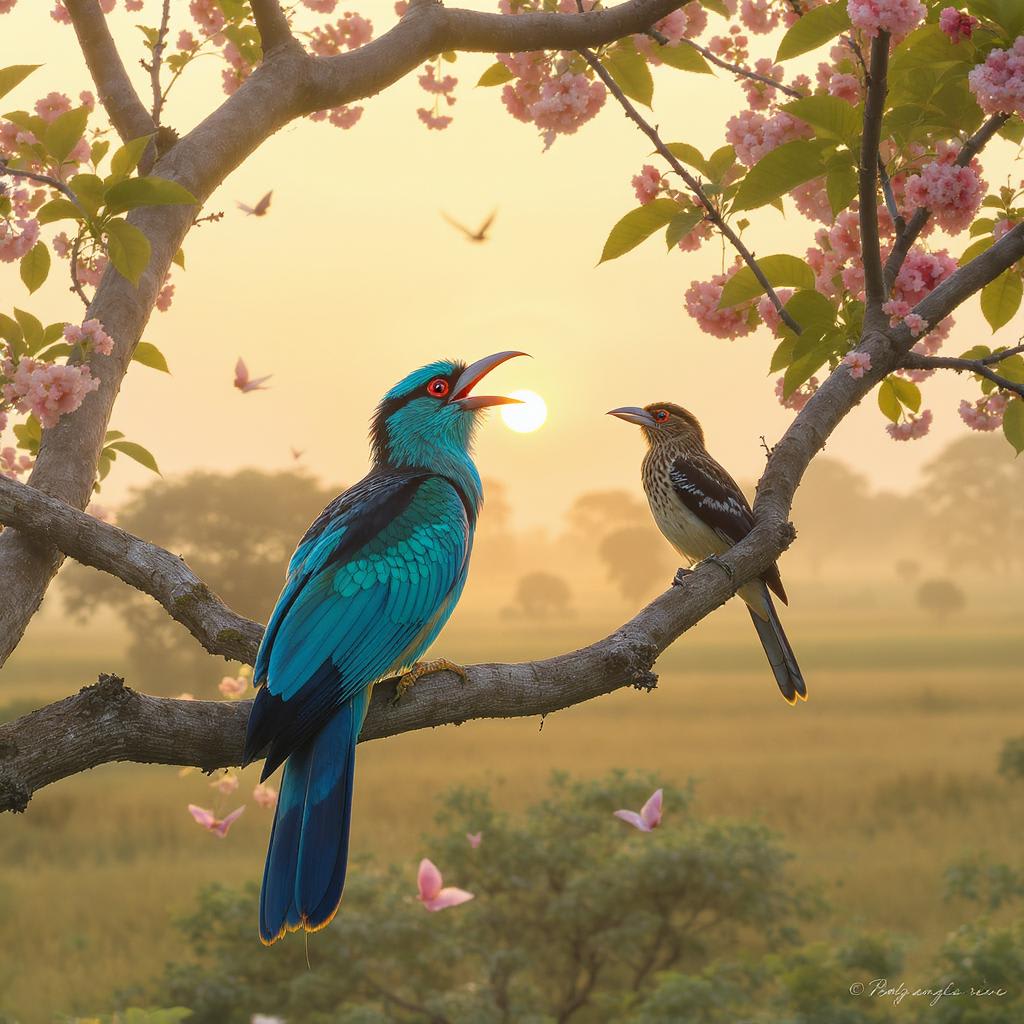
The Asian Koel measures between 39 to 46 centimeters in length and weighs between 190 to 327 grams. The male koel has a glossy bluish-black plumage, a slightly greenish-gray beak, and crimson-colored eyes. Its legs and feet are gray.
The female koel has a brown crown with reddish stripes, white and yellow spots on the ribs, and a heavily barred inner white part. Juvenile koels have plumage similar to males but with black beaks. Both sexes have reddish eyes, making the bird easily recognizable from a distance.
Call and Seasonality
The Asian Koel is a very vocal bird. The male’s song is a repetitive “koo-ooo–koo–ooo” sound, while the female produces a sharp “kik-kik-kik” call. Their calls are especially associated with the arrival of spring and the rainy season, spreading joy among people. The koel’s call is highly praised in literature and folk tales. They usually lay eggs from March to August, which is why their calls are more frequent in spring and summer. Ancient Hindu scriptures regard the koel’s call with respect and even command its protection.
habitat and Distribution
The Asian Koel inhabits light forests and agricultural areas. Its population thrives in warm regions such as Iran, Pakistan, India, Bangladesh, Maldives, Sri Lanka, southern China, and the forests of Southeast Asia. It is a resident bird and adapts quickly to new environments. For example, it has established populations in places like Singapore and Indonesia. Occasionally, the bird is also seen as far as Australia.
Diet and Ecological Role
The Asian Koel relies on fruit-bearing trees. It feeds on fruits such as mango, hog plum, fig, jamun, and pumpkin. Occasionally, it also consumes small insects and larvae, but adults primarily eat sweet fruits. Because the koel can swallow large seeds, it disperses seeds over long distances. It plays a significant role in spreading sandalwood trees in India. Large seeds are usually regurgitated near the nest, while smaller seeds are flung farther away through physical effort. This behavior helps in forest regeneration and ecosystem renewal.
Reproduction (Brood Parasitism)
The reproductive system of the Asian Koel is unique: the male and female do not raise their young together in their own nests but lay eggs in the nests of other birds, usually jungle crows or house crows.
When the female lays an egg in the host’s nest, she sometimes removes some of the host’s eggs or places her egg alongside them. The male distracts the host bird during this time. While the koel’s egg is mixed with the host’s, some of the host’s eggs might remain.
Koel chicks cry loudly like crows to demand food and often grow alongside the host’s chicks. Interestingly, koel chicks do not push out the host’s eggs or chicks. Experts believe that since koel chicks are relatively large, pushing out the host’s chicks could lead to starvation, so they coexist with them.
Koel eggs hatch in about 12 to 14 days, and chicks fledge after 20 to 28 days.
Cultural and Literary Significance
The koel is frequently mentioned in ancient traditions and literature. Its call is often used in Urdu, Hindi, and Bengali poetry as a symbol of spring’s arrival and longing for the beloved. In Hindu scriptures, it is called "Kokila" and is one of the oldest references to brood parasitism in the Vedas. The Manusmriti praises the koel and prohibits harming it.
Literarily, the koel symbolizes love and spring. In Sri Lanka, it is believed that the golden New Year begins with the koel’s call on April 9th. The Indian Union Territory of Puducherry has adopted it as its state bird.
Ecological Importance and Role
The Asian Koel plays an important ecological role by helping disperse fruits and seeds, thus facilitating the natural regeneration of forests. Additionally, the insects consumed by koel chicks help maintain the balance of small insect populations. The presence of such birds is vital for the overall health of natural ecosystems. Although the koel spreads easily, increasing human populations and deforestation threaten it, so conservation of its habitats and food sources is essential.
Conclusion
The Asian Koel not only brings the message of spring with its melodious call but also plays a vital role in maintaining nature’s beautiful balance. Its unique lifestyle, especially brood parasitism, teaches us about the fascinating secrets of nature — that every creature has a purpose. We must ensure the protection of the koel’s habitat and food resources so that this herald of spring continues to sing for generations to come.
About the Creator
Hassan
Nature lover & storyteller 🌿✒️ Sharing the beauty of birds, wildlife & emotional journeys through words. Let’s fly together through stories that touch the soul. 🕊️✨
How, Too
Many people wonder how, too. You are not alone, and I am an expert. I will teach you how, too! First, you need to remit a small application fee and fill out an application describing the nature of your financial situation and how often payments will be made, as this will have great bearing on how well I teach you how, too.
By Harper Lewis4 days ago in Fiction
The Case of the Missing Ring
It was an average Moonday. My mead was hitting me in the right spot as the elvish weed propped me up and forced me to consider the day ahead. I had a feeling in my guts that there would be a very serious disturbance to my day, like two orcs fighting over who gets to eat a dwarf, or whatever those thugs like to chow on. I was in no mood for big surprises, but I also wanted to pay my rent for the month. You can only have so many elves wondering if the loves of their lives are cheating on them before you develop a rep as the bearer of bad parchment. No one really wants the truth...but they want the things they lost to get found, even if it's from a hobbit on his last drop of mead.
By Kendall Defoe about 24 hours ago in Fiction



Comments
There are no comments for this story
Be the first to respond and start the conversation.