
Ashes of Tomorrow
In the ruins of the old world, survival means facing the past as much as the future

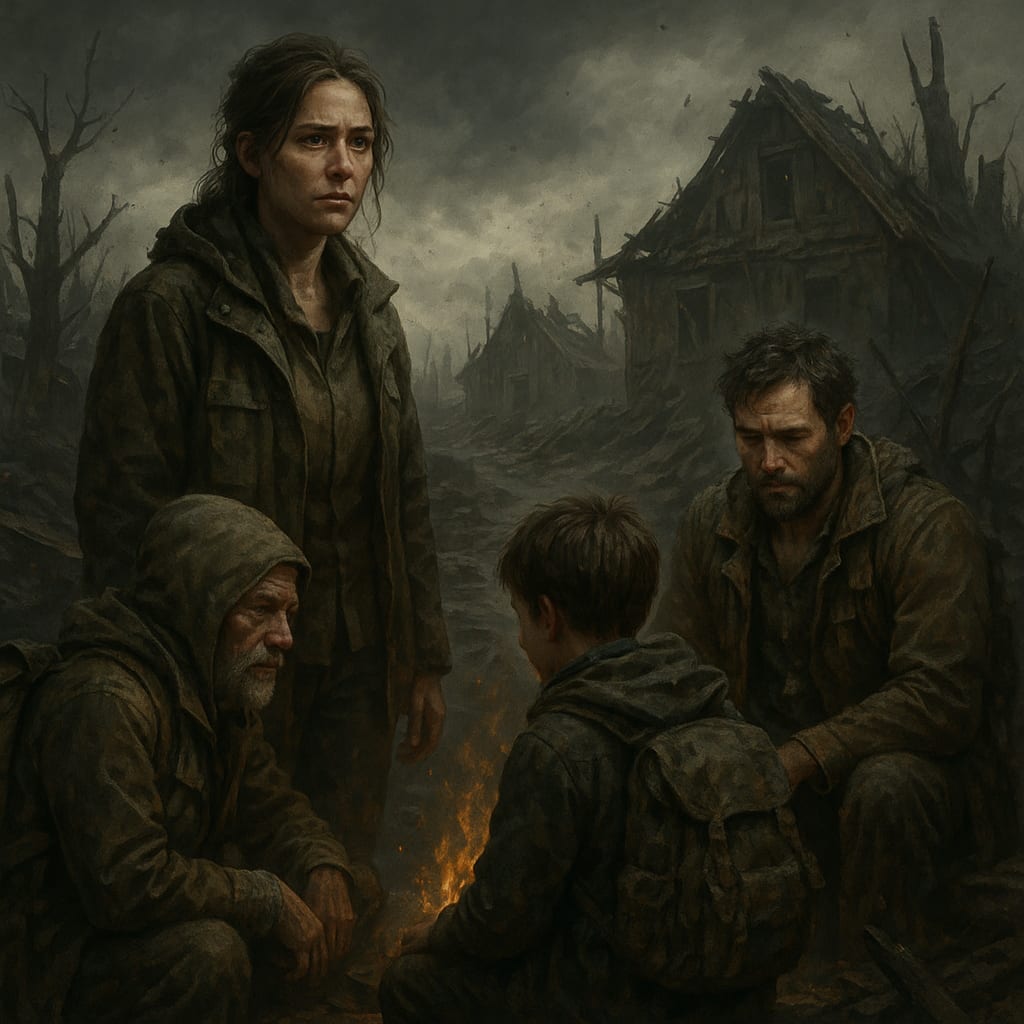
The world didn’t end in a single cataclysmic event. It unraveled piece by piece—droughts, rising seas, plagues, civil wars, and finally, the Collapse. The last governments fell when the supply chains did. Satellites blinked out one by one. Cities became tombs. Then the silence came.
Fifteen years later, what remained of humanity lived in scattered enclaves, clinging to pockets of land spared by radiation, disease, or chaos. In what was once northern California, a group of survivors gathered near the cracked foundations of an abandoned research institute. They called it Ember Point.
Led by a woman named Mara Jennings, Ember Point wasn’t just a camp—it was a vision. Before the Collapse, Mara had been a behavioral neuroscientist, her work centered on trauma recovery. Now, her skills served a new purpose: keeping fractured minds from tearing the fragile community apart.
Among the settlers were others haunted by old ghosts.
There was Noah, a former soldier whose hands still trembled from decisions made in the last war. He volunteered to lead patrols, but refused to carry a weapon. Eva, once a tech entrepreneur, now worked the hydroponic fields, obsessed with calculating crop yields down to the last decimal, as if precision could protect her from grief. And then there was Leo, a teenager born after the fall, full of questions no one dared answer—especially about his parents.
Every week, Mara held what she called “gatherings.” No scripts, no rules—just conversation. Some refused to speak. Others cried. But over time, words returned. And with them, trust.
Their greatest challenge came not from the wasteland beyond, but from within. A second group of survivors arrived—twenty-three people from a former prison colony, hardened by violence and accustomed to strict hierarchy. Their leader, Cassian Rook, was intelligent, charismatic, and dangerous. He saw Ember Point as weak, governed by sentiment instead of order.
Mara didn’t back down. She offered integration, not surrender.
Rook tested her. First with words, then with intimidation, and finally with sabotage—cutting power lines, hoarding food, instigating fights. When confronted, he simply smiled and quoted the old world: "Only the strong survive."
But Ember Point wasn’t built on strength. It was built on healing.
In the end, it was Leo who turned the tide. He had grown close to one of Rook’s men, a quiet ex-medic named Julian. When a virus swept through the camp—one of the old lab strains thawed by shifting climates—it was Julian who stepped up, organizing care, risking exposure, saving lives. And when Rook tried to flee with supplies, it was his own people who turned against him.
The crisis passed. Ember Point survived. And in the quiet aftermath, something shifted. People began to build—not just structures, but stories. Shared meals became rituals. Children learned to read again. Hope, once rationed like water, started flowing freely.
Mara often said the apocalypse hadn’t ended the world—only revealed its foundations. And maybe that was true. Beneath the ash and rubble, people still wanted to believe. In each other. In redemption. In something worth rebuilding.
Thank you for reading Ashes of Tomorrow. If this story resonated with you, feel free to share it with others who believe that even after the darkest endings, humanity still holds the light of a new beginning.
About the Creator
Lucian
I focus on creating stories for readers around the world




Comments
There are no comments for this story
Be the first to respond and start the conversation.