
The Last Equation
When the skies turned hostile, humanity’s survival came down to a scientific miracle

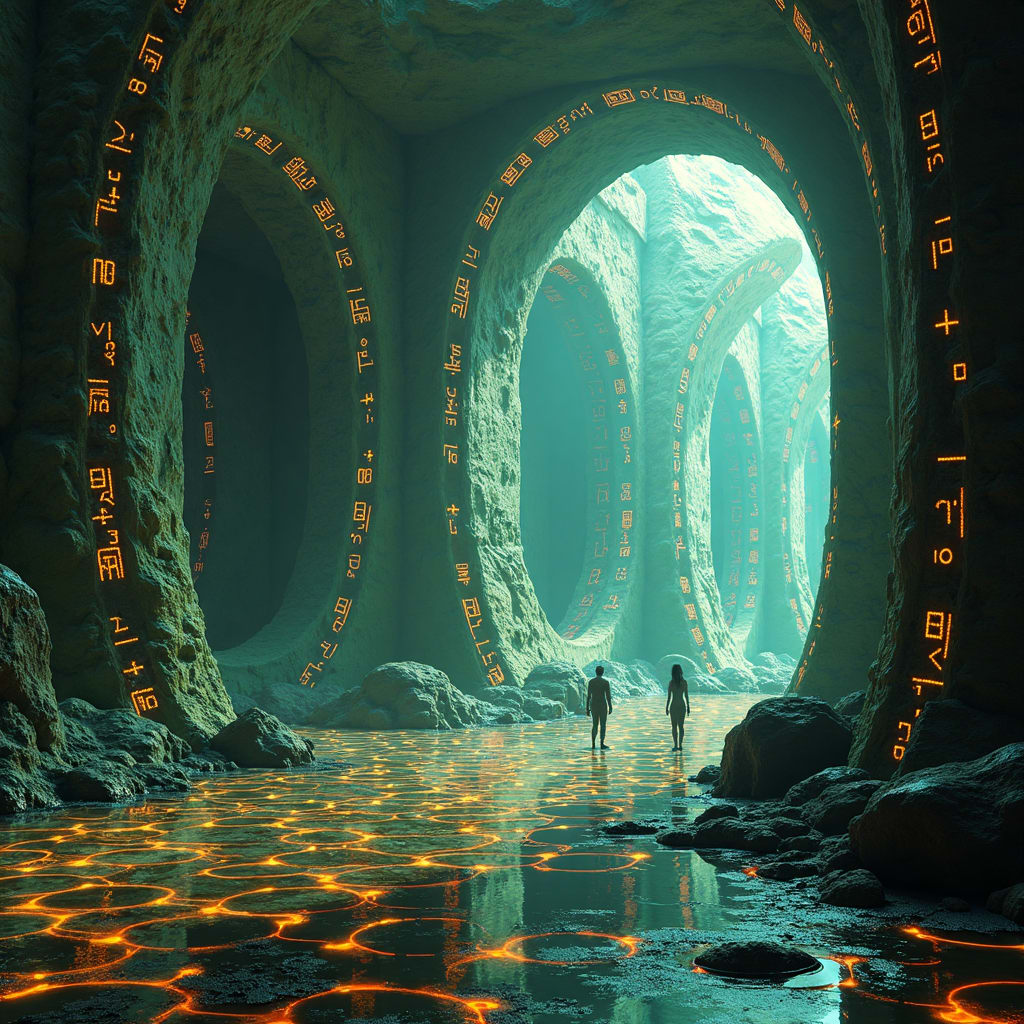
It began on a quiet Thursday.
Telescopes around the world picked up the same anomaly: a fleet of objects breaching the Kuiper Belt, moving too fast, too coordinated, to be natural. Within forty-eight hours, every government knew the truth—Earth was not alone, and whatever was coming wasn't coming in peace.
They called them the Aethari. Not much was known at first—only that their vessels were massive, constructed from an alloy not found in our periodic table, and moved like they were alive. Communications failed. Defense systems proved useless. Satellites dropped from orbit. Power grids flickered. Then the sky over Paris cracked open.
By the time the global response had fully mobilized, three major cities were gone.
In a fortified research compound beneath the Rocky Mountains, a team of twelve scientists—mathematicians, physicists, xenobiologists, and AI theorists—were brought together under the codename Project Horizon. The task was unthinkable: reverse-engineer a defense, or a weapon, against an enemy that had conquered faster than humans could comprehend.
At the helm was Dr. Alina Reyes, a theoretical physicist who had spent her life chasing ideas others called impossible. She had once theorized that information—raw data—could alter reality at a quantum level. Her “semantic particle” theory had been dismissed as speculative nonsense. Now, it was the only lead humanity had.
The Aethari didn’t kill with brute force. They used waves of harmonic resonance to dissolve infrastructure and organic tissue. It wasn’t violence—it was cleansing, a quiet unraveling of the world. Dr. Reyes believed they were not trying to destroy us out of malice but out of ideological necessity. To them, chaos was sin, and Earth was a blemish.
“We can’t outgun them,” Alina told her team. “But we can outthink them. If their weapons operate on quantum harmonics, then maybe we can introduce a counter-frequency—a disruptive equation.”
The project became a race not of engineering but of comprehension. Every branch of knowledge was tested. Music theory, prime number sequences, ancient languages—all fed into the AI built to decode the Aethari’s operating principles. Days blurred. People slept under desks, sustained by caffeine and desperation.
Breakthrough came through the unexpected: a series of crop circles found in rural Kenya, untouched by the Aethari's destruction. Alina saw not symbols, but mathematics—a Fibonacci sequence overlaid with a fractal pattern unique to living organisms. It was communication. The Aethari had not come for conquest, but for correction.
Earth, with its unpredictable variables—war, emotion, love, error—was seen as incompatible with the Aethari’s model of existence. Their solution was deletion.
So the team wrote a new equation. One that couldn't be solved. A self-perpetuating paradox encoded in harmonic resonance—a frequency that introduced endless variability into the Aethari's systems. When deployed via satellite transmission, it didn’t explode—it infected. And for the first time, the Aethari ships paused.
Within hours, they withdrew. No explanation. No retaliation. Just silence, and a sky slowly clearing.
Dr. Reyes never sought glory. When the world hailed her as the savior of Earth, she simply said, “We didn’t win. We made them curious.”
And maybe, curiosity was the one thing we had in common.
Thank you for reading The Last Equation. If you enjoyed this story or found its themes thought-provoking, feel free to share it with fellow lovers of sci-fi and speculative fiction. Your support keeps imagination alive.
About the Creator
Lucian
I focus on creating stories for readers around the world
Lightning Never Strikes Twice
The distant rumble, the sudden deluge, the crescendo of sound, the flash of light, the explosive energy — it never gets old. I became an amateur storm chaser about two years ago. My wife, Cindy suggested it. Sort of. She said, "Alex, you know this cancer is killing me. I've come to terms with that, but you're smothering me. Go join a band, write a book, or become a storm chaser, for all I care. I love you, but you need a hobby."
By Julie Lacksonen5 days ago in Fiction


Comments
There are no comments for this story
Be the first to respond and start the conversation.