


It was the eyes that caught him first.
Not the way the sunlight framed her auburn hair. Not the delicate way she carried herself through the crowded street, gliding as though untouched by the noise and chaos around her. It was her eyes—impossibly blue, like glacier lakes under starlight—that froze David in his tracks.
He didn’t know her name. Didn’t know why she made his breath catch in his chest. All he knew was that he had to speak to her.
It was spring in Paris, and the world smelled of blooming jasmine and buttery croissants. David, a struggling American artist barely scraping by in Montmartre, was sketching near the cathedral steps when she passed. She wasn’t looking at anyone, just staring straight ahead, lost in thought.
He stood.
“Excuse me?” he called, louder than intended.
She stopped, turning her head slowly. Their eyes met—and David felt something shift inside him. Like the world tilted for a second and then realigned.
“Yes?” she said, her voice smooth, almost hesitant.
“I’m sorry to bother you, but... would you sit for a portrait?”
She blinked. “You want to draw me?”
“I know it’s forward,” he stammered, “but you have... the most incredible eyes I’ve ever seen. It’d be an honor.”
She looked down, then back at him with a soft smile.
“My name is Elara.”
She returned the next day, wearing a white linen dress, and sat beneath the tall iron lamp post near the stairs. David sketched feverishly, trying to capture the curves of her face, the softness of her mouth—but it was the eyes he couldn’t quite get right.
They held too much. Sadness, yes, but also kindness, wisdom, and something he couldn’t name. Something ancient.
“You’re not from here,” he said between pencil strokes.
She shook her head. “Not exactly.”
“Where are you from?”
She smiled faintly. “Somewhere far. Very far.”
He laughed. “That sounds mysterious.”
“You wouldn’t believe me if I told you.”
“Try me.”
She looked at him then, those angelic blue eyes locking with his. “I’m here for someone,” she said quietly.
“A lover?” he asked, teasing.
“No,” she replied, serious. “Someone who’s forgotten what love feels like.”
Over the next weeks, Elara returned almost daily. She never stayed long, always drifting away before the sun dipped too low. David painted her obsessively, trying again and again to get the emotion in her eyes just right. None of his canvases satisfied him.
Still, her presence changed him. His art became more soulful, deeper. Galleries that had ignored him for years suddenly called back. People saw something divine in his work. Something that made them pause.
And David? He was falling in love.
Not just with her beauty, but with the stillness she carried. The mystery. The way she listened like no one else did.
One evening, after painting her under the golden haze of dusk, he said, “You always leave so quickly.”
“I can’t stay too long in one place,” she replied.
“Why not?”
She hesitated. “Because I’m not meant to belong.”
“But you belong here,” he said, stepping closer. “With me.”
She looked down. “You’re kind, David. And your heart is pure. But I wasn’t sent to stay. I was sent to remind.”
“Remind me of what?”
“What love truly is.”
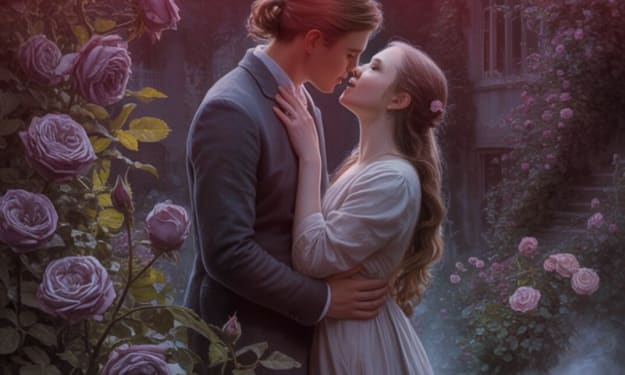
That night, she kissed him.
It was gentle, like a falling star brushing the earth. A kiss that carried eternity in a single breath.
He felt weightless—like time itself paused to watch.
But in the morning, she didn’t return.
David searched everywhere. Asked shopkeepers. Roamed parks. Waited on the cathedral steps for hours each day. Days turned to weeks.
One day, he found a note tucked beneath his easel.
It read:
David,
Thank you for seeing me—not just with your eyes, but with your heart.
You have everything you need to love fully, to create freely, and to live bravely. Never forget that.
You saw an angel—but I saw a soul worth saving.
—Elara
Tears blurred the words. He clutched the note to his chest.
Months passed. David’s art flourished. He became known as the painter of light and longing. But he never stopped painting her. In every gallery, at least one piece showed a woman with flowing hair and glacial-blue eyes.
And in every painting, her expression changed—subtly, softly. As if she were still watching him, still living in the canvas.
Years later, an art critic asked him, “Who is the woman in your paintings? She’s in nearly all your greatest work.”
David smiled, gazing at the newest piece—Elara beneath the stars, one tear sliding down her cheek.
“She was a messenger,” he said. “Sent to show me what love really looks like. And what it means to be seen, truly seen, by someone who asks for nothing in return.
About the Creator
Ludacris and Nelly draw backlash over bookings at MAGA-coded music festival
Ludacris and Nelly headlining a mostly right-wing event is good for them. It’s also great for the genre of hip hop. The two rap veterans have showcased their talents on other stages. Why can’t they perform for mostly MAGA folks and grab that bag?
By Skyler Saunders6 days ago in Beat



Comments (1)
so sweet