
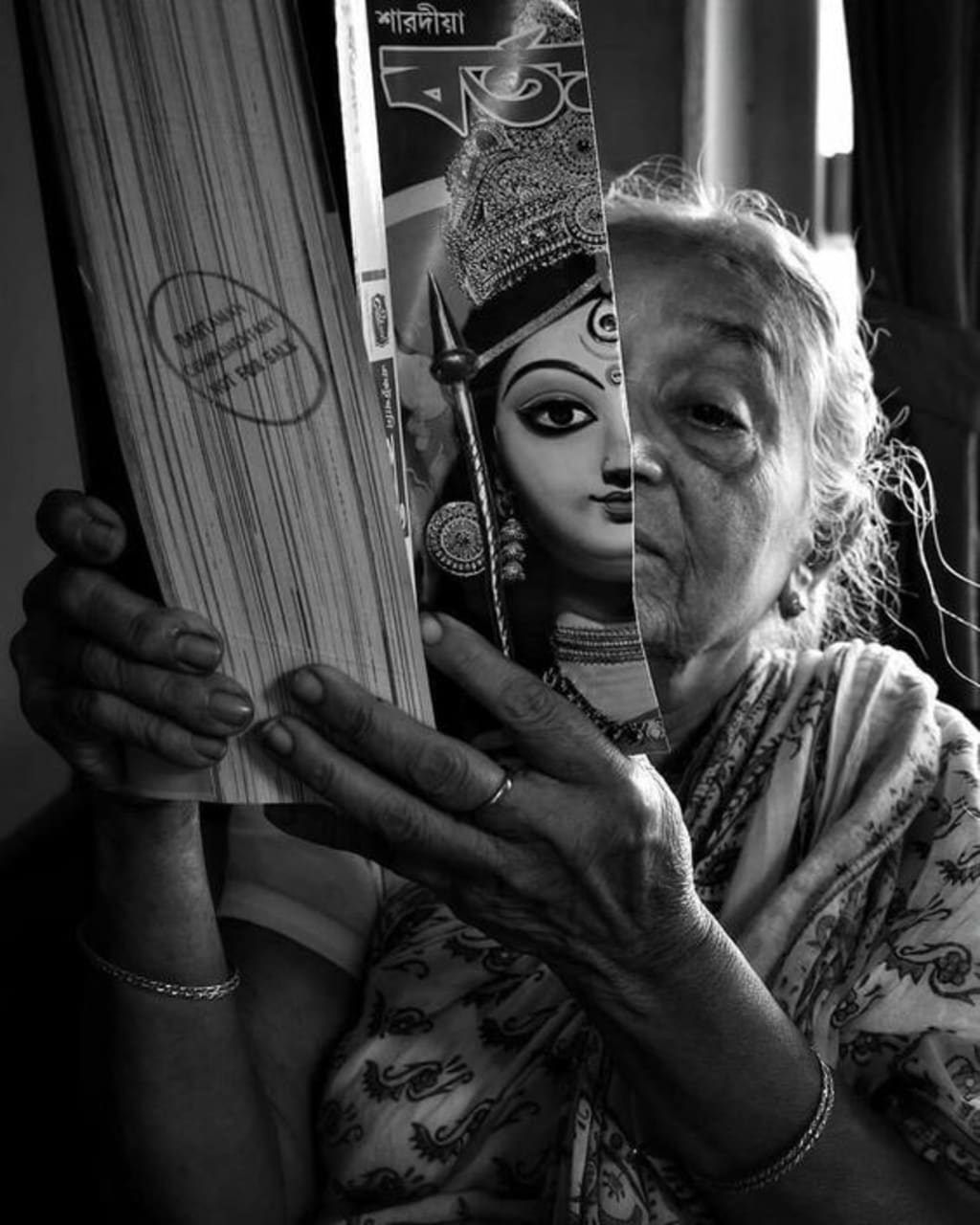
Amma, the housekeeper of the senior girls’ dorm, rang the loud alarm bell at 6 A.M. sharp every weekday like clockwork. She walked into each room and followed a robotic ritual. She opened the curtains, loudly screamed, “Good morning. Wake up. Jogging.”, and without any eye-contact, she moved on to the next room, continuing the attempt to wake up the girls. Hardly anyone would wake up right away so Amma followed the same routine twice. With sleep-laden eyes and contagious yawns painted on their faces, no one noticed how Amma was all dolled up before sunrise everyday. No one would recognize how she walked in each morning with a perfectly draped saree, keys tucked in on the side of her waist, hair oiled and pulled back in a neatly tied bun. Amma woke up at 5 A.M. every morning, bowed down to mother earth and got dressed. She had a total of 7 sarees and you could tell the day of the week just by looking at the color of her saree. Much like the fixed menu of boarding school breakfast, Amma’s sarees also followed a strict routine.
Amma’s mornings and nights revolved around the girls. Once the girls got back from the morning jogging at 7:30 A.M., she would spend the next hour making sure the girls were getting ready on time and were out the door by 8:30 A.M. sharp to keep Sheela happy. Sheela was the Art Teacher and the houseparent for the senior girls’ dorm. She was a wicked old lady in her mid 40s who hated her job. On good days, Sheela didn’t care to step out of her room to check if the girls were on time. On bad days, she wore her night suit with her bed hair and sat on the couch near the door for inspection. The girls feared Sheela deeply. Her devilish gray cat-eyes sent shivers down their spines. Amma only spoke Tamil, Telugu and broken English words but that didn’t stop her from looking out for the girls and making sure they didn't get in trouble. Pavi from room 6 was the only girl who could speak Telugu so on the bad days, Amma would run up to Pavi’s room and with quick short breaths departing her, she’d ask Pavi to warn the girls to cut their nails, wear their hair up, not wear any coloured bras that could be seen through the shirts, polish their shoes, and wear their skirts below the waist so they’re not above the knees. Meanwhile Amma would go into each room to help them make the beds or braid their hair if anyone was running late.
When the girls went out the door for the day to attend school, Amma stood outside for at least 15 minutes to make sure no one forgot anything. Her eyesight wasn’t the best but she wouldn’t move until she didn’t see the blurry image of every single one of the girls entering the dining hall from a distance.
Once the girls were gone, Amma was usually called into Sheela’s room to perform tasks that she wasn’t getting paid for. When girls weren’t around, Sheela treated Amma like her personal slave. In the mornings, she asked Amma to iron her clothes, bring her breakfast and clean her room before she headed out. At night, Amma sat at the foot of the bed and pressed her feet, oiled her hair and made her tea. If the tea wasn’t warm enough, Sheela would get angry and she’d throw it on Amma’s face and use it as a gesture to bring her another one. There were no bounds to Sheela’s ill-treatment of Amma but Amma was no stranger to this. Most people treated her like a worned out rug in the attic and a handful of them pitied her but no one cared enough to indulge her miseries and lend an ear. She was like the Mumbai local train that was boarded by many but appreciated by none.
When the girls returned in the evening, Amma walked up and down the stairs by placing some weight on her bad knee with her right hand. Amma loved to tell stories about her daughter to whoever that’ll listen to her broken English, “Big brown eyes like mother and thick black hair, so pretty, you no believe”. Some days she’d tell Pavi to translate and tell all the girls about her daughter. She’d walk the halls singing her stories, “She a great dancer with a big job in Dubai. People come see her dance from all over the world. Talent like you’ve never seen, beauty that make people stop and stare and a heart of gold.”
Somedays her daughter lived in London and was an artist and some days she was studying to be a doctor. Girls often made fun of Amma and her stories and they’d often ask her which one is it? Is she a dancer or a doctor? An artist or an engineer? The girls thought Amma’s stories were unreal and often questioned why Amma was working at the boarding school if her daughter was so successful. Amma didn’t care for it, she’d shrug it off and say, “No believe me no problem, she a star” and she carried on. Some girls felt sad for Amma and the pity on their faces didn’t go unnoticed but that didn’t stop Amma’s daughter from living the dream in her stories. Despite the relentless storytelling that sometimes became annoying, the girls didn’t mind having Amma around. She kept the girls from getting in trouble with Sheela, no work was too big or too small for her, and she never got in anyone’s way even if she was constantly around. Amma was good at being invisible that way. She didn’t understand English very well and she was often in her own world so the girls felt comfortable living their lives and exchanging secrets with her in the room.
Amma was mostly cheerful except when someone in the dorm fell sick. The smile on her face melted faster than a popsicle in the summer and the wrinkles on her forehead seemed to never leave. Words like “Oho”, “Ah”, “Aii” constantly departed her lips as if she shared the pain in everyone’s illness. When Adena fell sick in the middle of the finals, Amma didn’t let her step foot out of her bed. She checked on her every half hour during the day and slept on the floor near her bed all night. Everytime Adena coughed, Amma thought the worst. Even a simple change of position during the night woke Amma up. The bags under eyes made it evident that she barely slept. Amma couldn’t have made a good doctor or a nurse but no one could deny that she made a great Amma. Parents often bribed the houseparent with gifts to ensure their daughters were in good hands as they stayed miles away from their home but it was really the underpaid, unnoticed single old woman that cared for their daughters like she would her own.
On hot summer days she complained about her prickly back and asked around for talcum powder and each monsoon she walked around with a swollen knee and asked for some tiger balm. She found a new problem to complain about with every change in season. Ria, the shy girl from room 4, had a soft spot for Amma. After every vacation, she brought Amma talcum powder to beat the prickly heat and tiger balm for her aching knee. Ria once asked Amma what her name was to which Amma replied with glee and glassy eyes, “I just Amma. Amma meaning mother. I Amma.”
Amma was both her first and last name, that’s how people knew her, that’s what they called her. If someone spilled something on the floor, if someone wanted to know when the tea was arriving, if someone wanted to skip jogging the next day without permission or get any other mundane tasks done, the halls heard the word “Amma” over and over again. She fulfilled every request diligently. There wasn’t a single time when someone screamed “Amma” and she didn't come running as fast as she could in spite of her limp. As much as she tried to stay young, Amma had started feeling her old age in her bones. The stairs felt steeper and the objects felt heavier each passing day. Amma’s body could no longer carry the weight like it used to before. The energy that once rushed through her veins like electricity now felt dimmer each morning. She still worked undeniably hard with or without her body’s might. At nightfall once everyone was sound asleep in their beds, she took refuge near the main door. She spread her thin quilt on the floor and wrapped herself with the loose end of her saree.
On the first day of every March, Amma was occupied with her own thoughts. Anyone who paid attention could tell that she was not herself. Her walk was slower, as if her feet were like a dog’s leash, carrying her body forward with force. She greeted everyone with glassy eyes and grief stricken shrill in the morning. Amma didn’t know how to read and she didn’t own a calendar or a phone. She didn’t need to keep track of the dates or the days because all days were the same for her. Yet, year after year, she didn’t have to know the date to feel the emptiness that crawled up her bones. If she ever consulted a doctor, they’d have told her that what she experiences every year is called the anniversary effect. Every 1st of March, felt like the kind of day that just didn’t feel right in the gut and in the heart.
No one had recorded the day Amma was born so she never really knew her true age. When Amma was 20 something years old, she got married to a young boy from her village and only a year after the wedding, she was pregnant with a child. The family was elated about the news and Amma was both scared and excited at the same time. After 8 and a half glorious months of pregnancy, the child exited its safest home to enter the world. It was a girl. The laughter that echoed in the village quickly turned into howling cries and the mouths that once devoured the sweets now spit out curses. The child that was once a blessing was now unwanted.
Much like all women in the village, Amma delivered the baby at home. It was a difficult pregnancy and she lost a lot of blood. The women of the family made herbal pastes and soaked clothes in cold water to break her fever. While some hands were tending to an ailing life, others were busy burying a healthy newborn. By the time Amma regained consciousness, her newborn daughter had departed the earth. Her life was 21 minutes long. Amma never got the chance to hug her little girl when she was still breathing. She didn’t get a chance to tell her that the world was hers and that she could do anything she wanted to with her mother by her side. Amma was a mother without a child.
Amma dug the earth like a dog digging for water in a desert. Amma was aware her daughter couldn’t have lived but she never gave up. After days of digging, when she finally found her daughter’s body, she embraced her with so much might as if she could take her back in her womb and keep her safe. Amma held her daughter’s lifeless body covered in mud and told her that the world didn’t deserve her and that she will always live in her mother’s heart. After saying goodbye, she took off with eyes soaked in tears and nails covered in mud and never looked back. Amma wasn’t good at being her own company. She needed people to call her own. She needed to love and be loved but this time something inside her died. People she called family were murderers. They didn’t see her as anything but a body whose only job was to give them a son. Amma decided that it’s not the world’s right to tell her who she can be, who she is or who she wants to be. Amma walked away in search of new people, a new family and landed at the boarding school.
Every few years when the girls graduated high school, Amma teared up. She wasn’t allowed to attend the graduation ceremony so she always asked the girls to take a picture with her right before they left the dorm to attend the ceremony. Amma was so proud of them. Amma often begged anyone who’d listen to get her a print out of the photo. Even though the girls went on to live their great lives and never looked back, they were all she had.
Amma was 80 something years old, she worked very hard but her age was catching up to her. Sheela was tired of having to do her own chores when Amma grew weaker and became slower to take on work that wasn’t a part of her job. Sheela needed someone new, someone younger and so just like that with just one bad review, Amma was fired. Amma wasn’t good at fighting for herself or placing blame on anyone particular for her miseries. She liked to believe that fate was a puppeteer that controlled lives and that everyone just played their parts on the elaborate show called life. Her hardened life had imparted one of the most valuable skills on her, she was a natural at comforting herself. It’s what kept her breathing all her life. Times when the dark clouds of pain became her roof, when the shadow of her grief tailed along, when the tears crawled up her eyes and when her lonely heart frailed with fear, she asked herself, “Why does the heart ache? Why do the eyes weep? After all, this is how the world works. The sound of silence that has come to greet me, time has strewn for each. Grief lives under every roof and heat is in every deed.”
Amma walked out of the huge iron doors with her 7 sarees, worn out brown book full of photographs, half-used tiger balm and talcum powder neatly wrapped in a knotted white cloth and her life savings tucked into her blouse. She headed off to the streets, walked around in a market, ate a spoiled muddy tomato off the floor and made friends with a dog she named Meera. She had no job, no people and no fear of her own. Meera and Amma walked to the nearest temple in search of a meal and safe shelter before nightfall. She filled up on a handful of prasaad she split with Meera and made a bed out of an empty jute bag she found on the road. Meera snuck up to Amma and kept her warm throughout the night and the days that followed.
About the Creator
Rage
Content Warning: Domestic Violence, Assault Rage D. A. Ratliff “Who did this?” My voice echoed through the house. All I wanted was a cup of tea, but one of the twins, running through the house like maniacs, knocked it over. My nerves tingled, and every muscle in my body felt coiled like a spring. Survival seemed out of reach.
By D. A. Ratliff5 days ago in Fiction




Comments
There are no comments for this story
Be the first to respond and start the conversation.