
A Woman’s Journey of Love, Laughter, and Advocacy
Steve's Law: The Fight Against First Responder Abuse in Australia

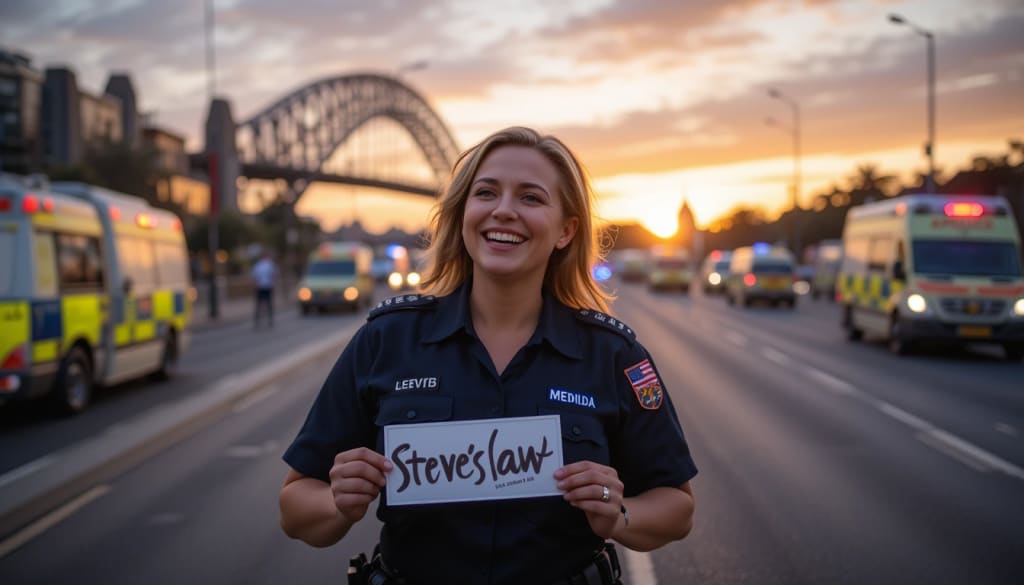
In the bustling streets of Sydney, where the hum of ambulances often blends with the city’s heartbeat, Amara Jenkins found her purpose—and her love—through an unexpected blend of goofiness and grit. At 34, Amara, a paramedic with a quick smile and a quicker wit, had spent years racing against time to save lives. But when a tragic loss shook her world, she channeled her grief into a fight for change, advocating for Steve’s Law, a proposed legislation to protect first responders from abuse in Australia. Along the way, she discovered that love, with all its quirky, playful moments, could be the pulse that keeps us going, even in the face of heartbreak. This is Amara’s story—a journey of laughter, love, and the courage to stand up for those who run toward danger.
The Pulse of a Paramedic’s Life
Amara’s days as a paramedic were a whirlwind of adrenaline and empathy. She thrived on the chaos, her hands steady as she bandaged wounds or administered CPR, her voice a calm anchor for panicked patients. “I loved being the one who shows up when everything’s falling apart,” she says. Off-duty, though, she was a bundle of quirks—known among her crew for her habit of wearing mismatched socks under her uniform and her ability to make even the grumpiest patient crack a smile with a terrible pun.
Her partner, Riley, a 35-year-old graphic designer with a penchant for doodling cartoon ambulances, was her perfect match. They met at a hospital fundraiser where Amara, dressed as a giant Band-Aid for a costume contest, tripped into Riley, who was juggling a tray of cupcakes. “I caught her—and a cupcake,” Riley laughs. “It was love at first tumble.” Their relationship was a canvas of goofiness: they’d stage mock “emergency rescues” in their apartment, with Riley playing a dramatic patient while Amara “saved” her with a spatula. These moments of levity were Amara’s lifeline, a reminder that joy could exist amid the trauma she witnessed daily.
But in April 2023, that joy was shattered. Amara’s colleague Steven Tougher, a 29-year-old paramedic, was fatally attacked during a break at a Sydney McDonald’s. Steven, newly married and expecting a daughter, was a friend whose laughter had often filled their station. His death sent shockwaves through the first responder community, exposing a grim reality: abuse against them was rising, with assaults reported every fifteen hours in Australia. “It felt like the world stopped,” Amara recalls. “Steven was one of us—someone who gave everything to help others. And he was taken for no reason.”
The Birth of Steve’s Law
Steven’s death wasn’t just a personal loss; it was a call to action. His father, supported by the community, proposed Steve’s Law, a legislation designed to protect frontline workers with a mandatory minimum 12-month jail sentence for assailants, though the sentence could be suspended if offenders completed programs addressing anger, substance abuse, or mental health issues. The law aimed to shift the burden off victims by relying on camera footage and witness accounts, ensuring first responders could focus on their jobs without fear.
Amara, grappling with her grief, found purpose in advocacy. She joined the campaign, speaking at rallies and distributing Steve’s Law car stickers, her voice trembling but resolute. “We can’t bring Steven back,” she told a crowd at a Sydney vigil, “but we can make sure no one else loses their life for doing theirs.” Her passion was fueled by a mix of anger and love—love for her fellow first responders, for the job that defined her, and for Riley, who stood by her through every tearful night.
Riley brought goofiness into their activism, designing playful protest signs—like one reading “Don’t Mess with Our Medics!” with a cartoon ambulance flexing muscles. They’d wear matching mismatched socks to rallies, a silent nod to their shared humor. “Riley reminded me to laugh, even when it hurt,” Amara says. “She’d doodle little hearts on my hand before every speech, saying, ‘You’ve got this, Super Medic.’” This blend of silliness and support kept Amara grounded, a reminder that love could be a shield against despair.
The Goofy Heart of Healing
Goofiness wasn’t just a coping mechanism; it was a bridge to deeper connection. Psychologists note that shared laughter fosters intimacy by lowering defenses, a truth Amara and Riley lived daily. One evening, after a grueling day of lobbying lawmakers, Riley turned their living room into a “paramedic spa,” complete with a bubble bath (in a kiddie pool) and a “massage” using a rolling pin. “You’re my favorite patient,” Riley teased, as Amara giggled through fake “medical emergencies” like a stubbed toe. These moments, absurd as they were, were a radical act of love, allowing Amara to reclaim joy in a time of loss.
Their playfulness extended to their advocacy. At one event, they organized a “First Responder Olympics,” where paramedics competed in silly challenges like bandaging a teddy bear while blindfolded. The event raised awareness for Steve’s Law while reminding everyone of the humanity behind the uniforms. “We wanted to show that we’re not just heroes—we’re people who laugh, who mess up, who love,” Amara says. This approach echoed the ethos of chosen families, a cornerstone of queer culture, where joy becomes resistance. As a queer couple, Amara and Riley found strength in their community, their quirks a celebration of authenticity.
Amara’s dreams, once plagued by sirens and blood, began to shift. She dreamt of Steven laughing in a field, Riley by her side, their hands linked as they danced in mismatched socks. Dream researchers suggest that dreams process emotional transitions, and for Amara, they were a canvas where love and grief intertwined. “It felt like Steven was telling me to keep going,” she says, “and Riley was there to make sure I didn’t lose myself.”
The Fight Against a Rising Tide
The fight for Steve’s Law wasn’t easy. Australia’s first responders faced increasing hostility, a trend mirrored globally as societal tensions rose. Paramedics, nurses, and firefighters reported verbal and physical abuse, often from those they were trying to help. The statistics were stark: one in four women and one in eight men in Australia had experienced violence from a partner or family member, and many first responders bore the brunt of this aggression. Amara herself had been spat on, her ambulance vandalized, her kindness met with rage. “It wears you down,” she admits. “You start to wonder if it’s worth it.”
But Steven’s memory—and Riley’s unwavering support—kept her fighting. They lobbied lawmakers, shared stories of abuse, and rallied communities, their goofy energy a beacon of hope. At one meeting, Riley handed out cookies shaped like ambulances, breaking the ice with a pun: “Let’s roll out some change!” The room laughed, and for a moment, the weight lifted. This resilience aligned with research showing that humor strengthens bonds, particularly in high-stress professions, allowing Amara to face the fight with a lighter heart.
External challenges loomed large. Some critics argued that mandatory sentencing undermined judicial discretion, a point raised by the Law Society of Western Australia, which advocated for imprisonment as a last resort. Others feared the law wouldn’t address root causes like mental health or substance abuse. Amara understood these concerns but believed Steve’s Law was a start—a way to signal that violence against first responders wouldn’t be tolerated. “We’re not asking for perfection,” she told a reporter. “We’re asking for safety.”
A Community’s Heartbeat
Sydney’s first responder community became Amara’s extended family. They held vigils for Steven, shared stories of abuse, and laughed through their pain, their bond a lifeline. At one gathering, Amara and Riley led a “Goofy Gratitude” circle, where everyone shared a silly memory of a colleague. “Steven once wore a Santa hat in July,” Amara said, her voice cracking with laughter and tears. “He said it made kids smile.” These moments of joy were a form of resistance, a reminder that love—for their work, for each other—could outshine the darkness.
Their advocacy drew others in, from nurses to firefighters, creating a ripple effect. They organized “Sticker Days,” where first responders handed out Steve’s Law stickers at hospitals and stations, their laughter echoing through the halls. This communal heartbeat mirrored the spirit of chosen families, where shared experiences forge unbreakable ties. For Amara and Riley, a queer couple in a field often marked by stoicism, their goofiness was a radical act, inviting others to embrace their humanity.
The Pulse of Tomorrow
As of June 2025, Steve’s Law remains under review, its future uncertain. But Amara and Riley continue their fight, their love a steady pulse through the uncertainty. They’re planning a “Goofy Gala” to raise funds, complete with a costume contest and a “paramedic karaoke” night. “We’ll probably sing ‘Sweet Caroline’—badly,” Riley laughs. Their home is a gallery of advocacy mementos—stickers, doodles, a photo of them in mismatched socks at a rally. Amara’s dreams now pulse with hope, featuring her and Riley leading a parade of first responders, Steven’s laughter in the air.
Amara’s journey shows that love, for women navigating grief and purpose, can thrive in the absurd. In Sydney’s vibrant embrace, she found a partner whose laughter matched her heartbeat, a cause that gave her pain meaning, and a community that held her up. Steve’s Law isn’t just about protection—it’s about honoring the humanity of those who save us, one goofy, loving step at a time. As poet Maya Angelou wrote, “Love recognizes no barriers.” For Amara and Riley, that love is a fight, a laugh, and a heartbeat they’ll never let go.
About the Creator
Shohel Rana
As a professional article writer for Vocal Media, I craft engaging, high-quality content tailored to diverse audiences. My expertise ensures well-researched, compelling articles that inform, inspire, and captivate readers effectively.
Keep reading
More stories from Shohel Rana and writers in Fiction and other communities.
The Game of Deception: Unraveling the Blind Man's Bluff
In the quiet corners of Savannah, Georgia, where Spanish moss drapes over ancient oaks and secrets linger like the humid air, Lila Carter learned that love could be a game of deception—one she’d play with a blindfold and a heart full of giggles. At 28, Lila was a librarian with a sharp mind and a guarded soul, her days spent among dusty books and her nights avoiding the vulnerability of romance. Yet, through an unexpected twist of fate and a childhood game called Blind Man’s Bluff, she stumbled into a journey where goofiness became her guide, unraveling layers of fear to reveal a love as true as it was absurd. This is the story of how Lila confronted the masks we wear and found herself in the laughter that followed.
By Shohel Rana8 months ago in Fiction
Miss Persephone's Manual to a Seemingly Ordinary Life
Miss Persephone was found at the dining table, her blue eyes swollen, her tears arriving and retreating like the tides of the ocean. Earlier that day, her family had visited her in the retirement home where she had lived for eight years. It was her eightieth birthday.
By Imola Tóth7 days ago in Fiction



Comments (1)
This story is really something. It shows how a tragic event can turn someone's life around. I can only imagine how hard it must be for Amara to deal with that loss and then fight for change. It makes me think about how important it is to have something to hold onto, like love and humor, even in the toughest times. Do you think her fight for Steve's Law will make a big difference? And how do you think she'll keep that love and joy alive in her life now?