
Lost in MIGRATION
A story of love, exile, and the house that was destroyed in freedom

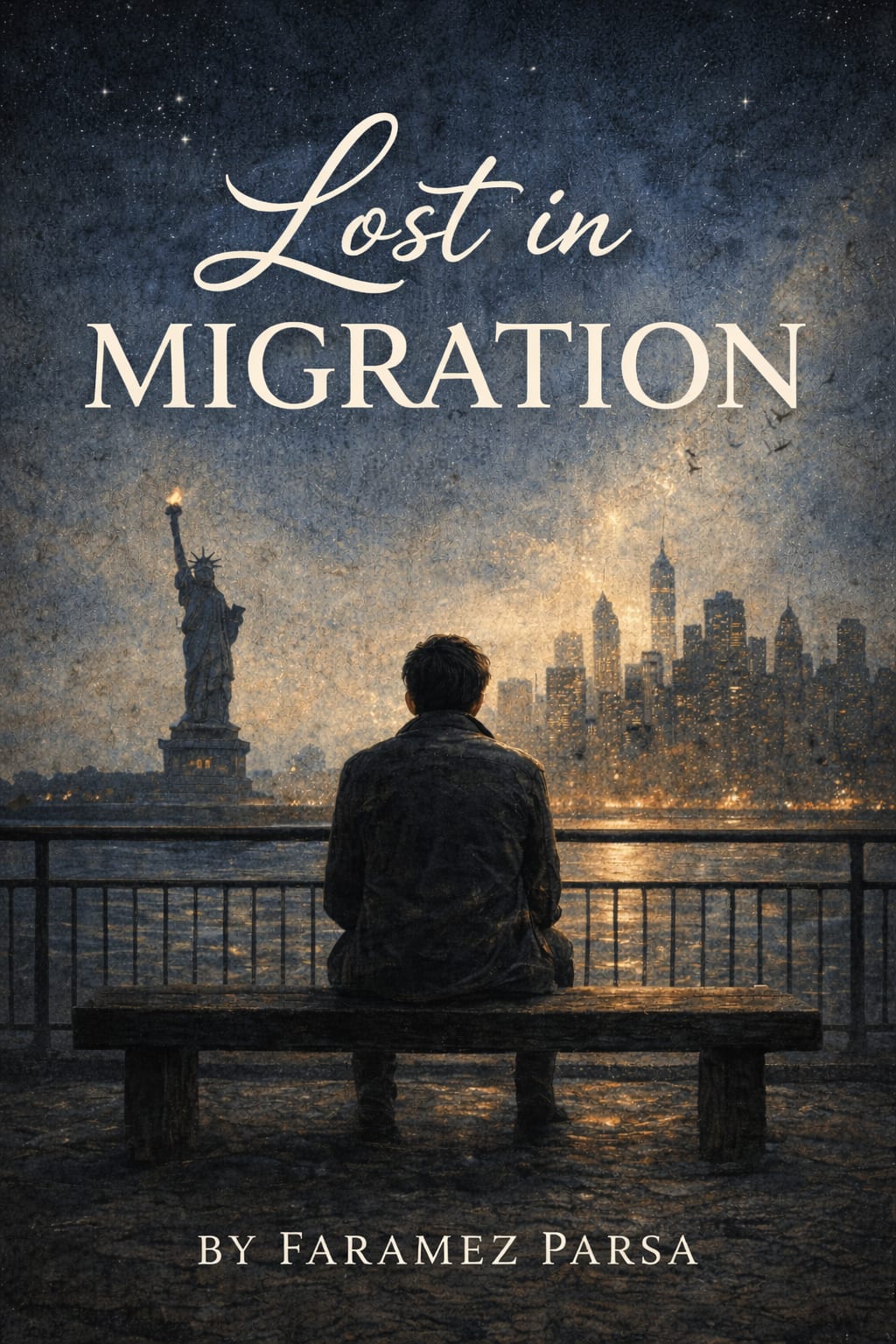
Lost in Migration
By Faramarz Parsa
Author’s Preface
Migration, for many, is a bridge to freedom — a promise of light, opportunity, and a life reborn.
But within that freedom lie wounds rarely spoken of. Wounds that cut not through the skin, but through the soul.
This story, Lost in Migration, tells of countless people who leave behind their bound lands, chasing dreams that shine from afar — only to find that what they gain demands the heaviest price: separation, loneliness, the loss of home and roots.
Shahrokh and Parichehr are not figments of imagination; they are mirrors of truth.
Within them, we may recognize our own reflections — love that becomes sacrifice, dreams that turn to regret, a home destroyed in the name of freedom.
This story is not written to accuse or glorify anyone.
It only seeks to show the quiet truth of migration — one that many have lived, but few have voiced.
And if one day, far from your homeland, you read these words and hear your own echo within them, know that this tale is not only theirs.
It is ours — the story of those who, between hope and exile, home and freedom, love and remorse, became lost.
The House That Was Destroyed in Freedom
It was near sunset.
The weak sunlight stretched across the old brick walls of the neighborhood, and the air smelled faintly of damp soil after watering.
Shahrokh unlocked the gate and stepped into the courtyard. His mother was sitting on the wooden bed under the mulberry tree, her dry cough shaking her frail body.
He walked to her side and gently touched her shoulder.
“Did you take your medicine, Mother?”
She smiled faintly. “Yes, my son. God bless you.”
His father, a few steps away, leaned on his cane and moved slowly.
And yet, something inside Shahrokh still glowed — Parichehr.
Her smile could erase his exhaustion. They had been married for eight years, their life filled with laughter, small trips, long nights of tender talk.
But lately, Parichehr had grown restless.
Each evening he’d find her standing by the window, gazing out as if her soul were trapped behind glass.
One night she said abruptly,
“Shahrokh… I can’t take it anymore.”
He looked up, startled. “Can’t take what?”
“This life. These walls. This suffocation. I want to breathe.”
That night, migration entered their home — silent at first, then impossible to ignore.
For her, it was hope.
For him, it was the beginning of loss.
The Farewell
Winter arrived.
The windows fogged in the mornings, and smoke from half-burned wood drifted through narrow alleys.
Parichehr spoke endlessly of visas and embassies. Shahrokh stayed quiet, torn between duty and love.
One evening, he told his mother, “Maybe I have to go.”
She looked at him for a long time and said softly,
“Be happy, my son.”
That night, Shahrokh knew there was no turning back.
When the plane lifted off, Parichehr gripped his hand and whispered,
“This is the beginning of everything.”
He looked out the window at the shrinking land below — the soil that held his parents, his memories — and felt his heart remain there.
The New World
They arrived in a European city first — a stopover for their dream.
Then months later, America.
Parichehr’s eyes shone. “Everything will change now.”
Their apartment was small but full of hope.
She explored the city; he worked in a restaurant, washing dishes, carrying boxes, living between fatigue and silence.
Each night he came home with flowers or sweets, hoping to see her smile.
She spoke of new friends, language classes, and freedom.
He nodded, tired but listening.
And when the lights went out, he whispered to himself:
“I hope all this was worth it.”
The Distance Between Them
Weeks turned to months.
Shahrokh worked two jobs; Parichehr found new circles.
Her laughter drifted further away from him.
At a dinner one night she said,
“Other men here speak English so well. You should practice more.”
He only smiled, silently wounded.
At a friend’s party, Shahrokh tried to speak a few English words:
“I work… in restaurant.”
Someone laughed softly — so cute.
Parichehr joined in:
“Yes, his accent is adorable! I tell him he’d make a better comedian than translator!”
Laughter filled the room.
Shahrokh smiled faintly, but inside, something broke.
That night he whispered to the window,
“I left everything behind for her. Now I’ve lost even myself.”
The Breaking Point
One Friday, he came home early, carrying flowers and her favorite food.
He set the table, lit candles, waited.
When she arrived, her face darkened.
“I told you I need space, Shahrokh! I don’t want this prison!”
Before he could speak, she struck the table — food and glass scattering like their years together.
He left quietly, walking into the cold.
At the park, he sat under a bare tree and whispered,
“I gave up everything. Why do I feel so empty?”
The Silence After
Days later, she was gone.
Her note lay on the table:
“I need to find my own path.
You’re not enough for me.
Don’t look for me.”
He read it again and again.
The room was silent except for the echo of those words.
Outside, life went on.
Inside, everything stopped.
Two Solitudes
After she left, the apartment turned gray.
Each morning Shahrokh worked, each night he returned to emptiness.
He still called his mother, pretending strength.
But after every call, he pressed the phone to his heart and wept.
Parichehr lived with a friend now.
At first, it felt like freedom — laughter, parties, pictures.
But as time passed, the joy faded.
In the mirror, she saw a woman she no longer knew.
Then one evening, a call came from Iran.
Her sister’s voice trembled:
“Father’s very sick. Please come if you can.”
Later, another call.
“Parichehr… he’s gone.”
Her phone slipped from her hand. The room blurred through tears.
The End of the Bridge
That same night, across the city, Shahrokh sat alone on the old couch, dialing his mother’s number again and again.
No answer — only the endless tone of distance.
He looked at his cracked hands and whispered,
“I built a home… but there’s no one left to share it.”
Somewhere else, Parichehr sat with their wedding photo in her lap, her tears falling on the glass.
Migration had promised them freedom.
Instead, it gave them distance — from home, from each other, from themselves.
Shahrokh lost his love.
Parichehr lost her roots.
And in that loss, they became one with millions of others —
those who, in search of light, walked into the fog and vanished.
The house that was destroyed in freedom was not made of walls and roofs.
It was made of hearts.
About the Creator
Ebrahim Parsa
⸻
Faramarz (Ebrahim) Parsa writes stories for children and adults — tales born from silence, memory, and the light of imagination inspired by Persian roots.
Keep reading
More stories from Ebrahim Parsa and writers in Fiction and other communities.
Miss Persephone's Manual to a Seemingly Ordinary Life
Miss Persephone was found at the dining table, her blue eyes swollen, her tears arriving and retreating like the tides of the ocean. Earlier that day, her family had visited her in the retirement home where she had lived for eight years. It was her eightieth birthday.
By Imola Tóth5 days ago in Fiction
Rachel Reviews: The Spiral Archive by Pieter Hendrik
It's difficult for me to know where to start with a review of this book as it was, for me, an entirely unique experience and one that I'll probably never have again. I don't want that to be interpreted as unenjoyable but it has left me scratching my head a little and ruminating on its content, its themes and its characters.
By Rachel Deeming2 days ago in BookClub


Comments
There are no comments for this story
Be the first to respond and start the conversation.