
The Game of Deception: Unraveling the Blind Man's Bluff
A Tale of Love, Laughter, and Finding Truth in the Dark

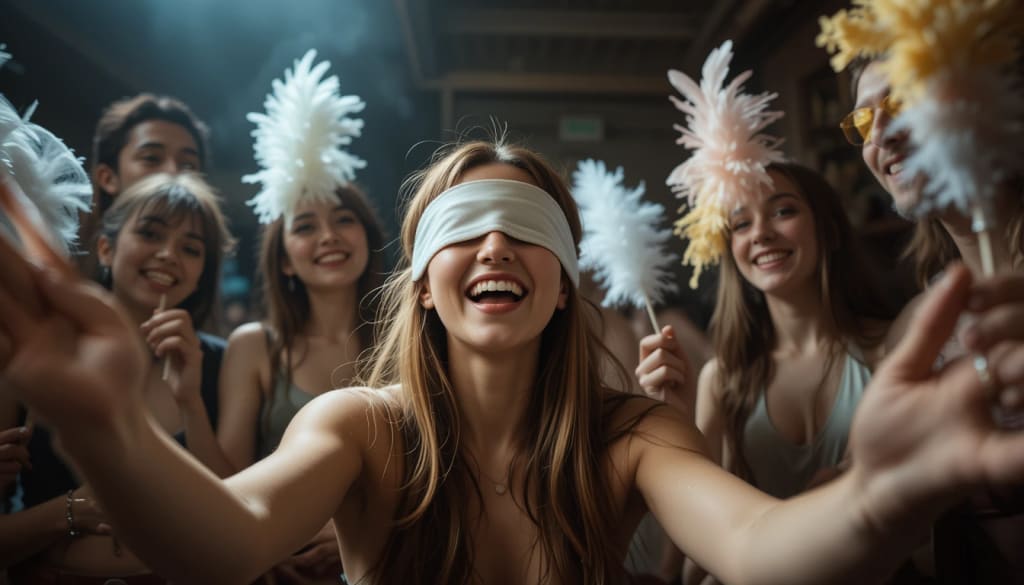
In the quiet corners of Savannah, Georgia, where Spanish moss drapes over ancient oaks and secrets linger like the humid air, Lila Carter learned that love could be a game of deception—one she’d play with a blindfold and a heart full of giggles. At 28, Lila was a librarian with a sharp mind and a guarded soul, her days spent among dusty books and her nights avoiding the vulnerability of romance. Yet, through an unexpected twist of fate and a childhood game called Blind Man’s Bluff, she stumbled into a journey where goofiness became her guide, unraveling layers of fear to reveal a love as true as it was absurd. This is the story of how Lila confronted the masks we wear and found herself in the laughter that followed.
The Shadows of Caution
Lila’s life was a well-organized shelf, each book in its place, each emotion tucked away. Growing up in a family where trust was a luxury, she’d honed the art of self-reliance, her wit her shield. Relationships, to her, were like uncharted novels—intriguing but risky. “I’d rather lose myself in a story than in someone else,” she’d joke, though the humor masked a deeper truth: love felt like a blind leap she wasn’t ready to take.
Her turning point came at a community festival, where the local historical society hosted a “Games of Old” event. Among the hoop races and sack hops, Blind Man’s Bluff stood out—a game where one player, blindfolded, sought others by sound and touch while they dodged with giggles and taunts. Lila, coaxed by her friend Mara, agreed to play, her competitive streak piqued. Blindfolded, she stumbled through the crowd, her laughter bubbling up as she swatted at thin air. Then she collided with Jasper, a 30-year-old carpenter with a crooked smile and a knack for puns, who whispered, “Guess you’ve caught me—now what?” His tone, playful yet warm, sparked something in her she couldn’t name.
That encounter, born of goofiness, planted a seed. Psychologists like Dr. Dacher Keltner, who study positive psychology, note that laughter lowers defenses, fostering connection. For Lila, this game was the first crack in her armor, a moment where deception—her own guarded nature—met the possibility of trust.
The Dance of Deception
Jasper, with his easy charm and habit of wearing mismatched socks, became a regular at the library, borrowing obscure gardening manuals and leaving notes like “Roses are red, violets are blue, I’m bad at poetry—coffee with you?” Lila, wary but intrigued, played along, crafting witty replies on overdue slips. Their flirtation was a game of its own, a blind man’s bluff where each revealed just enough to keep the other guessing.Goofiness was their language. One rainy afternoon, Jasper arrived with a paper crown, declaring Lila “Queen of the Stacks,” and challenged her to a duel with foam swords made from rolled-up newspapers. Their laughter echoed through the aisles, drawing amused glances from patrons. “It was ridiculous,” Lila recalls, “but it felt like we were speaking a secret code.” This playfulness, as sociologist Robin Dunbar suggests, mirrors primate grooming—social bonding through shared joy—allowing Lila to lower her guard without realizing it.Yet, deception lingered. Lila hid her growing feelings, fearing Jasper’s warmth might fade if he knew her fully. Jasper, too, wore a mask, his cheerful exterior masking a recent breakup that left him hesitant. Their game of bluff continued, each step forward shadowed by the question: Could love survive the unmasking?
A Blind Leap into Love
The turning point came during a library fundraiser, where Jasper suggested a Blind Man’s Bluff night to raise funds. Lila, now co-organizer, found herself blindfolded again, this time seeking Jasper among a crowd of volunteers. The room buzzed with laughter as she tripped over a chair, only to be steadied by Jasper’s hands. “Found you,” she whispered, her voice trembling with more than play. In that moment, the blindfold fell—both literal and metaphorical—as Jasper admitted, “I’ve been hiding how much I like you.”
This vulnerability, wrapped in goofiness, shifted their dynamic. Lila confessed her fear of losing herself in love, her words spilling out like a overdue confession. Jasper, with a grin, replied, “Then let’s lose ourselves together—starting with a terrible dance.” They waltzed awkwardly to a tinny radio tune, their steps a mess of giggles and missteps, yet perfect in their imperfection. As poet Rumi wrote, “Out beyond ideas of wrongdoing and rightdoing, there is a field. I’ll meet you there.” For Lila and Jasper, that field was a dance floor of shared absurdity.Dreams became a mirror of this shift. Lila’s sleep, once filled with locked doors and silent libraries, now featured Jasper leading her through a forest of laughing trees or building a castle from books. Dream researcher Dr. Tore Nielsen suggests dreams process emotional transitions, and for Lila, they were a canvas where love painted itself in playful strokes, easing her fear of the unknown.
The Community’s Role
Savannah’s tight-knit community amplified their journey. The Blind Man’s Bluff night raised funds and spirits, drawing locals into a shared celebration of silliness. Elderly patrons joined the game, their laughter mingling with children’s squeals, creating a tapestry of connection. Lila and Jasper’s antics—staging mock chases or crafting goofy blindfold designs—became local lore, a reminder of joy’s power to unite.
This communal aspect echoed queer culture’s chosen families, where authenticity thrives. As a bisexual woman, Lila found freedom in spaces where her identity was celebrated, not judged. Research from the American Psychological Association highlights how humor strengthens marginalized communities, offering resilience against societal pressures. Jasper, an ally with his own quirks, fit seamlessly into this world, their goofiness a bridge across differences.
Unraveling the Masks
Love, however, tested their newfound openness. When Jasper’s ex reentered his life, Lila’s old fears resurfaced. “I thought he’d leave,” she admits. Instead of retreating, she leaned into their goofy bond, challenging him to a “Truth or Dare” night. Jasper’s dare—sing a love song off-key—ended with Lila joining in, their duet a cacophony of laughter. His truth revealed his commitment: “You’re my home, bad singing and all.”
External pressures added strain. Lila’s family questioned her choice, their disapproval a shadow over her joy. Jasper countered with a family dinner where he wore a clown nose, turning tension into giggles. This resilience aligns with Dr. John Gottman’s findings that humor de-escalates conflict, strengthening relationships. For Lila, each laugh was a step toward letting go of deception, embracing love’s messy truth.
A New Game Begins
Two years later, Lila and Jasper run a “Story and Silliness” program at the library, blending books with blindfolded games. Their home is a gallery of goofy mementos—paper crowns, foam swords, a photo of their disastrous waltz. They dream of a cross-country trip, mapping it with laughter-filled detours. Lila’s dreams now pulse with possibility, featuring Jasper and her building a treehouse or racing rubber ducks down a river. “I’m still scared sometimes,” she says, “but with Jasper, it’s a game I want to play.”
Lila’s journey shows that love, for women navigating fear and expectation, can be found in the blind leap of goofiness. In Savannah’s warm embrace, she unraveled the deception of self-protection, finding a love that sings through laughter. As Rumi penned, “The wound is the place where the light enters.” For Lila, that light was the blind man’s bluff, a game that led her home.
About the Creator
Shohel Rana
As a professional article writer for Vocal Media, I craft engaging, high-quality content tailored to diverse audiences. My expertise ensures well-researched, compelling articles that inform, inspire, and captivate readers effectively.
Keep reading
More stories from Shohel Rana and writers in Fiction and other communities.
Two Bus Tickets: A Prequel to a Rural Adventure
The hum of a Greyhound bus winding through the rolling hills of rural Vermont was an unlikely backdrop for a love story, but for Ellie Harper, it was where her heart found its rhythm. At 29, Ellie was a freelance photographer with a knack for capturing life’s fleeting moments but a fear of living her own. Her journey, sparked by two bus tickets and a shared love for goofiness, became a prequel to an adventure that would redefine her understanding of love, courage, and the beauty of embracing the absurd. This is the story of how Ellie, through laughter and vulnerability, discovered that love is not just a destination but a wild, joyful ride.
By Shohel Rana8 months ago in Fiction
Affection and Healing for Yourself
During the night of the last quarter moon, I gathered my ritual supplies. I carefully handled the chunk of black tourmaline that would protect me from your overall negative and narcissistic energy. I carefully walked the house with my stick of selenite in hand, asking the universe to cleanse our working space.
By Alisha Wilkins ✒️🦋🖋️3 days ago in Fiction



Comments (1)
This story of Lila is really something. It makes me think about how unexpected moments can change our lives. Like when she played Blind Man’s Bluff and met Jasper. It shows that sometimes, the silliest things can lead to the most meaningful connections. Have you ever had an experience like that, where a random event changed the course of your day or even your outlook on something? I also wonder how Lila will deal with her past fears as she moves forward with this new connection. Will she be able to fully open up and embrace love? It's a journey I'm curious to follow.