

"Don't go through my things while I'm gone!"
Mom's parting words each time she left the house to run errands, work in her classroom, or have lunch with a friend.
So of course, I went through Mom's stuff. I'd start with her bedroom dresser drawers. Or the hall closet, where her ironing pile lived. A pile whose existence was a paradox, given that she never actually ironed. Since it was, in fact, a stack of wrinkled clothes, I was less careful about being sneaky, less concerned about covering my snooping tracks. And then again, I was only a kid, so I was bound to leave a trail of breadcrumbs. And I did.
"Oh Susie! What did I tell you about going through my things? You're wrinkling everything!"
She pursed her lips, angrily rearranging the closet's contents in such a way that soothed her need for things to be just so, just the way she wanted them. It looked just the same to me.
"Mom, the clothes are here because they're wrinkled, right?"
The irony of it all was lost on her, but not on this 11-year-old. Nor was the obvious fact that if she hadn't told me - all the time - not to go through her stuff, it never would have occurred to me. Talk about flashing a neon sign inviting people to do the very things that upset you.
In our family, such as it was - consisting of me, my mom and my dad - everything was a secret. How old they were. How much money they made. Who was my grandfather? What was he like? Why was O-mama married and divorced so many times? Every inquiry I made met with deflection. Evasive answers.
Our house had three bedrooms: mine at one end, my parents' at the other, and my dad's study in the middle. The very next time the cat was away I went through the middle bedroom closet. There were three big Bekins boxes, still unpacked, from our move to Hawaii several years earlier. These intrigued me most of all.
I had a field day, mining the rich ore of this particular vein, when I came across a photo. It was a wedding picture of my mom and a man. My dad? I couldn't be sure.
I couldn't be sure because Dad had a beard, had one for as long as I could remember. Pictures of him clean-shaven were few and far between. I didn't think this guy was him...
I heard Mom's car pull into the driveway. When she got inside I showed her the photo.
"Is this a picture of you and Dad?" I asked.
A look of surprise crossed Mom's face, then she flushed.
"I've told you time and time again not to go through my things!" Where did you find this? Oh Susie!"
Mom made a beeline for the study, muttering under her breath, grabbing items I'd set down on a chair and putting them back in the box, everything Just So.
"If it's not Dad, then who is this man?" I questioned.
"That's my first husband," Mom finally answered.
"What? You were married before?! How come you never told me this?"
I was visibly upset. To my mind this felt like a betrayal by my mother. And justified my need to continue searching for more clues. Here was proof that there were actual secrets lurking in the nooks and crannies of our house.
"It was a long time ago, Susie. It's just not something I think about," she answered.
Mom moved to the kitchen, started shuffling things around, wiping the counter. Puttering, she called it. I called it annoying. Mom would never just sit down and talk, she was always busying herself with something.
"We were only married for a few months before he died in a tractor accident."
"That's so sad, Mom." And I meant it.
That summer we visited my grandmother, who lived in Texas.
She was fun, entertained a lot, belonged to the country club, and I was excited to visit my O-mama. We would go about every other year, just me and Mom. Dad never came and so of course, I needed to know why. I was turning into a regular Nancy Drew.
"Why doesn't Dad ever come with us to Texas?" I would ask Mom.
"Oh, I don't know. I guess because he has summer classes to teach along with his research."
This felt like more evasion. But truth be told, I didn't really want him to come. Nothing was more torturous than being around my parents when things were strained. Dad would withdraw into icy silence, Mom anxiously trying to make things better. The more she tried, the more he withdrew.
This started when I was eight, not long after we moved to Hawaii. The three of us took trips to the outer islands: Kauai, Maui, the Big Island. No happy memories there. We would spend days driving around each island, taking in the scenery. No conversation between them, or with me. No music on the radio, not one thing to make this the least bit enjoyable for a kid.
"How long is this drive? Are we there yet?" I asked constantly.
"Simmer down."
Those two words uttered by Dad always stopped me in my tracks, and I knew to shut my mouth. The same way I knew there was nothing at the end of the drive that would make the trip any more fun. My two memories from these trips? Dropping a can of soda on my foot, prompting me to lose a toenail, and getting chickenpox.
My great memories of Dad are from when I was younger. Saturday was our day together. We would hike the fire trails in our rural northern California town. We hung out with the fascinating, quirky neighbor, Rocky, an old bachelor who lived next door. He had a magnificent penny collection - enormous bags of them - and we'd mine those for the special 'wheat' pennies.
Or we'd go into San Francisco, seeing all the hippies and street vendors, or visiting Dad's oddball friends. It felt like I was stepping into a Mary Poppins sidewalk drawing and entering a world of wonder.
After we moved to Hawaii everything changed. Dad became a vegetarian and a Buddhist, and after a couple of years our Saturday excursions came to an end. Mom had no interest in vegetarian cooking, so we stopped having family meals together. I began feeling not just like an only child, but as though I was the only person in the house, so separate were our lives.
At O-mama's there was always interesting talk, a luncheon, a dinner party, swimming at the country club. Although her friends were as old as she was, they were fun, told stories, laughed a lot, and included me in their conversations. And O-mama wasn't tight-lipped like Mom.
One night during this visit O-mama and I were lying in her bed, cuddling, when she told me a secret.
"I don't know if your mom ever told you, but her father was Jewish."
That was big news to me. Like I said, Mom didn't go around divulging information.
"We were living in Germany and Czechoslovakia during the rise of the Nazi party. Your mother's father Leo and I had been divorced for many years and I was married to Armand at that time, who was not Jewish. But as the situation got worse and worse in Europe I worried over the safety of my daughters, afraid their Jewish heritage would be discovered. So when Hitler annexed Austria we got on a ship and sailed back to America."
Wow. Now here was a story! As it happened I was reading "The Diary of Anne Frank," swept away by her writing and dire situation. I had just learned that my Aunt Peggy and Anne Frank shared the exact same birth date, and that gave me the shivers. Had my family not left Europe in time my mom and aunt would have likely suffered the same horrific fate as so many other Jews.
I don't recall why O-mama chose to tell me this, but I would never forget it - so astonishing for a grownup, someone I adored, to confide something in me of such great importance.
Looking through O-mama's photo albums next day I came upon that same wedding photo. I turned it over and couldn't believe what she'd written on the back:
Betty's first husband, who shot himself in the head.
Right away I went in search of Mom. She was in the kitchen, reading a magazine. I handed her the photo.
"Why did you lie to me? Why did you tell me it was a tractor accident?" I asked accusingly.
Mom let out a big sigh, and with a look of resignation, told me the story.
"I don't know. It was a terrible time. While Bud was in the Navy he'd been around some explosions and apparently suffered from debilitating migraines as a result. It was during one of these episodes that he shot himself. Mother and Peggy were on a tour of Europe when it happened. I cabled them, they returned home, and Mother took care of all the arrangements."
I hounded Mom with more questions, and to my great surprise the pestering worked.
"Bud's suicide wasn't the only terrible thing. His family was very upset with me because I insisted on a closed-casket funeral. They also wanted me to give them Bud's car and life insurance money, but I refused. After the funeral I never had anything to do with them again."
"Mom, that's awful."
"The worst thing though, is that I was a few months pregnant when Bud died. I carried the baby to term but it was stillborn."
That was the saddest thing I'd ever heard. And I just couldn't get over it. If not for this tragic event I might have had an older brother or sister, my heart's greatest desire. I loved my parents, of course, but ours wasn't exactly a house of mirth. As a result I spent as much time as possible at my best friend's house. Lani was one of eight kids, her home a place of happy disorder where there was talking, yelling, laughing, a constant stream of people coming and going.
"Was it a boy or a girl?" I asked Mom.
"A girl."
"Did you give her a name?"
"No, I don't think so. I knew she was stillborn before I went into labor."
Poor, poor Mom. So many things I didn't know about her, both then and now.
A couple of weeks after Mom and I returned home my rummaging expeditions continued. I came upon another treasure.
It was the sweetest thing ever, a little gold-plated compact and 'secret' music box, with the inscription - To my darling Squirt April 11, 1953
There was a trick to making the music box work. You had to slide something and then lift it, eliciting from this pretty compact a beautifully poignant tune.
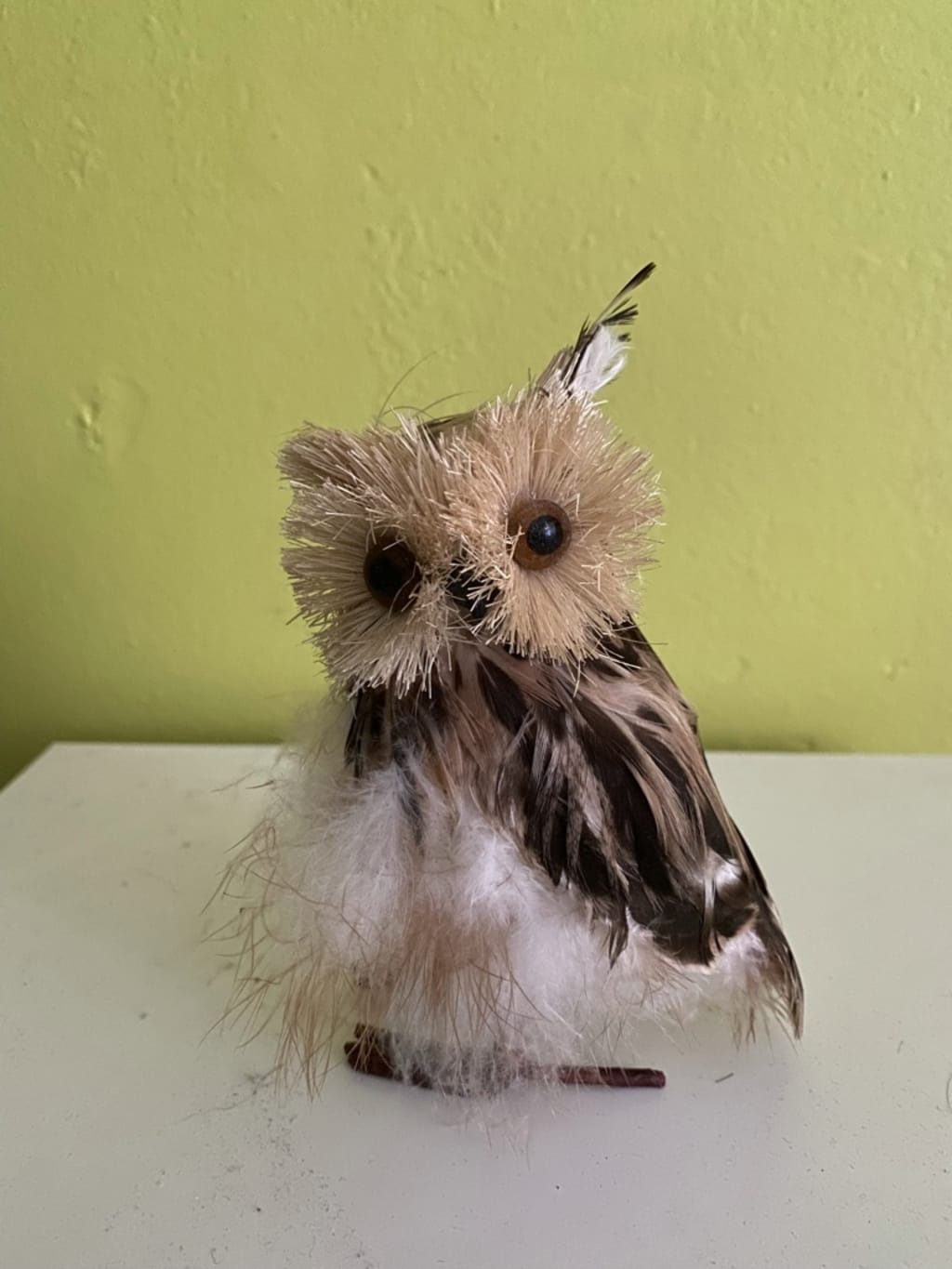
A wedding gift from Bud to Betty. Though upset, again, with my continued snooping, Mom let me keep the music box. I put it in my desk drawer with other cherished tchotchkes: a special card from my O-mama, treasures found on beach walks, a little figurine of a barn owl. The latter was a gift from my beloved second grade teacher, Miss Alexander. It was one of my favorite things.
I was seven years old, just starting second grade, when we moved from California to Hawaii. This was a big adjustment. Not only was I one of the few white kids - the Hawaiian word is haole (HOW-LEE) - but the social norms were completely baffling as well. Other kids didn't say hi. They raised their eyebrows imperceptibly or gave the barest upward tilt of their heads as they walked past. I didn't 'get' any of this.
At recess everyone ran out to play on the playground. I was left on the sidelines, hoping someone would come up and ask me to join in. One dejected day I was in the classroom while all the other kids were playing, and Miss Alexander - strict and a little scary, at first - asked what was wrong.
"No one wants to play with me," I cried.
Next day when I was out of the classroom using the bathroom, she let the class have it. That she'd done so was not lost on this little seven-year-old, because at recess that afternoon everyone wanted to play with me. After school that day, Miss Alexander gave me the little barn owl.
Many years went by. While my parents still resided in Hawaii, I was married with three children and living in the Midwest. One sad January day Mom called, saying she had bad news.
Her annual physical and chest x-ray revealed a lung tumor. Mom had smoked for about 40 years and although she'd quit 20 years ago, the damage had been done. The cancer was Stage 4, her doctor said, and gave her about a year to live.
I thought over this sobering news for a moment.
"Mom, when the time gets closer I'd like you to consider coming to Michigan and doing hospice at our home."
She, in turn, thought for a moment.
"Maybe I'll just come now."
I flew to Hawaii to help Mom get things in order for the move, and she arrived a couple months later. Mom surprised us both with her ability to adapt: to a Michigan winter, her cancer, making new friends, taking an interest in the world around her. I was between jobs when Mom arrived, allowing me ample time to help her adjust.
When my new job started two months later I had an idea.
"Let's start an interactive journal! I'll make an entry, you write a response - or you write something and I reply. What do you say?!"
Mom liked the idea. I kicked things off, she responded. Our back and forth continued for a couple of days, and then I wrote:
"For some reason, I woke up this morning thinking about Bud Denman, this music box (which I'd laid out next to the journal), and the baby you lost. When I've asked you about this in the past, you claim to remember hardly anything. Try to remember something...
How did you meet? What was your anniversary? Did you name the baby that died? Was there a funeral? Did your mother comfort you? Your sister? When did Bud Denman die?"
Mom answered all my questions - somewhat of a first.
They met at a party. Married on April 11. Bud died around the end of August. She didn't name the baby, a girl. No funeral. I'm sure my mother and sister comforted me.
The next day I wrote my response.
"I spent all of my three pregnancies mulling over names. I'm astonished that you wouldn't have named the baby. Even if you did not, officially, you must have had a name or names in mind. Try to recall, please: I can't say why, exactly, but it is very important to me.
Both Bud's suicide and the baby's stillbirth must have been devastating. Each of these individually is tragic; together, I can't even imagine... Can you talk about how you got through that time, how you felt, your own state of mind? Did you have friends there to help you?"
And then. Mom's response.
"In order to be done with the subject of Bud Denman I'll tell you something that absolutely no one knew but Mother and Peggy, not even Sally, who was my best friend for many years. I never told you because I was sure you would disapprove.
Anyway, the baby was not stillborn, I gave it away for adoption. After Bud committed suicide I didn't want to have a baby and be a single parent, and I thought about this very carefully. The doctor to whom I'd gone sent me to a doctor in Harlingen, many towns away. This doctor had arranged for adoptions before."
Decades after I began mining, I'd hit the motherlode.
I immediately embarked on a new quest of discovery. Mom was very upset about this, but I couldn't not try. Online research uncovered some useful information, and old newspaper articles revealed the doctor who undoubtedly arranged for the adoption, along with the hospital at which he practiced.
Finally, I reached out to the Texas Adoption Agency. I exchanged numerous emails with a very helpful woman there, forwarding her all the information I'd gathered.
I checked my email time and again. Nothing.
And then one day the response I'd been hoping for arrived, and with it - contact information.
My heart raced. I closed my eyes and took a deep breath.
And then I picked up the phone.
About the Creator
Nancy Peterson
Nancy is the author of "Dear Husband: Letters to an Addict" and "From the Alps to America: The Life Story of Patrick Alfred Muller." She is a lifelong journaler, poet and personal historian residing in northern Michigan.
Keep reading
More stories from writers in Fiction and other communities.
So You Decided To Become a Nurse Practitioner:
So you decided to become an "Advanced Practice" nurse. Congratulations!... is what I would say if this was a good idea. Grad school? In this economy? What were you thinking? Likely it was something along the lines of either 1) “I've seen these other chucklefucks do it— Why can't I?” or even 2) “I've got a nice career, I should shake it up. I miss feeling like I have no clue what I'm doing.”
By Sandor Szabo7 days ago in Fiction


Comments
There are no comments for this story
Be the first to respond and start the conversation.