
The couple in the photo held each other in eternal embrace, locked away safely from the harms and hardships of life.
The pinstriped man donned a wide smile; his thick, oily hair and chiselled features giving him the look of a 1950’s superman-by-the-seaside disguise.
The young woman’s head tilted on his shoulder with a casual familiarity, as though fate itself conspired for it to be resting there just for this moment; her make-up and Monroe-style blonde hair were immaculate. She was, to use the vernacular of her time, a blonde bombshell, who’s image would have been comfortable pouting luscious red lips on the side of a B-52.
Sarah stared at the photo, nervously rubbing a corner between her thumb and finger. Ever since her father passed away her mother, Catherine, insisted on carrying it everywhere in her handbag. Its worn edges spoke of a much-loved item.
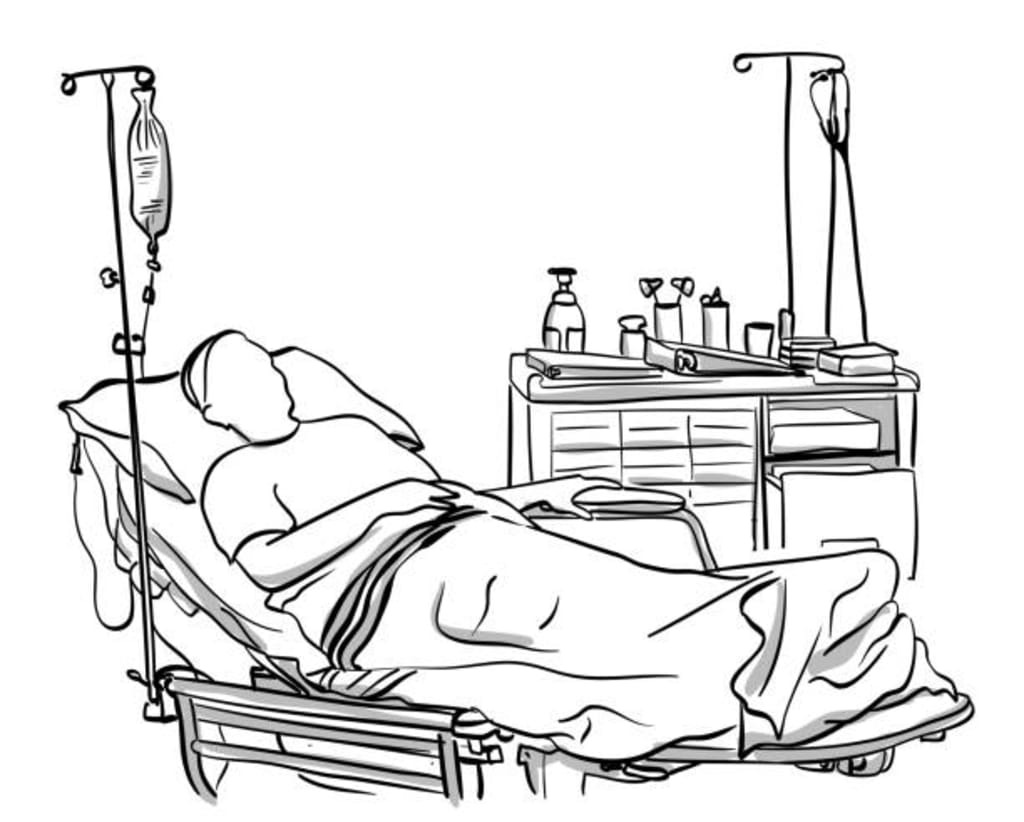
The curtained cubicle of the emergency ward was quiet, only disturbed by the soft beep of the monitor and the shallow breathing of an old woman half-raised on a hospital bed, her frail frame propped up by sterile-white pillows. She was far removed in both form and years from the young woman in the photo - porcelain features now gaunt and jaundiced-yellow; Hollywood blonde curls reduced to a bald head hidden by a floral headscarf. The oxygen mask over her mouth and nose seemed to be forcing more than assisting her breathing.
Catherine let out a shallow cough, and though she seemed incapable of showing any discomfort physically, her eyes exposed a more sinister truth – a deep, constant pain only held at bay with a cocktail of morphine, oxycodone, tramadol.
Another cough, this time followed by a muffled groan through the mask.
With the mechanical movement that only comes from more years of repetition than anyone deserves, Sarah was on her feet, setting the photo on the small drawer by the bed and consoling her mum; she gently stroked her head and spoke soothingly.
“It’s all right, Mum?” She said, softly. Even as she spoke, Sarah knew how ridiculous the statement was. It was anything but all right. But what could she say? Why are you putting us both through this. Why can’t you just let go? Instead, she asks, “Do you want some water?”
Her mum shook her head and tried to speak, but her lungs could not afford the expense of something so valuable as a deep breath; all she could expect for so arduous a task was shallow rasps. Again, Catherine tried, only softer now, and this time she managed to whisper something coherent.
Sarah leaned in close.
“W-why are you here?” Catherine asked in a struggled whisper.
“What do you mean,” Sarah said, sternly, in no mood for games. “You’ve got an infection, remember? We had to call an ambulance.”
“-Photo…read photo…” her mum said.
“It’s all right mum,” Sarah assured her. “I have the photo here. It’s safe.”
“No. Read…why…you here,” her mum tried again, weakly pushing Sarah’s hand away.
“Where else am I bloody well going to be, mum?” Sarah snapped, and it was hard to tell if it was anger in her voice, or fear, or bitterness, or sadness; or perhaps all of them at once. Then more gently she added, “Besides, someone has to keep your hands off these young doctors.”
Catherine let out a strained sound that might have been half-laugh, half-cough, and for a moment, Sarah caught a glimpse of the woman who would greet her after school when she was a young child. She wasn’t sure why, but this was a memory she returned to frequently when remembering her mum as a younger woman. She always remembered leaving the school and being met with a wave of parents all looking for their own children. Sarah’s nervous eyes would dart around searching for her mum and for an instant there was always that moment of ‘what if she’s not there?’ But she always was, the young woman from the photo, blonde curls and porcelain face and a smile as wide as her open arms; and her perfumed hug, that most subtle scent of spices and the faint promise of exotic places never travelled.
Dampening a facecloth in the small wash basin for her mum’s dry lips, Sarah caught a glimpse of herself in the mirror.
My God, you look old, she thought. Old and tired.
She inherited her mother’s blonde curls which, in Sarah’s case, were hidden; tied back military tight and streaked with premature grey.
Where did you go?
As though somehow sensitive to her daughter’s building self-resentment in the moment, Catherine tore Sarah away from the thoughts with a wheezing fit.
Before Sarah could react, a young nurse with a friendly face passed briskly through the blue curtain.
“You’re all right, Catherine,” said the nurse, with such matter-of-fact conviction that Sarah found it difficult to believe otherwise. “Now, let’s see if we can get you sitting up a bit more.” Then to Sarah she asked softly, “Did you want to help?”
The question was so gentle, and so unintrusive, the young nurse might just as easily have been offering a stick of gum easily refused without offence.
Standing on the opposite side of the bed, Sarah followed the nurse’s prompts, taking her mother under the arm and heaving her up until she was all but upright.
The nurse stayed and fussed around with blankets and the oxygen mask until Catherine’s wheezing had abated back to the same strained breath as before.
“The doctor will be in soon,” she said, gently stroking Sarah’s arm before leaving.
Human contact; an affectionate touch. How long it had been Sarah couldn’t remember.
Ever since her mum had been diagnosed, Sarah had discovered a newfound respect for nurses; they seemed blessed with the perfect balance between the connection of empathy and detachment of efficiency. Both were something Sarah had struggled coming to grips with, having gone through stages of being incapacitated from crying and exhaustive sleep in the first weeks, to slowly shutting her emotions down altogether until nothing could get in.
“Did you hear that, mum, the doctor will be here soon,” Sarah said. “If you’re lucky it’ll be that young one that reminds you of dad.”
Her mum managed a gasp meant as a laugh. “No one... like dad,” she whispered.
Sarah saw the sadness etched into her mum’s face. It had always been there since he passed, but on her good days Catherine had been able to mask it; now though, it was a constant in her eyes if you knew where to look, just behind the physical pain.
“Soon...see him soon,” Catherine whispered.
“Why?” Sarah asked, her tone scolding and her face turning stone-serious. “You’re not going anywhere, mum.”
Her mum’s breathing grew agitated at this.
“Let...me go.”
“No, mum,” Sarah said. “I told you you’re not going anywhere.”
The more Catherine tried to protest the less breath she seemed to have to speak. With the obstinance of her father, Sarah went on, this time unmistakable anger in her voice and tears straining to not come.
“Now, you listen to me, mum,” she began, tight-lipped. “The doctor will give you something for the infection and you will come home with me, all right?”
Catherine could only close her eyes and smile at her daughter’s stubbornness – mulish, is what she used to call Sarah when she was a child and refused to be told.
“As mulish... as your dad,” she whispered and let out a chuckle. “...only wish...had been quicker... for your sake.”
“Please mum, just stop,” Sarah said, gritting her teeth to hold back an oncoming sob. “You’ll come home with me and stay a long time yet, okay?”
“Read…photo,” Catherine whispered.
“I told you, mum,” Sarah said, reassuringly. “I have you photo here. Look.”
Sarah showed her the photo. But Catherine shook her head, irritably
“Read…” she tried more sternly.
But the moment was interrupted with the scratch of curtain rings dragging across a rail. Likewise, Sarah quickly dragged her own emotions into check, but physically, every ounce of her being seemed tensed, on the edge; she could feel the sinew of her muscles like loose thread, ready to unravel should someone tug at it in just the right place.
“Hello there,” said the doctor, completely ignoring the tears that managed to escape Sarah’s authority. He half-fumbled with a thick manila folder and Sarah caught a glance of her mum’s name on the front. “I’m Doctor Kali, and you must be Catherine.”
Sarah noted that, like the nurses, the doctor too made it feel like you were going through the most natural thing in the world. And the more Sarah pondered on it, which she was prone to doing too much of late, she supposed it was, given everyone would get to the same destination; really, it was just a question of how and when. In some way this brought its own comfort, and in that moment, she at least consoled herself with understanding the purpose of giving such a sense of normality.
“So, Catherine,” Doctor Kali went on, “got yourself a bit of a nuisance bacterial infection in the lung it would seem.
“J-just...wanted...see you, doctor,” Catherine strained to wink at the young doctor, but still there was the vague glimmer of her diamond smile.
Sarah rolled her eyes and for a fleeting instant allowed the same smile, glad to have back even the smallest measure of the woman she remembered.
The doctor laughed with a genuine humour and said, “Well, I’m here most Fridays, so next time just pop in to say hello. No need for nasty ailments, agreed?”
Catherine gave a pained cough and nodded weakly.
He set down the folder that contained so much bad news and picked up the chart at the end of the bed. Scanning its content, the doctor then looked at both patient and daughter; Sarah winced, feeling as though she were being measured up, assessed for something unwanted.
“Now then, Catherine,” the doctor said, casually hooking the chart back on the end of the bed. “We’re going to get you up to a ward so we can keep an eye on you and that infection.” Then to Sarah he added, “Under normal circumstances I wouldn’t be too concerned but given how advanced the cancer is...”
Sarah closed her eyes and nodded in acknowledgement. He didn’t have to finish. Over the past year of looking after her mum full time she had grown all too aware of the dangers of infections that would be no more than an inconvenience to an otherwise healthy person.
“You hear that, mum,” she said, leaning over and gently, lovingly, stroking her mother’s cheek. The doctor will get you all fixed up and you’ll be home in no time at all.”
Catherine smiled as Sarah leaned in and kissed her forehead.
Doctor Kali allowed the moment between the two before speaking again. “Could we speak privately?”
And that was it. Four words was all it took for Sarah to lose control of the entire situation, Sarah allowed herself to be led to a small room and suddenly she was a troubled twelve year old girl once more, being led to the principal's office. But this time her mother would not be swooping in to save her.
“Now then,” he said at last, “I see here you saw Doctor Patel last week and he updated you on your mother’s condition?”
“Yes, he did,” Sarah said, reluctantly.
“Well then,” Doctor Kali said, and there was a barely noticeable pause, but Sarah, the shreds of her nerves honed, picked up on it; she steeled herself, knowing what was coming, while her mind ran in a thousand directions to avoid it. “I think we need to ask a difficult question.”
A silence fell on the room that made the world beyond seem deafening.
“I’ve already said, she’s not going anywhere,” Sarah snapped, as though her words willed what would be; but the stony-faced carer was beginning to crack into the helpless daughter succumbing to the inevitable.
The doctor looked on with a passiveness of his own repetitions. Clearly, this wasn’t the first time he’d had this conversation. Sarah wondered just how many times this relatively young man was forced to give such a terrible option to families.
Passing back through A&E, the doctor led a now broken Sarah back to the cubicle; back to the only world she’d know for the last three years; back to her mum.
“I’ll give you some time and advise the nurses to prepare to move your mother,” he said, before returning to the nurses’ bay.
The doctor filled some notes in on the folder and dropped it into the Patient In-Tray; he let a nurse know Catherine was to be admitted to a ward before getting himself some water, and chatted with a colleague about the football at the weekend. Then, when he felt enough time had passed, he made his way back to Catherine’s cubical.
Pulling the curtain aside he could feel the shift of uneasiness. Sarah stood, holding her mum’s hand, visibly aged a decade and somewhat distant; Catherine, though still wheezing heavily, had a look of relief about her.
“So, how did we go?” he asked, non-intrusively, though he already knew the question had been answered.
The world froze, as though waiting on Sarah’s answer. After a few moments, she reluctantly gave a life-shattering nod which set everything in motion. The doctor made a note on the chart by the end of the bed; two nurses pulled the curtain aside and set about organising Catherine for the move up to a ward.
Helpless, Sarah resigned herself to not being needed in the moment; she sank onto a hard plastic chair in the corner, unable to take her eyes from the patient chart hanging from the end of the bed. Since her mum was first diagnosed, all through the chemo, the recovery, and the aggressive relapse, Sarah had slowly turned to stone; unbreakable, immoveable, impenetrable. And yet, for all that, here she now sat, crushed and defeated by three simple letters.
As the porter began to move the bed out of view the letters remained, burned into her mind for all time; so much so that even the welling tears could not vanquish the ominous certainty that was DNR.
Her hands shaking, Sarah whispered defiantly, “You’re coming home with me.”
In that moment of spiralling despair, out of the darkness, Sarah heard her mother’s frail voice, once more – “Read…photo.”
It was only then Sarah realised she was clutching the faded and worn photo of her parents. From memory, she had never looked at the back. With curiosity, Sarah slowly twisted the photo over and there, in defiant blue ink, were three simple statements in her mum’s handwriting:
Live.
Love.
Let go.
The words latched onto her like a miracle cure. It would take time, and there would be a lot of sorrow between now and then, but these would become the foundation of a healing process, of making a life for herself beyond this cubicle and everything it represents.
She turned back to the photo.
It was of a man and woman locked in an eternal embrace, safe from the harms and hardships of life, and suddenly, Sarah felt younger, stronger, and full of hope.
About the Creator
Keep reading
More stories from S E McCarthy and writers in Fiction and other communities.
Toy Soldiers
Toy soldiers. Don’t you just love them. When I was eight, I inherited an army. It was from our neighbour, Mrs Henson. She had been doing a clean out of her son Matthew’s room; he’d ran off to play soldier of sorts himself, and at only eighteen ended up paying the ultimate price; not so much as a ribbon or draped flag to show for it.
By S E McCarthy4 years ago in Fiction


Comments
There are no comments for this story
Be the first to respond and start the conversation.