
A Cup of Tea and Goodbye
Contemporary / Emotional Drama

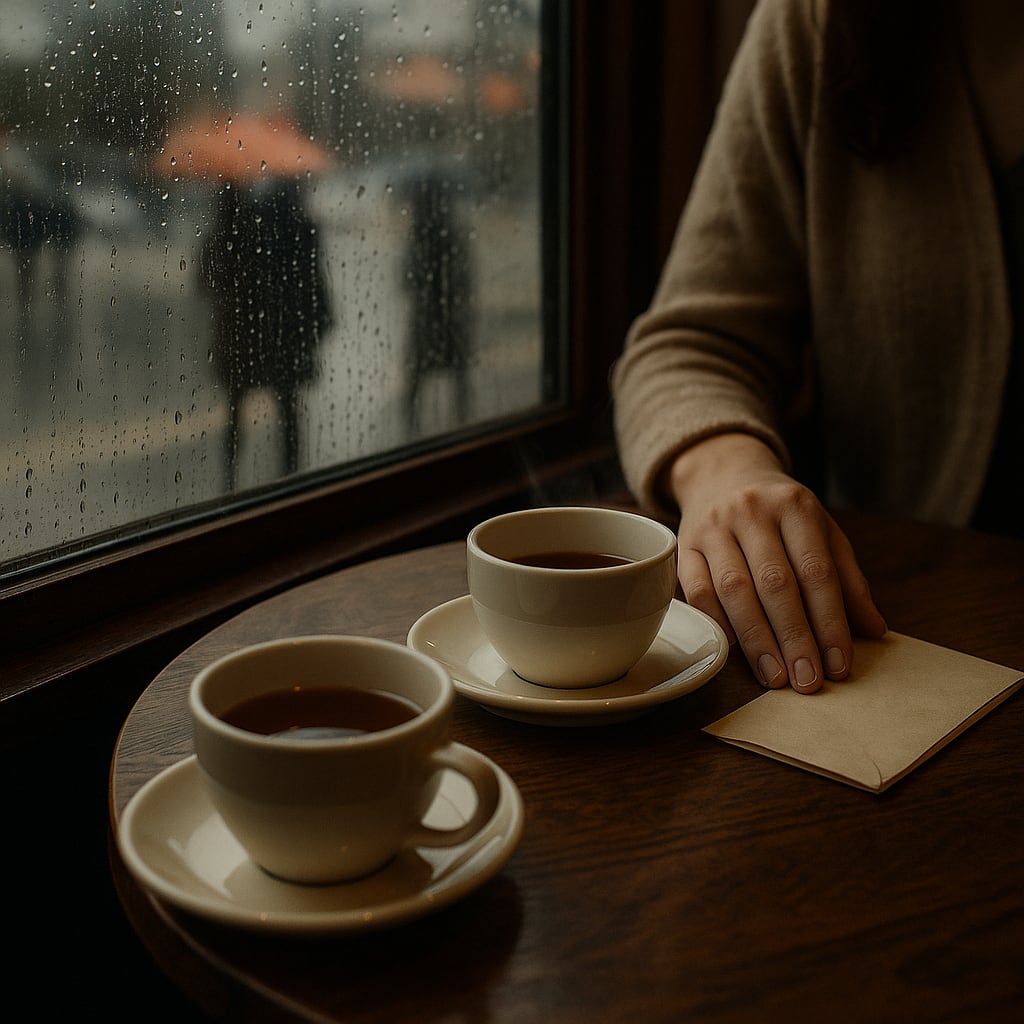
Every Sunday at exactly 4:00 p.m., the little bronze bell above the café door rang the same soft, hollow chime. It was never too loud, never rushed. Just enough to announce a presence — like a whisper in a quiet room. The staff had come to expect it, the way one expects the sunset or the smell of chai in the rain.
And with it, came Nida.
She entered with a calm elegance that seemed untouched by time. A soft beige shawl always draped across her shoulders, her long hair tied into a simple knot at her nape. She walked with grace, not to impress, but as if each step had purpose. She never looked around. She didn’t need to. Her table — second from the left, beside the window — waited for her like an old friend.
There, she would place her leather handbag on the seat beside her, unwrap her scarf, and give a polite nod to Imran, the waiter, who brought her order before she asked: two cups of chai.
One for her.
And one for someone who never arrived.
No one questioned her anymore. The first few weeks after she started coming, the staff had whispered theories: Was she meeting someone? Was it a breakup ritual? A lost lover? But the months turned to years, and her ritual remained unbroken. Two cups. Quiet sipping. A long pause. Then she would pay, leave a generous tip, and disappear into the dusky Karachi streets with the same silence she came in with.
But today felt... different.
The rain outside was heavier, more deliberate. The air inside the café was dense with the smell of cinnamon and wet earth. And Nida, though composed as ever, looked… expectant. As if the world was holding its breath.
The cups arrived, steam swirling gently from their rims.
She reached for hers with a slight tremor in her fingers — unusual. The other cup sat untouched, as always, its warmth fading slowly like a memory.
She stared out the window. Raindrops chased one another down the glass, blurring the world outside into watercolor shadows. Pedestrians scurried beneath umbrellas. A child splashed in a puddle. Life moved on, unaware of the quiet drama unfolding by the second table from the left.
Then the bell rang again.
She didn’t look up. Not right away.
But the footsteps were not familiar. They were heavier, older. A presence that didn’t match the regulars. When he stopped at her table, she slowly turned her gaze upward.
He was in his sixties, maybe older, with salt-gray hair and a trimmed beard. His coat was damp, his shoes worn from travel. But his eyes — soft, brown, and exhausted — carried a strange sorrow. He held a small envelope in his hand.
“Are you… Nida?” he asked gently.
Her lips parted slightly, but no sound came.
“I’m sorry to interrupt. My name is Azfar. I knew... Sami.”
The name crashed through her like a wave she had braced for but still wasn’t ready to face.
She stared at him. Blinked.
Azfar held the envelope out. “He asked me to give you this.”
She didn’t move at first. The world had tilted. The background noise of rain, of spoons against ceramic, of low conversation — it all blurred into nothing. Slowly, she reached out and took the letter, her fingers brushing the damp paper.
Azfar took the seat across from her — the chair that had remained sacred, untouched for years.
“Sami passed away three months ago,” he said, his voice calm, not cruel. “In Istanbul. He had been ill for a long time.”
Nida’s lips trembled, but she kept them sealed. Her hands clutched the envelope as if it might vanish.
“He spoke of you often,” Azfar continued. “Regretted not coming back. But he… he thought he would bring you more pain than peace.”
She stared at the second cup. Still warm. Untouched.
Her fingers slowly opened the envelope. Inside was a single sheet, folded with care. She unfolded it, her breath shaky, and began to read.
“My Nida,
You always had a way of making silence feel like music. I hear that music now, even in my final days.
I ran. Not because I stopped loving you — but because I feared you’d see me falling apart. I wanted to protect you from my ruin, not realizing that disappearing would leave a deeper scar.
I watched from afar. I saw the photos. You, at the café window. Every Sunday. Still waiting. Still hoping. Forgive me for not having the courage to sit across from you.
But if this letter has found you, I am no longer in this world. And I pray that it brings you peace, even if it arrives far too late.
You were my home in a world that kept shifting. I never stopped loving you. Never will.
Drink your chai, my sunshine. Let me go.
I will always be one cup away.
— Sami”
By the time she finished reading, the ink had begun to smudge — not from the rain, but from tears she hadn’t realized had fallen.
Azfar said nothing. He let the silence settle, respectful, like a mourner in a sacred place.
“I never stopped waiting,” she whispered. “Every Sunday.”
“I know,” he replied.
She looked at the chair Sami had left behind — always empty, always ready.
Then, for the first time in years, Nida reached for the second cup. Her hands no longer shook. She lifted it slowly and brought it to her lips. The chai was still warm — sweet, spiced, and filled with quiet ache.
She closed her eyes.
Outside, the rain softened. Light pushed gently through the clouds, casting a golden hue across the wet street.
She folded the letter, placed it back in the envelope, and tucked it into her bag.
Then she stood up. No words. No goodbyes.
Just grace.
As she stepped out of the café, the bell chimed one last time — not with sadness, but with release.
About the Creator
Keep reading
More stories from Sana Ullah and writers in Fiction and other communities.
Beneath the Dust of Time
Dust. That’s what Eleanor saw first when she entered the old manor house—thick layers clinging to the furniture like time itself had fallen asleep here and never bothered to wake up. The scent of forgotten wood, faded roses, and something older—like parchment or secrets—filled the air.
By Sana Ullah7 months ago in Fiction
A Knight of the Seven Kingdoms: The Untold Story Before Game of Thrones
A Knight of the Seven Kingdoms: A Simpler, Deeper Story from the World of Westeros When people think of epic fantasy television, the first name that comes to mind is Game of Thrones—a brutal world of power, betrayal, dragons, and blood-soaked politics. Later, House of the Dragon expanded that universe with even more fire and royal conflict.
By Junaid Shahid 2 days ago in Fiction
Ludacris and Nelly draw backlash over bookings at MAGA-coded music festival
Ludacris and Nelly headlining a mostly right-wing event is good for them. It’s also great for the genre of hip hop. The two rap veterans have showcased their talents on other stages. Why can’t they perform for mostly MAGA folks and grab that bag?
By Skyler Saunders6 days ago in Beat




Comments
There are no comments for this story
Be the first to respond and start the conversation.