
“180 Rupees That Killed a Man”
He taught children, lived in silence, and died because nobody helped in time.

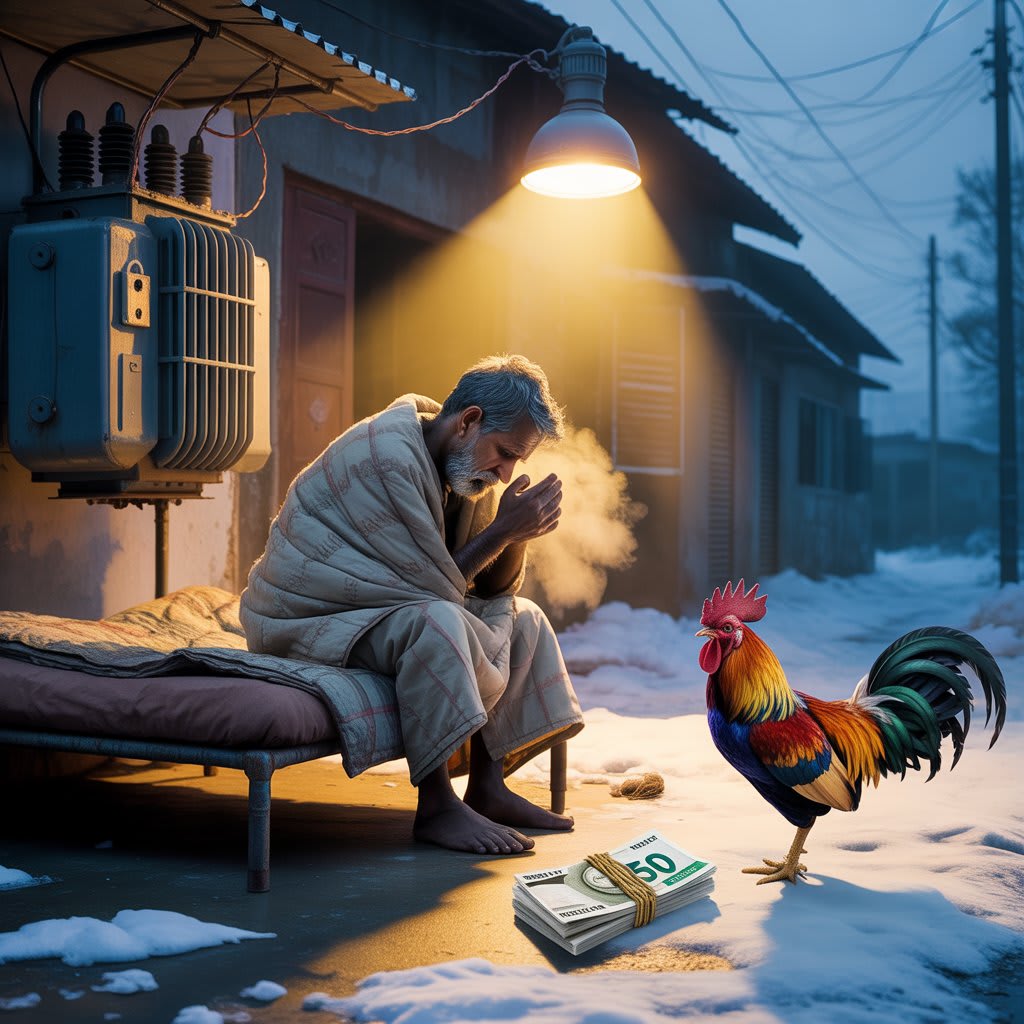
Nobody knew exactly when Master Ilyas came to this neighborhood and when he rented this room, but everyone knew that Master Ilyas was a migrant and belonged to an area in Ambala because he spoke the dialect that is spoken in Ambala. Master Ilyas lived in a rented room and the neighborhood boys would come to him to learn counting, recite multiplication tables, and write on slates. He had a pair of partridges and a purebred rooster. The partridges remained in cages, but the purebred rooster would stand a little distance from the door of his room. Master Ilyas had put a brass anklet on one leg of the rooster and tied a strong string to it, and tied the other end of the string to a nail hammered into the threshold of his room. All the people of the neighborhood respected Master Ilyas and would pass by his door saying 'Assalam-o-Alaikum'. Master Ji also did some other work, but nobody knew what it was. Perhaps he worked as a clerk in the vegetable market, or set up a stall in a distant neighborhood, or worked as a daily wage laborer painting and varnishing in a factory. Nobody knew about him very well, but everyone knew that Master Ilyas's livelihood was just barely sufficient. Actually, Master Sahib was a simple man and did not know how to keep up with the times. For some reason, his face was such that seeing it did not generate a feeling of love or sympathy in people's hearts, and for some reason, his conversation style was such that nobody would believe him. He did not lie. He did not cheat. He did not exaggerate. He did not boast. He did not scare anyone. Because of this People did not believe him. His conversation contained many grammatical and rhetorical errors, and the listener would get frustrated and leave his company. He was so simple and innocent that he didn't seem human. He seemed like a burden on the whole neighborhood and society, and since no one liked to associate with such people, he had no friends. That is why the neighbors respected him and would say "peace be upon you" as they passed his door. One winter evening, the landlord scolded Master Ilyas in harsh words and threatened that if he did not pay the past six months' rent of 180 rupees within three days, he would throw his belongings out. Master Ji was struck dumb with fear because he did not have one hundred and eighty rupees in a lump sum. He only had forty rupees, which he had made fifty by stringing a ten-rupee note with them. Earlier, the landlord used to take forty or fifty rupees and give a future date, but this time he became stubborn and threw the fifty rupees strung on a thread in front of the purebred rooster and said, "Go away! I will not take it. Give me the full one hundred and eighty." When he said this and left, Master Ilyas picked up the fifty rupees from the floor and put them in his waistcoat pocket. Then he went into his room, sat sadly on the cot, and due to severe grief, his voice was choked, and this was the first time someone's voice was choked without crying! Ghagha (choked voice) also means loss of voice in the throat. As promised, the landlord threw his belongings out. He placed Master Sahib's cot behind the two transformer poles and arranged the rest of his belongings around it. He put a new Chinese padlock on the room and rode his scooter home. His house was quite far from this neighborhood, and he used to come monthly to collect the rent for his rooms.
Master Saheb spent a night somehow under the transformer and the next day went to Sheikh Karim Nawaz's house and asked for two hundred rupees as a loan. Sheikh Saheb politely refused, considering him a simple and naive person. Because it is not good to give more money to such foolish people. Then he went to the shop outside the neighborhood and reduced the amount, asking for one hundred and fifty. He also refused. He also refused. There was no barber, confectioner, butcher, doctor, physician, or lawyer in the neighborhood that Master Saheb didn't approach, but he faced disappointment from everywhere because severe inflation had gripped these people and they had nothing left to lend. The day Master Ilyas showed his pulse to the homeopathic doctor was the eighth day he had been sleeping near the transformer. The doctor checked him with a stethoscope and said, "Master Saheb, you have pneumonia. I can give you medicine, but you should also show someone else." Master Saheb said, "Very well," and went to the confectioner Jabbar's shop to drink hot milk. After drinking the milk, he showed his pulse to Jabbar and then earnestly requested a loan of two hundred rupees from him. Jabbar laughed. He knew that no one would lend even one rupee to such a simpleton. He was asking for a full two hundred. When such an unusual thing happens, everyone laughs, and that's why Jabbar laughed; otherwise, in general life, he rarely laughed. For three consecutive days, Master Ilyas sat on his cot, wrapped in his quilt like an owl. Anyone who passed by would say "Assalam-o-Alaikum" and definitely ask, "Why, Master Ji, are you sunbathing?" And Master Ji would reply in a muffled voice from inside, "Yes, I feel a little cold. I'm sitting in the sun." On the fourth day, at the time of the Fajr prayer call, when Master Saheb passed away, every single person in the neighborhood felt great sorrow at his death. By the time breakfast was over, everyone stood in the sun, wrapped in silence and grief. A bowl full of millet was put for Master Ji's quails and a bowl full of flour pellets was put for his hens. Sheikh Karim Nawaz came out of his mansion and sat under the transformer. Here, people , A mat was spread out and two or three fresh newspapers were placed. People started gathering. Sheikh Karim Nawaz took out two hundred rupees and sent Saeed and Bilal on a scooter to arrange for the grave. Three hundred rupees were given to Babu Jalal to take Rehmat along and arrange for the cloth, camphor, rose water, and flowers. Jabbar the confectioner prepared a pot of milk tea and delivered it to the mat. People started collecting money for Master Sahib's "rasm-e-qul" ceremony, and soon the residents of the neighborhood had collected eight hundred and eleven rupees and safely stored them with Sheikh Karim Nawaz Sahib.
About the Creator
Muhammad Haris khan
Why its so hard to write about myself?
simply My Name is Haris Khan I am studing Master in creative writer, Having 4 years of experience in writing about a wide range of things, fiction,non-fiction and specially about the psychy of humans
Keep reading
More stories from Muhammad Haris khan and writers in Fiction and other communities.
Manzoor: The Boy Who Healed Hearts.
When he was admitted to the hospital, his condition was very bad. On the first night he was kept only on oxygen. The nurse who was on duty thought that this new patient would die before morning. His pulse rate was uncertain. His body was soaked in sweat. Sometimes he lay on one side and sometimes on the other. When the restlessness increased, he would sit up and start taking long breaths. His color was yellow like a lump of turmeric. His eyes were sunken inward. The bridge of his nose was cold like a piece of ice. There was trembling over his whole body.
By Muhammad Haris khan a day ago in Fiction
The Devil's Triangle
The sails ruffled in the breeze as we cruised along. The Sea Breeze was a mid-size catamaran that sailed out of Royal Naval Dockyard in Bermuda. We had booked this trip weeks in advance and were now looking at our Captain, Spike and two boat hands. Paddy and Wilson seemed like nice guys, joking around with the passengers and telling us some stories about Bermuda that only locals would know. Their island accents sounded almost British but they were pleasant to listen to.
By Barbara Gode Wilesabout 5 hours ago in Fiction



Comments (3)
that's amazing
I really love it, you are doing really great , keep going
your article on fiction is a masterclass in storytelling - your thoughts are insightful and your narrative is engaging, making for a truly captivating read. keep it up ,