
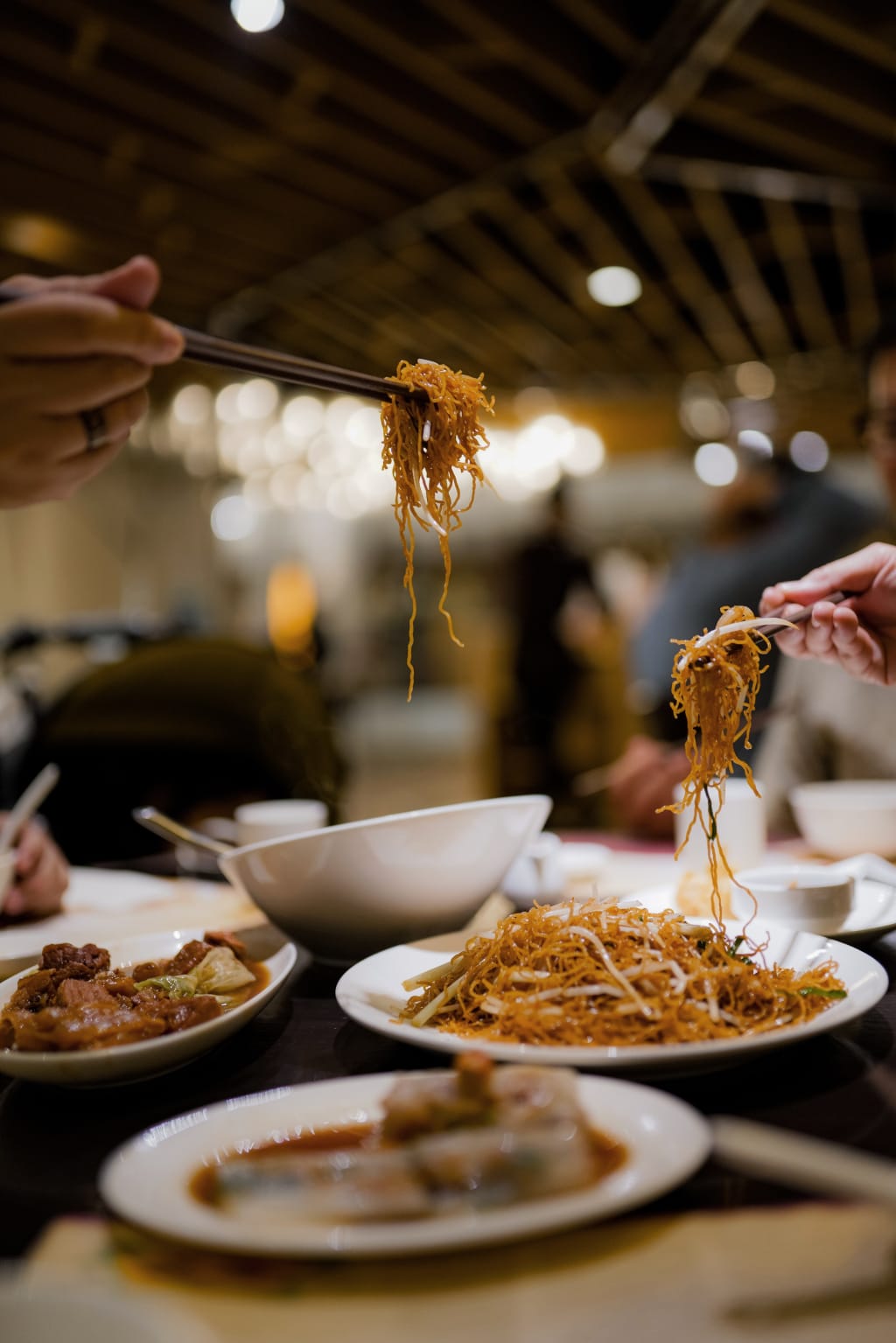
What is the biggest difference between a Chinese restaurant and a Western restaurant?
Probably the service. Many people would think that the service level of any Western restaurant is much higher than that of any restaurant on the street. At least their waiters do not lift the cloth at the corner of the table to wipe off the oil stains on their hands after serving the food. Some say it's the environment, too. Although the number of elegantly decorated Chinese restaurants is increasing, but on average, or Western restaurants are better. Eat Western food place furnishings again, in the end the light is dark enough, a black cover three ugly, under the dim candelabra not only the opposite will be beautiful a few points, even the corner of the peeling wallpaper or peeling paint is also hidden without trace. Which is like a traditional restaurant, a bright room, all the unsightly things have nothing to hide.
But in my opinion, the biggest difference between Chinese and Western restaurants is the menu served by the waiter. When most Western restaurants today are practicing food selection "minimalism", the menu is only a thin sheet of paper, while Chinese restaurants still adhere to a "book" menu of the original.
By "minimalism", I mean the belief that a kitchen should not be too distracted by spending too much money to buy too many spare ingredients and too much work to prepare different cooking procedures, but should instead focus on getting the best goods and getting the best dishes. Less choice is not a problem, what matters is that a dish must be a masterpiece. Therefore, in addition to a few traditional restaurants such as Jimmy's Kitchen and Amigo, most of the new Western restaurants are strictly controlled in terms of the variety of food offered, and even the top restaurants in five-star hotels are no exception to this path. It is the popularity of this "minimalism" that has led to the trend of private dining in recent years; guests are simply not allowed to order food, and the kitchen is in charge of everything.
Compared to the elite policy of Western-style restaurants, most Chinese restaurants are still striving to be all-inclusive. Especially in recent years, a group of the South from the Mainland to Hong Kong, whether it is Shanghai cuisine, Hangzhou cuisine or Sichuan cuisine, the menu is so thick that almost people can not lift one hand, after opening is dazzling. Than many western restaurants in the first plate but seven or eight kinds, these Chinese restaurant cold dishes can take up several pages of snacks.
In this way, it seems that Chinese restaurants are lagging behind the situation, and we have found a new evidence that Chinese is not as good as the West. But as long as you try the real level of the restaurant, you will find that the number of dishes on the surface is actually no more than a few variations of the basic elements, and the changes are not too bad. For example, a Shanghai restaurant just the first plate of smoked fish there are three different fish, smoked in the same way, the result is surprisingly also okay.
Recently, I read "All Things" by the famous Chinese art historian Riedel Hau of the University of Heidelberg, Germany, which has such a small paragraph about the characteristics of Chinese cuisine: "Some people who frequent Chinese restaurants may be surprised: how there are more than a hundred kinds of dishes listed on the menu, and usually within a few minutes after you order the finished product can be presented on the table. The secret lies in the fact that many menus have standard pairings; stir-fried pork with mushrooms and bamboo shoots, stir-fried pork with mushrooms and bean sprouts, stir-fried diced chicken with mushrooms and bamboo shoots, stir-fried diced chicken with mushrooms and bean sprouts, stir-fried chicken with mushrooms and bamboo shoots, so on and so forth." In other words, Chinese food is a bit like the tea restaurant in "McMug", where breakfast, lunch, fast food and tea are actually regular meals.
What Redhou illustrates with this small example is a big point: Chinese culture is one of the most "industrialized" cultures, and all the variations are no more than a combination of a few basic elements. The seemingly complicated Chinese characters can all be reduced to a few strokes in the "Cangjie" input method; the meandering patterns on bronzes are no more than a patchwork of a few basic elements. But such a simple element can give birth to everything in the world, and creative chefs can create differences in a fine and subtle way; just like the terracotta warriors and horses, although thousands of them are all the same size, but only when you look closer do you realize that the expression of each terracotta warrior is different.
About the Creator
Keep reading
More stories from Moxadple ggg and writers in Feast and other communities.
The mattress
My name is Li Ming, I am a reporter, last month received a mysterious hotel interview assignment. This also starts six months ago. There is a Ruchun Inn in Qiqihar, Heilongjiang Province, where travelers who come to stay here have been missing one after another. The number of missing people has reached 3, but the police could not find any clues, so these cases were shelved. As a result, the business of Ruchun Inn was slow and almost closed down.
By Moxadple ggg3 years ago in Fiction
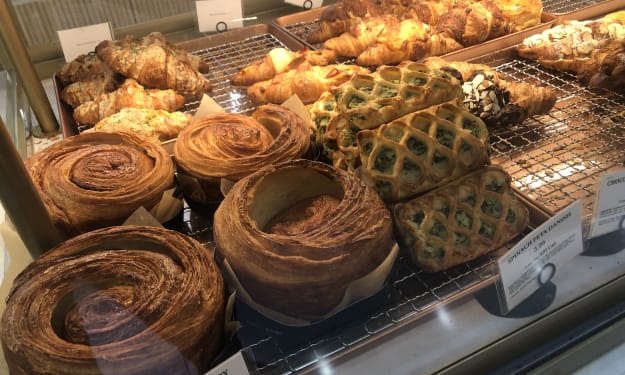
My Tous les Jours Trip
As someone who lives in a rural area, I don't get the chance to visit fancy restaurants or bakeries that often. So, when a friend told me about a French-Asian bakery that's less than an hour away, I knew I had to check it out and grab some pictures for social media. Tous les Jours ended up providing an immersive experience that went above and beyond my expectations--although I did leave with a few reservations.
By Kaitlin Shanks22 days ago in Feast


Comments
There are no comments for this story
Be the first to respond and start the conversation.