
Study: Mealworm Pizza “Not as Terrible as Consumers Thought”
A recent study reveals that worm larvae pizza is not quite as awful as you’d expect — and that’s a big deal


A recent study on insect protein examined how consumers react to pizza topped with mealworms. Yes — this is real. The study title sums it up pretty well: Newbie consumers try pizzas in which bacon is replaced by Tenebrio molitor L. larvae: Not as healthy as expected and not as terrible as they thought.
The study, from the Federal University of Paraiba in Brazil and University of Extremadura in Spain, looked at consumers expectations and reactions to pizza topped with mealworms, both fully intact and minced, compared to bacon pizza as a control.
The findings are amusing, but also important for the acceptance of insect protein as a potential human food source, which could help in the fight against climate change and in the fight against poverty and food insecurity.
Consumer Preferences
The main purpose of the study was to examine consumer preferences with regard to mealworm pizza compared to bacon pizza. Consumers’ emotional reactions to both pizzas were recorded based on pre-tasting expectations, and on post-tasting reactions.
Not surprisingly, prior to tasting, the bacon-topped pizza received higher scores than the mealworm pizza for sensory quality and willingness to purchase. However, after tasting the pizzas, consumer attitudes towards the insect-based protein improved, while the attitudes towards the bacon pizza stayed the same. Compared to their initial reactions, consumers associated the insect-based pizza with fewer negative emotions after tasting.
The researchers suggest that focusing on the positive emotions associated with edible insects, such as adventurousness, could be the right marketing strategy to overcome consumer hesitancy.
Nutritional Implications
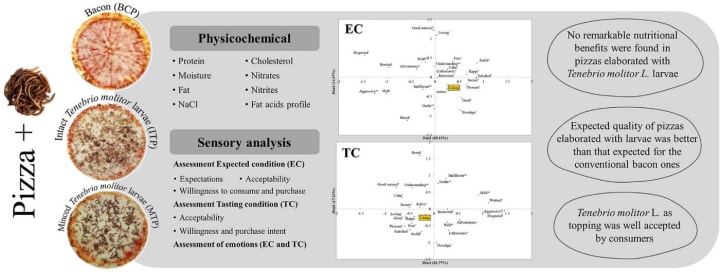
Bad news though if you were looking to this particular insect-based pizza as a healthier alternative to bacon-topped pizza. The study also examined the nutritional profile of the two toppings. They concluded that the mealworm pizza fared no better than bacon pizza in nutritional value, at least at the macronutrient level.
A chart showing nutritional facts and sensory reactions to mealworm-topped pizzas.
Nutritional value and consumer expectations of mealworm pizza. Image from source study published on Science Direct.
Based on this nutritional analysis, the authors conclude that presenting this mealworm protein as a more “nutritious” or “healthy” alternative to traditional meat sources may be unjustified. Note that this finding refers specifically to the mealworm pizza studied in this research, not to insect based protein in general.
Interestingly, even without being told that the mealworm pizzas were a more nutritious alternative to bacon, the consumers in the study did have an initial expectation that the mealworm pizzas would be healthier.
The Future of Food?
In spite of the amusing headline and minor ick-factor, the research is studying an interesting and important question: how can insect-based foods be made more attractive to consumers? It’s an important question because insect-based protein has several advantages over traditional meat sources.
Most notably, insect-based foods could be an important tool in the fight against climate change. Insect-based protein a far more sustainable alternative to traditional meat production. Per pound of edible protein, the production of traditional meat products (beef, pork, chicken) releases far more greenhouse gas emissions and requires far more land than the production of insect-based protein.
Additionally, insect-based proteins can be cheaper, easier to farm, and more nutrient dense compared to other meat sources, and so may be useful in the fight against poverty and food insecurity.
But in order to start getting these benefits from insect-based proteins, there are several hurdles to clear: consumer attitudes and in some cases legal restrictions hinder the adoption of insects as a food source. The current research is part of an effort to understand consumer expectations and reactions to insect-based proteins, and attempts to analyze which marketing angles would be most effective.
Would You Eat Insect Pizza?
I, for one, would be more than willing to try mealworm pizza, especially now with the expectation that it can be made to taste like bacon. Like the consumers in this study, I would probably opt for the crushed mealworms rather than the whole insects.
What about you — would you be willing to eat mealworm pizza if it tasted like bacon and was better for the environment? Tell me how you’d feel about it in the comments below!
About the Creator
Jonathan
Jonathan enjoys writing personal stories on his computer and never ever ever sharing them with anybody until years later he realizes that, hey, you know what, maybe there's no harm in letting people read this, I might even enjoy it.
Australia Fish and Seafood Market 2026: Sustainable Consumption, Aquaculture Growth & Premium Seafood Demand
Australia Fish and Seafood Market Australia’s fish and seafood market is expanding steadily as consumers increasingly prioritize high-quality protein sources and sustainable food options. Fish and seafood products—including salmon, tuna, shrimp, shellfish and other marine species—play a vital role in the Australian diet due to their nutritional value and culinary versatility. Growing awareness of seafood’s health benefits, particularly its omega-3 fatty acids, vitamins and minerals, is driving consumption across households, restaurants and foodservice channels.
By Amyra Singha day ago in Feast


Comments
There are no comments for this story
Be the first to respond and start the conversation.